Your tyres have an expiry date, and it is not written as one
Rubber does not politely wait for you to wear it out. It ages on the car, in the boot and on the shop shelf, whether the wheels ever turn.
A tyre is a chemical structure, not a lump of solid rubber. The compound that gives it grip depends on oils, waxes and antioxidants that slowly migrate out of the material and are attacked from outside by ultraviolet light, heat and the ozone in ordinary air. As they go, the rubber hardens, its bite in the wet and in the cold falls away, and fine cracks open at the base of the grooves and across the sidewall. None of that registers on a tread depth gauge. A tyre can carry 6 mm of tread, look immaculate on the wheel, pass a roadworthiness inspection without a word of comment, and still put your car several lengths further down a wet roundabout than a new one would. The information that catches this is not in the service book or the owner's manual. It is moulded into the sidewall a metre from where you park, in a code almost no driver has ever been shown how to read.
Where the date hides, and how to read it
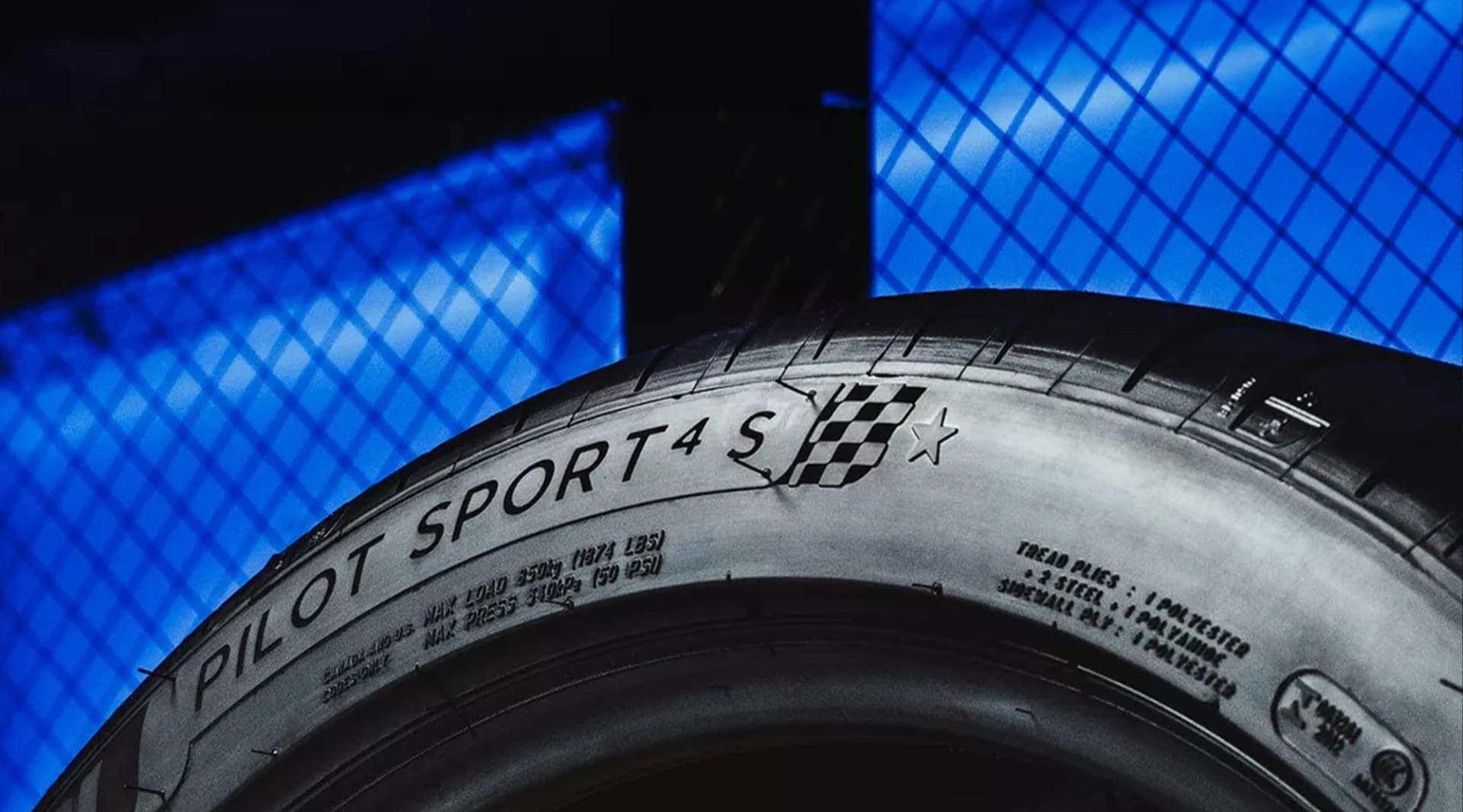
Look on the sidewall for the letters DOT followed by a run of characters. Ignore all of it except the last four digits. The first two are the week of the year, the second two are the year. So 3223 means the tyre was built in week 32 of 2023, roughly the first week of August. A code ending in only three digits was made before 2000 and belongs in a recycling skip rather than on a moving car. One quirk catches people out: the manufacturer is only obliged to mould the full code including the date on one side of the tyre, so if you crouch down and find a DOT code that stops after a few characters, walk round to the other sidewall, or shine a torch at the inner face of the fitted wheel. Do all four when you take delivery of a used car, and do the spare while you are down there. Finding four different dates is completely normal. Finding one tyre three or four years older than the rest is not unusual either, and it tells you something about how the previous owner ran the car.
The point where age beats tread
No European country retires a passenger car tyre purely on its birthday, so there is no legal deadline to work to. What there is instead is a remarkably consistent recommendation from tyre manufacturers and from the big motoring clubs: start inspecting closely once a tyre passes five years from its date of manufacture, and treat ten years as a ceiling you do not cross, whatever the tread looks like. The tyres most likely to trip over that line are the ones on cars that barely move. The weekend car. The second car covering 3,000 km a year. The caravan or trailer that spends eleven months of the year standing on a driveway. And above all the full-size spare under the boot floor, which on a great many cars is still the original tyre the vehicle left the factory wearing, quietly turning fifteen while everything above it has been replaced twice. Standing still is the worst thing a tyre can do. Flexing under load helps draw the protective waxes to the surface where they do their job, so a tyre parked in the sun for years ages faster than one that is used.
The tread figure that is legal, and the one that is safe
Across the EU the legal minimum is 1.6 mm, measured across the central three quarters of the tread and right around the circumference. The wear indicators built into the main grooves, small raised bars usually marked TWI on the shoulder, sit at exactly that height, so when the tread has worn flush with them the tyre is finished as a legal matter. But 1.6 mm is the point at which a tyre becomes illegal, not the point at which it becomes poor. Wet braking distances and resistance to aquaplaning fall away sharply below roughly 3 mm, because there is simply no longer enough groove volume to push water out of the contact patch at speed. Set your own replacement point at 3 mm for summer tyres and 4 mm for winter ones, and note that several countries write that higher winter figure into law rather than leaving it to your judgement, Austria among them. If your car is due its periodic roadworthiness inspection, tyres are one of the most common reasons for a fail, and it is almost always the inner shoulder that is worn out of sight.
What the rest of the numbers are telling you
Take a common size, 205/55 R16 91V. The 205 is the section width in millimetres. The 55 is the sidewall height as a percentage of that width, so a lower number means a shorter, stiffer sidewall. The R means radial construction and the 16 is the wheel diameter in inches. Then come the two markings that get quietly downgraded to save money. The 91 is the load index, a coded maximum weight the tyre may carry, in this case 615 kg each. The V is the speed symbol: T is 190 km/h, H is 210, V is 240, W is 270 and Y is 300. Your car carries a plate, usually in the driver's door shut or inside the fuel flap, listing the approved sizes with their minimum load and speed ratings. Going below them is an insurance and homologation problem as much as a safety one, and a lower load index on a heavy estate or a battery-laden EV is a genuine structural risk rather than a technicality. If you see XL or Reinforced on the sidewall, the tyre is built to carry more, but it only achieves that at the higher inflation pressures specified for it, which is a common reason a car on XL tyres rides harshly when the pressures have been copied from a generic chart instead of the label on the car.
M+S no longer makes it a winter tyre
For decades, M+S moulded into the sidewall was enough to satisfy European winter tyre rules, which was awkward because any manufacturer could stamp it on without passing a test. The marking that counts now is the three peak mountain snowflake, a small pictogram of a mountain with a snowflake inside it, which is only granted after a measured snow traction test. Germany completed its switch on 1 October 2024, and an M+S tyre without the snowflake no longer satisfies the requirement to be equipped for wintry conditions there. The French mountain rules covering designated areas of 34 départements, in force each year from 1 November to 31 March, went the same way. Austria and Italy have their own dates and details but the same direction of travel. The practical consequence, if you drive south or east for the skiing: an all-season tyre is only a winter tyre if it carries the snowflake. A good many tyres sold as all-season carry M+S and nothing else, and they will not keep you legal at a roadside check or, more expensively, in the conversation with your insurer afterwards.
What actually kills tyres before their time
Underinflation leads by a distance. A tyre running a few tenths of a bar low flexes more than it was designed to, builds heat in the sidewall, and wears its outer shoulders away while the centre still looks healthy, which is why a monthly check with a proper gauge is worth more than any product you can buy. Bear in mind that the warning light on your dashboard is a late alarm rather than a gauge, and on many systems it will not light until a tyre is already well down. Kerbs come next. A hard hit against a kerb edge pinches the sidewall between the rim and the concrete and can break the internal cords with no mark left on the outside, which is why the way you park against a kerb matters more than it looks. Any bulge in a sidewall, however small and however good the tyre otherwise appears, means the casing has failed internally and the tyre needs to come off now rather than at the next service. Fine crazing in the grooves or across the sidewall is age showing itself, and once it is visible to the naked eye the tyre has told you it is done. Add to that leaving a car standing for months on soft tyres so they take a set, and storing a spare set in a sunny window or beside a running electric motor, which generates ozone, and you have most of the ways a perfectly good set gets thrown away early.
What to actually do
Seven checks, and the first one costs you two minutes and a torch.
Read the last four digits of the DOT code on all four tyres and the spare, and write them down. Week, then year.
Start inspecting closely at five years from manufacture, and replace at ten years regardless of how much tread is left.
Check the DOT date before the fitter bolts new tyres on. You are paying for new, and a tyre that has spent three years in a warehouse is not new.
Replace summer tyres at 3 mm and winter tyres at 4 mm rather than running them to the legal 1.6 mm.
Match the load index and speed symbol to the plate in the door shut or the fuel flap, not to whatever the price list makes cheapest.
If you drive to the mountains, look for the three peak mountain snowflake. M+S on its own no longer counts in Germany or in the French mountain zones.
Run your hand around each sidewall once a month. Any bulge means the tyre comes off today.
Frequently asked questions
Is it illegal to drive on ten-year-old tyres?
For a private car in most of Europe, no. Periodic inspections fail tyres on tread depth, visible damage and mismatched or unapproved fitments, not on birthdays, and an old tyre in good condition will pass. That is not the whole picture, though. After a wet-weather crash, an insurer or a court can take a considerably less relaxed view of what a reasonable owner ought to have noticed, and operators of buses, taxis and heavy commercial fleets routinely work to stricter internal age limits precisely because the risk is understood. Treat the ten-year mark as a standard you set for yourself rather than one somebody will enforce on you.
Mine are seven years old with 5 mm of tread. Do I need to change them now?
Not automatically, but stop guessing and inspect them properly. Look into the base of the main grooves and along the sidewall for fine cracking, press a thumbnail into the tread blocks to feel whether the rubber has gone hard and glassy, and think honestly about whether the car has started letting go earlier in the wet or taking longer to feel settled on a cold morning. A clean, garaged set on a car that gets used regularly can reasonably run on with a plan to replace them. A set that has stood outside through seven summers, or one showing any crazing at all, should be changed now. If you are replacing anyway, doing it in early autumn rather than in the first cold snap costs less and gets you a better choice.
Can I fit two new tyres and keep the two older ones?
Yes, and the two new ones belong on the rear axle, even on a front-wheel-drive car. The logic is counterintuitive but settled across the industry: a front axle that runs wide in standing water understeers, which is recoverable by lifting off, whereas a rear axle that lets go spins the car, which mostly is not. So the deeper tread goes at the back. Never mix different tread patterns, brands or constructions on the same axle, and never run summer tyres on one axle with winter tyres on the other, which upsets the balance far more than most drivers expect.
Does the spare really matter if it is only for emergencies?
It matters more, not less, because you will call on it in the worst circumstances you are ever likely to face: a hard shoulder, poor light, traffic passing at speed. It is also the tyre most likely to be a decade old and half flat, since nobody ever looks at it. Check its pressure and its DOT date twice a year. A space saver is typically limited to 80 km/h and a short distance, and that limit is printed on it. If your car came with a sealant kit instead of a spare, find the bottle and read the expiry date on it, because the compound has a shelf life of roughly four to five years and a great many of them are long past it.
Is the EU tyre label worth reading when I buy?
More than the brand name is. Every new tyre sold in the EU carries a label grading rolling resistance and wet grip from A to E, along with external rolling noise in decibels, and since 2021 a QR code that takes you to the official product database entry. Wet grip is the column to read first, because the gap between an A-rated and a C-rated tyre is several car lengths in an emergency stop from motorway speed, which is the difference between a fright and a claim. Rolling resistance is worth real money across the life of a set, and on an electric car it feeds straight into your range, which is why EV-specific tyres exist at all.
