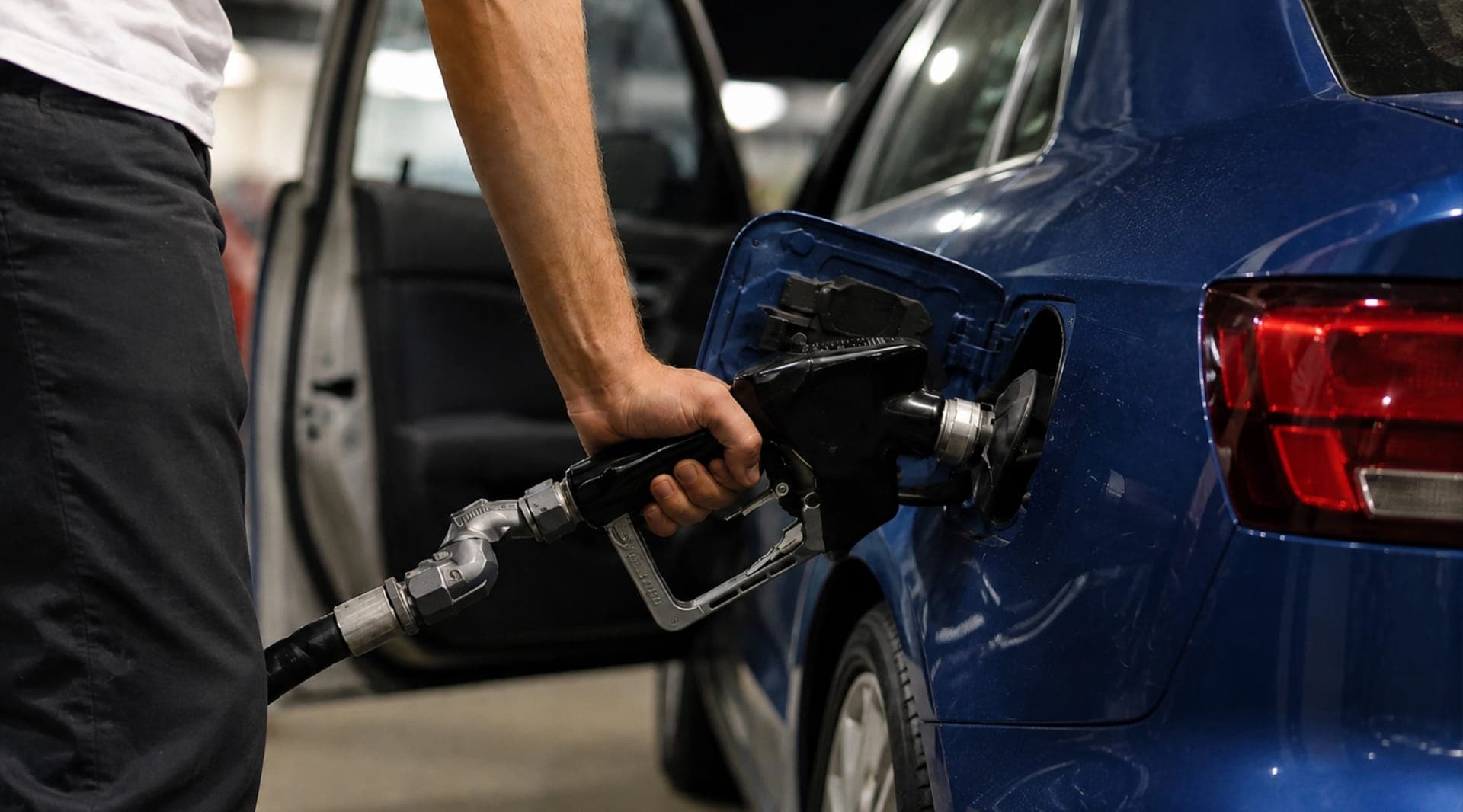
Filling up at dawn wins you about nine cents, and the pump's own tolerance is five times bigger
The tip survives because the physics behind it is completely correct. It is the arithmetic that nobody does.
Fill up early in the morning, the advice goes, because fuel is denser when it is cold, so the same litre gives you more. Every part of that sentence is true in a laboratory. Petrol expands by roughly one part in a thousand for every degree Celsius, which means a litre that warms up by one degree becomes a millilitre bigger while containing exactly the same amount of energy. Sell it by volume and warm fuel is genuinely worse value than cold fuel. The trouble starts when you put numbers on it and then ask where the fuel actually was before it reached your tank, because the answer is a large steel vessel buried under the forecourt, where it has been sitting at more or less ground temperature regardless of whether it is a July afternoon or a January dawn. The morning trick is chasing a difference that has already been flattened out by two metres of earth, and it is chasing it inside a measurement system whose own legal tolerance is several times larger.
What a degree is actually worth
Start with the number, because it settles the argument faster than anything else. Petrol expands by about a tenth of a percent per degree Celsius, and diesel a little less. Take a generous 50 litre fill and warm it by a full degree and you have gained 50 millilitres of volume, which at European pump prices is somewhere around nine cents. That is the entire prize, and it assumes a whole degree of difference in the fuel itself rather than in the air above the forecourt. To reach a euro of difference you would need something like ten degrees of variation in the liquid coming out of the nozzle, which does not happen anywhere in Europe. Notice too what does not change: the mass. A litre of warm petrol weighs slightly less than a litre of cold petrol, but the tankful you just bought contains the energy it contains, and once it is in your car it will expand or contract to match the temperature of your fuel tank without gaining or losing a single joule.
The fuel under the forecourt never felt the weather
This is the part that kills the tip outright. Filling stations across Europe store fuel in tanks buried below the forecourt, and the ground above them is an excellent insulator. A metre or two down, soil temperature in temperate Europe sits in a narrow band of roughly eight to fourteen degrees all year, and it lags the seasons above it by months rather than tracking them by hours. The fuel down there is close to that temperature at four in the morning and close to it again at four in the afternoon. Whatever the thermometer says on the forecourt, the liquid coming up the hose has not been consulted. Then consider how briefly the fuel is exposed on its way to you: a few seconds in a hose, arriving in a tank where it will sit for days. Petrol also takes a fair amount of energy to change temperature, roughly twice as readily as water for a given mass, so warming or cooling it is a process of tens of minutes rather than seconds. All of that warming happens inside your car, after the meter has stopped and the money has changed hands, which means it cannot affect what you were charged.
The tolerance nobody argues about
Here is the comparison that puts the whole debate in proportion. Fuel dispensers in the European Union are regulated measuring instruments, and the accuracy class that applies to them permits an error of half a percent. On a 50 litre fill that is 250 millilitres in either direction, five times larger than the entire effect of a one degree temperature change, and worth around 40 cents at current prices. Nobody stands on a forecourt worrying about that, and mostly they should not, because pumps are sealed, verified and re-verified on a schedule by national metrology authorities, and a well maintained one sits comfortably inside the limit. But it is the right thing to look at if you genuinely suspect you are being short-changed. Every dispenser carries verification markings and a seal, and if the numbers on your receipts are consistently out of step with a car you know well, the complaint goes to your country's metrology or consumer protection authority rather than to the cashier, and they have the equipment to test it. Keep the receipt, because a specific date, time and pump number is what turns a suspicion into an inspection.
Where temperature correction genuinely happens
Temperature correction is real, it is used every day, and it lives in the part of the trade you never see. Wholesale fuel moves in enormous volumes that do swing with the weather, so the industry settles those transactions against a standard reference temperature, which in Europe is 15 degrees Celsius. A tanker loading on a hot afternoon carries a certain gross volume, and the figure that counts for the invoice and for excise duty is the net volume that quantity represents once corrected back to the reference temperature. That is why the same physical delivery can be a slightly different number of litres depending on which thermometer you believe. Retail is different: the pump on the forecourt sells you the litres that actually pass through it at whatever temperature they happen to be, with no correction applied. That sounds like it ought to be a scandal, and every few years somebody argues it is, but the practical effect at retail is the nine cents above, because the underground tank has already done the temperature stabilising for free. It is a structural feature of how fuel is traded rather than a trick played on drivers.
The refuelling habit that does cost real money
If you want a genuine saving at the pump, stop topping up after the nozzle clicks off. A fuel tank is designed with an expansion void above the liquid precisely because the contents will grow as they warm, and squeezing in another two or three clicks fills the space that was reserved for that. In the mildest case you push fuel out onto the forecourt on a hot afternoon, wasting what you just paid for and putting solvent onto your paint. In the expensive case you push liquid petrol into the evaporative emissions system, whose charcoal canister is designed to catch vapour and is ruined by liquid. A saturated canister means a warning light, stored fault codes, a hard-starting engine, a smell of fuel, and a failed emissions check at the periodic inspection, and replacing one is a job measured in hundreds of euros rather than tens. Rocking the car to squeeze in more is the same mistake with extra effort. The first click is the tank telling you it is full, and it is worth far more than the litre of headroom you were trying to buy.
Where the money actually is
Every lever that genuinely moves your fuel bill is larger than this one by an order of magnitude, and most of them are free. Underinflated tyres cost you a couple of percent in consumption and a great deal more in tyre life, which is why the warning light is a late alarm rather than a gauge and a monthly check with a gauge is worth more than every early morning fill of your life put together. An empty roof box or a set of roof bars left on after the holiday can add something in the region of ten to twenty percent at motorway speed, for nothing at all in return. Dropping from 130 to 110 km/h on a long run saves roughly a fifth, because aerodynamic drag climbs with the square of speed. Short cold trips are brutally expensive per kilometre, since a cold engine runs rich until it warms up, so combining errands into one journey beats making four. And paying for a higher octane than your handbook asks for buys you knock resistance you were never going to use, rather than extra energy per litre. Electric drivers have their own version of this conversation, where preconditioning the battery does far more for a journey than the time of day at which you plug in.
What to actually do
Fill up when it suits you, and spend the attention you were going to waste on the clock somewhere it pays.
Stop at the first click. The expansion void above the fuel is not wasted space, and filling it is the one refuelling habit that can cost you hundreds.
Ignore the time of day. A whole degree across a full tank is worth about nine cents, and the fuel underground is not that much warmer in the afternoon anyway.
Check tyre pressures cold once a month with a gauge. It is the biggest free saving available to you and it never comes up in this argument.
Take the roof bars and the empty roof box off when the holiday ends.
Buy the octane your handbook specifies, not the one above it, unless the manual actually asks for it.
Keep your receipts if you genuinely suspect a pump. Date, time and pump number are what a metrology inspector needs.
Measure real consumption brim to brim over several tanks rather than trusting the dashboard average, which is an estimate.
Frequently asked questions
Is there any moment that genuinely is better to fill up?
Yes, but it is about price rather than physics, and the differences are enormous by comparison. Where you fill matters far more than when: motorway service stations across Europe charge a substantial premium over the same brand a few kilometres off the junction, and the gap on a full tank can be several euros rather than several cents. Many countries also have visible weekly rhythms in pump prices and publish official price data or apps that show what each station is charging right now, which is a two-minute habit that beats any amount of thermodynamics. Cross-border drivers know the other lever: excise duty differs so sharply between neighbouring European countries that a tank bought on the right side of a border can save more than a year of early mornings. None of that has anything to do with temperature.
Does the same apply to diesel?
Yes, and slightly more so in your favour, because diesel expands a little less per degree than petrol does. The same underground storage argument applies without change, so the conclusion is identical: the temperature of the fuel you buy is set by the ground, not by the forecast. Diesel does have a genuine seasonal story, but it is a different one. Suppliers change the blend through the year so that it resists waxing in cold weather, which is why a tank filled in a warm country in autumn and then driven into an alpine winter can occasionally cause trouble, and why long-term storage of summer diesel into the winter is a bad idea. That is worth knowing before a winter trip. It has nothing to do with how many litres you got.
Should I half-fill the tank to save weight?
The arithmetic says no. Petrol weighs roughly three quarters of a kilogram per litre, so a 50 litre tank is about 37 kg full and you would save some 18 kg by running it half empty. On a car weighing 1,500 kg that is a bit over one percent of the mass, and mass only affects consumption when you are accelerating or climbing, so the real saving is a fraction of a percent. Against that you are making twice as many trips to the filling station, each of them a short detour, and running consistently low on fuel makes you vulnerable to a bad day. It is a real effect that racing teams care about and ordinary drivers should not. If you want to lose weight from the car, empty the boot instead, which is usually where the forgotten twenty kilograms lives.
My range readout is wildly inconsistent. Is the pump short-changing me?
Almost certainly not, because the readout is not a measurement of anything you can hold. Range is an estimate the car builds from a level sensor in an oddly shaped tank and a rolling average of your recent consumption, so a week of short cold trips or a motorway run will move it dramatically without a drop of fuel changing hands differently. Dashboard consumption averages are estimates too and are commonly a few percent optimistic. The only honest way to measure is brim to brim: fill to the first click, note the odometer, drive a full tank, fill to the first click again at the same pump if you can, and divide the litres by the kilometres. Do that over three or four tanks and you will have a real figure, which is also the number you need before you can tell whether anything is wrong at all.
Is it bad to let the tank run nearly empty?
The old warning that the fuel pump relies on the fuel around it for cooling is largely overstated on modern cars, and running low occasionally will not damage anything. Two smaller reasons still argue for not making a habit of it. Any sediment or water that has settled in the bottom of the tank over the years sits precisely where the pickup is drawing from when the level is very low, and a modern high-pressure system, particularly on a diesel, is not cheap when it is contaminated. The bigger reason is simply practical: a car that runs dry stops wherever it happens to be, which in a tunnel, on a motorway or on a level crossing is a genuinely dangerous place to be stationary, and recovery costs more than the tank you were putting off. Treat the warning light as an instruction rather than a suggestion and none of this matters.