This one-off Porsche 911 Turbo S says "see ya later mate" when you floor it
Porsche built a one-off 911 Turbo S to mark 75 years in Australia, with paint that shifts through four colours and a hidden farewell message under the rear wing. It only appears in Sport Plus mode, or once the car passes 80 km/h
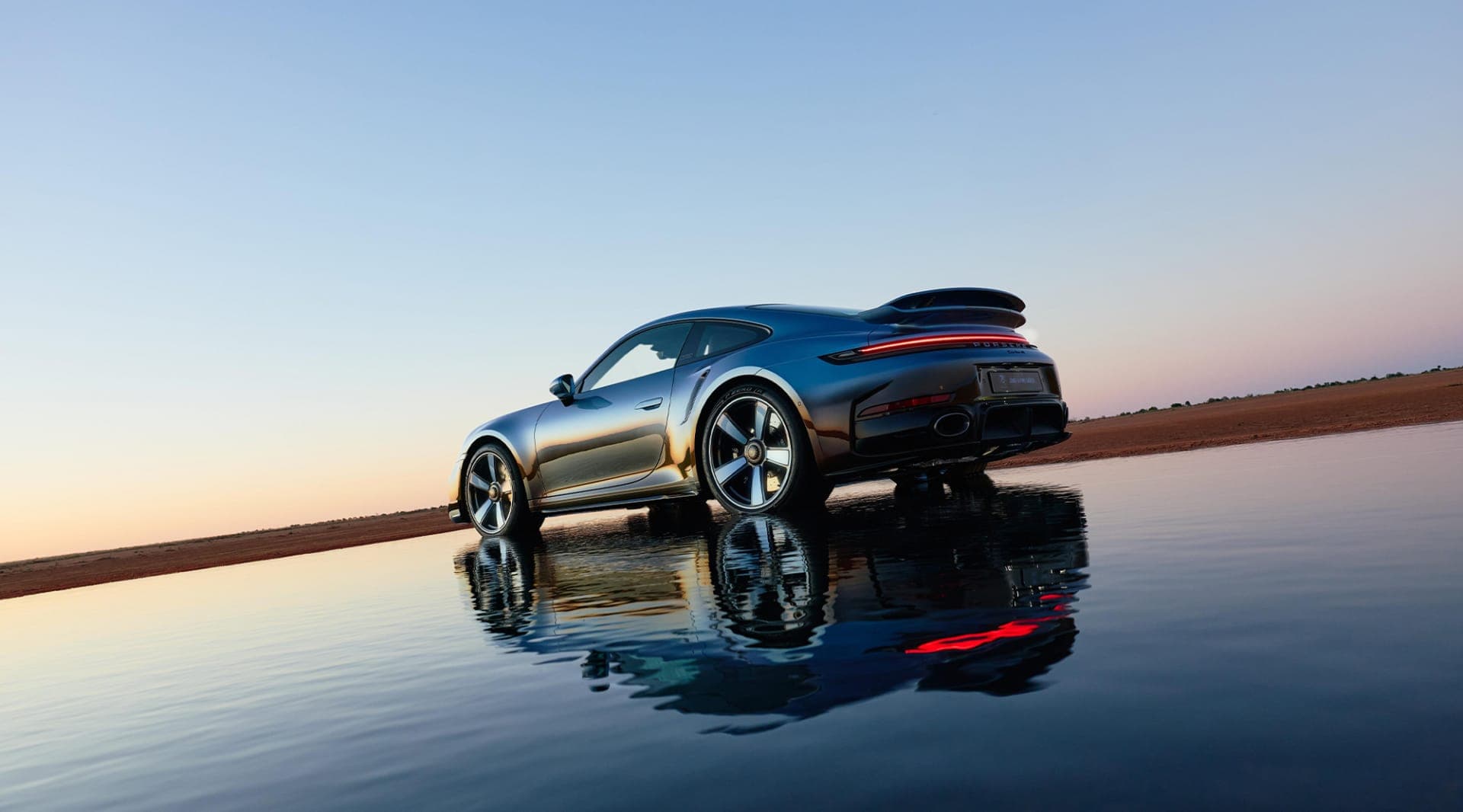
Porsche Cars Australia, working with the Porsche Sonderwunsch team, Style Porsche, and Sydney-based artist Werner Bronkhorst, has revealed the 911 Turbo S Land Down Under, a one-off commission marking 75 years of Porsche in Australia. The car uses two Chromaflair paint colours developed exclusively for it, Terra Australis Red and Southern Cross Blue, hand-applied across seven layers over more than 300 hours to create a gradient that shifts between desert orange, dusk-sky blue, eucalyptus green, and sunrise gold depending on the light. Underneath the rear spoiler sits a hidden message, "See ya later mate," rendered in the artist's own handwriting, visible only when Sport Plus mode is engaged or when the automatic rear wing deploys above 80 km/h.
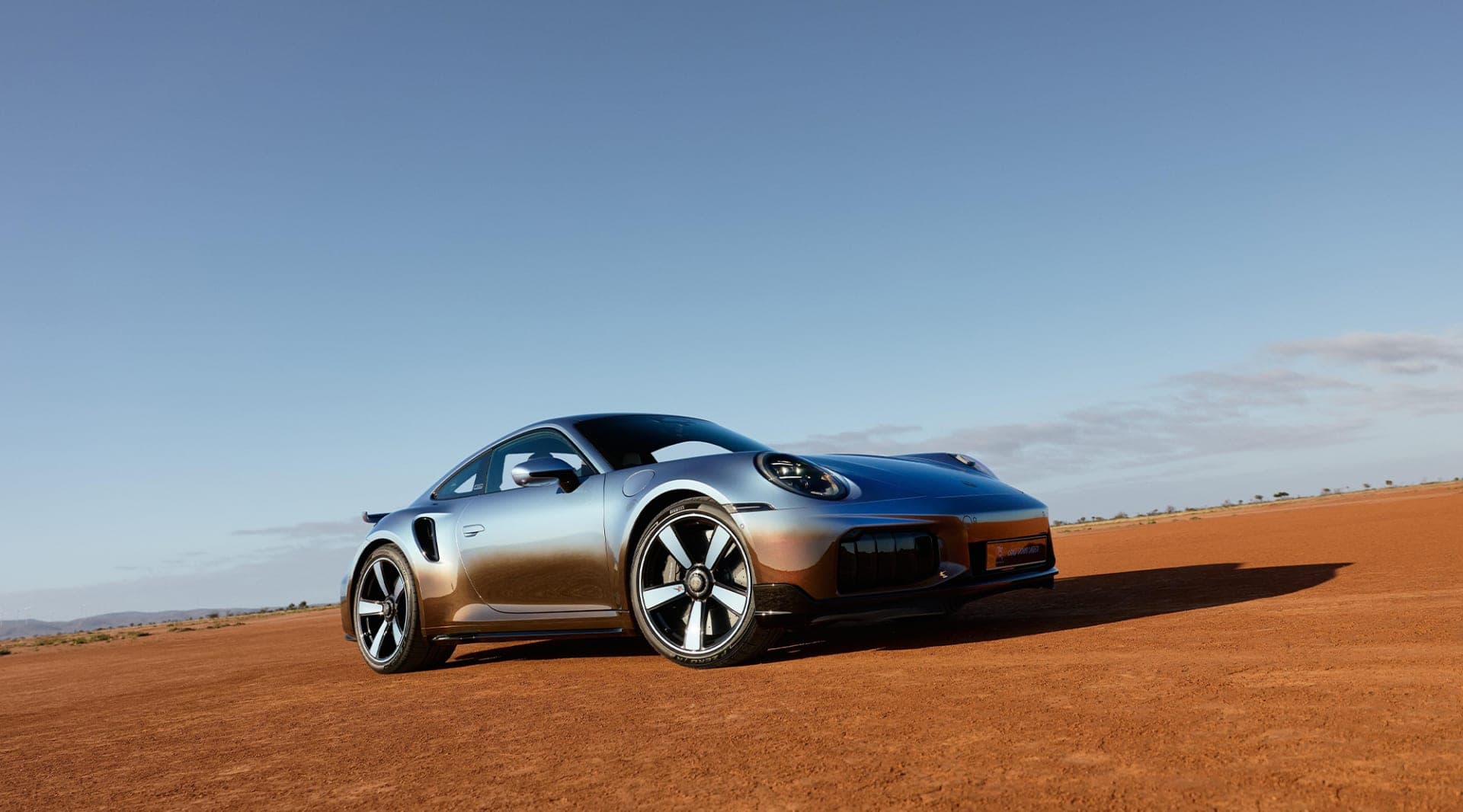
A sunset built from two new paint colours
Chromaflair paint uses ultra-thin flakes with a reflective aluminium core encased in a glass-like transparent layer, and the varying thickness of that layer changes how each flake reflects light. On the Land Down Under, Terra Australis Red runs across the lower body before transitioning to Southern Cross Blue from the shoulderline up, echoing the exact moment an outback sunset gives way to night. The 20/21-inch Turbo Exclusive wheels are finished in Southern Cross Blue to match, and the roof hides a subtle "ghosting effect" that reveals the number 75 in Bronkhorst's own handwriting, a deliberate double meaning for 75 years of Porsche Motorsport heritage and 75 years of Porsche in Australia at once.
An interior built around 14,417 tiny holes
Inside, Dark Night Blue leather pairs with a new colour created specifically for this car, Coolibah Brown. The 18-way Adaptive Sports Seats Plus feature a paintbrush-style perforated seat centre with exactly 14,417 individual perforations, each one positioned deliberately to translate Bronkhorst's brushstroke technique into leather rather than canvas. Contrasting Kalahari and Coolibah Brown leather, fine embroidery, and headrests embossed with a 75 years Porsche in Australia motif round out the theme, while the steering wheel mixes Dark Night Blue, Coolibah Brown, and Neodyme with a Kalahari marker at 12 o'clock. Australian silky oak wood inlays appear on the dashboard and rear seats, paired with Neodyme accents throughout the cabin.
A dashboard that doubles as a map
The detailing goes further than colour and texture. Topographical contour graphics of the Blue Mountains, capturing the region's escarpments and valleys, are printed across the upper dashboard and side trims. The roof lining carries an embroidered Southern Hemisphere constellation map showing the night sky exactly as it appeared over Uluru in 1951, the year Porsche first arrived in Australia, a level of specificity that goes well beyond decorative Australiana.
The programme behind the commission
Sonderwunsch is Porsche's reinterpretation of a personalisation programme it first ran in the late 1970s, letting customers co-create genuinely one-off vehicles with Porsche's own development and design teams. The programme has already produced a modern 911 S/T built around Camel GT Challenge racing heritage and a Turbo S that marked 70 years of Porsche in Kuwait, so a car built entirely around 75 years in Australia sits comfortably within that range. New-vehicle customers can already order a Paint to Sample Plus colour developed to their own brief, while the separate Factory Re-Commission offering lets owners of older cars redesign or restore them with the same in-house support. Porsche has not disclosed pricing for the Land Down Under, typical for a commission built around a single client's brief, and the mechanical package stays completely standard: a 911 Turbo S rated at 11.7 to 11.5 l/100 km combined on the WLTP cycle, with no performance changes mentioned anywhere in the reveal.
AutoNext Take
What stands out here is how specific the research actually is, rather than how much Australiana got thrown at a car. Reconstructing the exact night sky over Uluru from a single year in 1951, and hiding a joke that only reveals itself at the exact moment a driver would want to say it to whoever they just left behind, is a different level of craft than a boomerang decal and some red dirt paint.
Leaving the mechanical package completely stock is the right call. Nobody was going to buy this story on lap times, and Porsche wisely did not try to sell it that way. The only real downside is that a car this specific will likely belong to exactly one Australian collector, and the rest of us get to enjoy the 14,417 perforations through a press release and a gallery of photos.