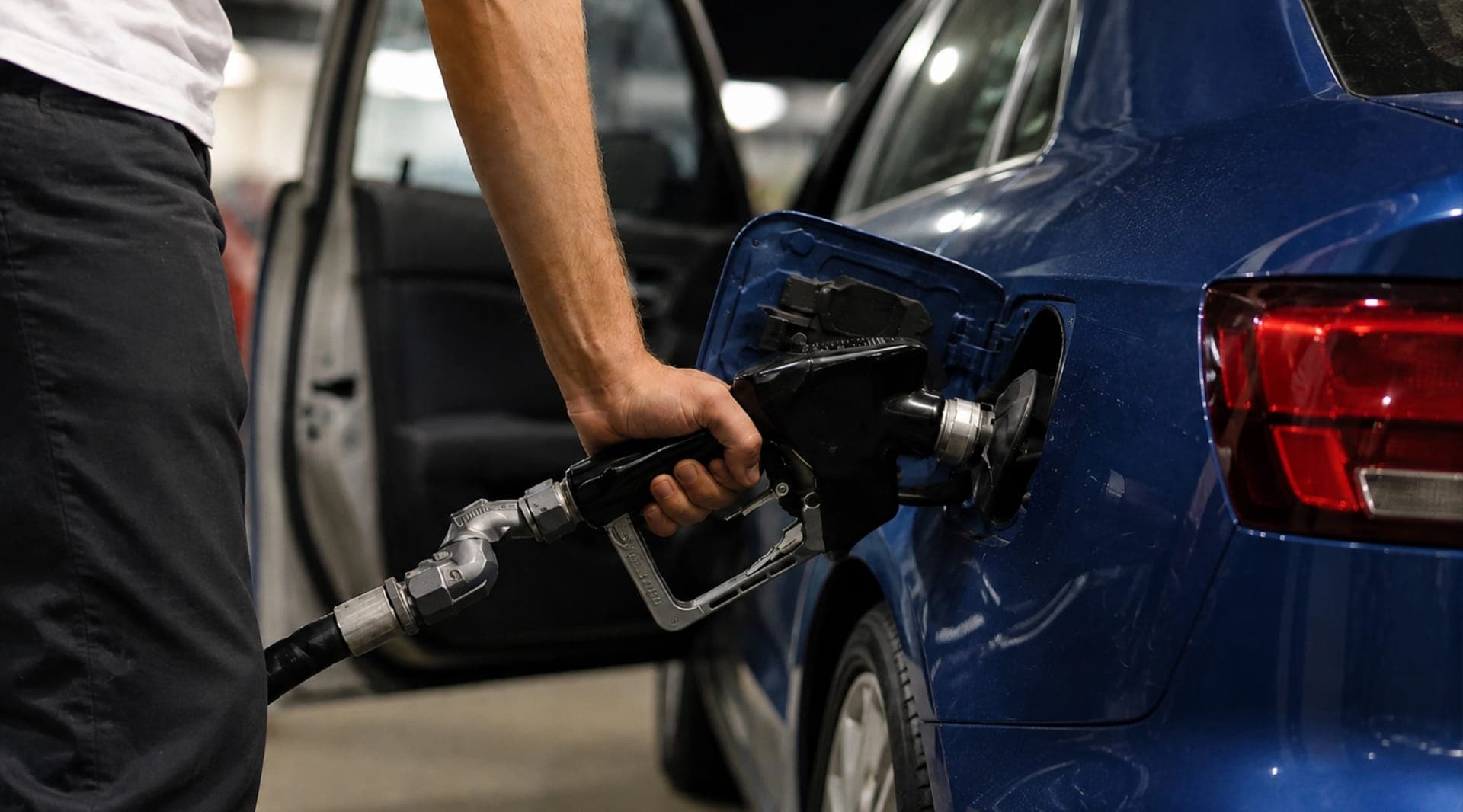
Your diesel has a second tank, and running it dry means the car will not restart
There is a blue cap next to your fuel filler, and European law decides what happens if you ignore it.
The fluid behind it is called AdBlue, which is a trade name for something far less exotic than the marketing suggests: 32.5 percent high-purity urea dissolved in 67.5 percent demineralised water, specified down to the last impurity by the ISO 22241 standard. It is not a fuel, not an additive and not a performance product. It is sprayed as a fine mist into the exhaust of almost every Euro 6 diesel sold in Europe since roughly 2015, where the heat breaks it down into ammonia and that ammonia converts nitrogen oxides into ordinary nitrogen and water vapour. A car uses somewhere around one to one and a half litres of it every thousand kilometres, carries perhaps ten to twenty litres on board, and warns you long before the tank runs dry. What makes it worth understanding is what happens if you let it. The engine keeps running until you switch it off, and then it will not start again. That behaviour is not a fault and not a manufacturer being difficult. It is written into European type approval, and it is the reason a fluid that costs a few euros a refill strands more drivers every year than almost anything else on the car.
What is actually in the tank
AdBlue is a registered name owned by the German automotive industry association, and the neutral description is AUS 32, aqueous urea solution at 32.5 percent. Every other brand you see on a forecourt is the same fluid under a different label, which is why the only thing worth reading on the container is whether it states ISO 22241 or AUS 32. The concentration is not a rounded marketing number either. It is the exact point at which the mixture freezes at its lowest possible temperature, around minus 11 degrees Celsius, and it is also the precise strength the engine management assumes when it calculates how much to inject. The fluid itself is clear, faintly ammonia-scented, non-flammable and not classified as hazardous, but it is mildly alkaline and unkind to bare aluminium, copper and paintwork, and it crystallises into a white crust as soon as a spill dries. It lives in its own tank with its own filler, usually a blue cap beside the diesel one, sometimes under the boot floor or in the engine bay on older installations.
How a tank of urea cleans up a diesel
Diesel engines burn lean and hot, which is what makes them efficient and also what makes them produce nitrogen oxides, the pollutant behind urban air quality limits and the reason low emission zones exist. Selective catalytic reduction is the answer Europe settled on. A metering valve sprays AdBlue into the hot exhaust stream, where heat and steam strip it down to ammonia and carbon dioxide, and that ammonia then reacts across a catalyst coated with zeolite or vanadium compounds, turning nitrogen oxides into plain nitrogen and water. A healthy system removes up to around 90 percent of them. There is one practical consequence hidden in the chemistry: the reaction needs heat, and dosing generally does not begin until the exhaust reaches somewhere around 200 degrees, which is another reason short cold journeys are the hardest life you can give a modern diesel. The system shares an exhaust with the soot filter but does an entirely different job, and it is worth knowing that the filter runs its own cleaning cycle that nobody tells you about either.
How much you use, and how the warning escalates
A passenger car typically consumes one to one and a half litres of AdBlue per thousand kilometres, which works out at roughly three to five percent of its diesel consumption. With a tank of ten to twenty litres, that means a refill every ten to twenty thousand kilometres, and here manufacturers diverge. Some size the tank to match the service interval so the garage handles it and you never think about it, while others expect the driver to top up between services. The warning sequence, though, is not left to anyone's discretion. European type approval requires the car to warn you while there is still enough fluid for at least 2,400 kilometres of driving, to escalate that warning as the level falls, to show an unmissable countdown, and finally to prevent the engine restarting once the tank is empty. Note carefully what that last step is and is not. Your car will not cut out on a motorway. It will let you finish the journey, and then refuse to turn over the next morning.
Where to buy it, and why the price varies so wildly
The same fluid is sold two ways and the gap between them is absurd. A dedicated AdBlue pump on a forecourt dispenses it in bulk at a price per litre that keeps a full ten litre refill in single-digit euros across most of Europe. The same ten litres bought as sealed bottles from a service station shop or a supermarket shelf can easily cost two to three times that, because you are paying for the packaging and the convenience. The catch with pumps is that many forecourts only have the truck lane version, with a wide magnetic nozzle designed for commercial tanks that a car filler neck will not accept, so look for the smaller car pump that most large stations now fit alongside it. Bottles remain the sensible answer for a top-up on a long trip, or for keeping one spare in the garage, and in plenty of places they are the only option. Whichever you choose, the label needs to say ISO 22241 or AUS 32, and nothing else on it matters.
The mistakes that turn a cheap fluid into an expensive repair
The system is not fragile, but it is intolerant of contamination, and almost every serious AdBlue bill starts with something poured in that should not have been. Putting AdBlue into the diesel tank, or diesel into the AdBlue tank, is the classic, and the rule in both cases is identical: do not start the engine, do not turn the key, call for a tow. Started, either mistake can write off injection components or the catalyst itself. Diluting with water is the next most common, and it does not work, because a quality sensor reads the concentration and the catalyst is damaged by what ordinary water carries. Decanting into a used bottle, or using the funnel that lives in the boot next to the oil, introduces exactly the dust, oil and fuel traces that ISO 22241 spends an entire specification excluding. The fluid also ages: a sealed container keeps for at least a year between roughly minus five and 25 degrees, and about half that if it has spent a summer in a hot garage or a sunlit boot. Finally, if a warning survives a genuine top-up, stop adding fluid. Failed nitrogen oxide sensors and metering valves produce the same countdown as an empty tank, and only a garage with a diagnostic tool can tell them apart, ideally before that countdown reaches zero.
What to actually do
None of this is difficult, and most of it is a habit rather than a job. Learn where your filler is, keep the level ahead of the warning, and never let anything into that tank that did not come out of a sealed container.
Find the filler before you need it. On most cars it is a blue cap beside the diesel one; on others it hides under the boot floor or in the engine bay. Two minutes with the handbook now beats hunting for it on a dark forecourt.
Top up when the first warning appears, not when the countdown starts getting interesting. That first message is legally required to arrive with at least 2,400 kilometres of fluid left, so there is no emergency, only a deadline.
Add at least ten litres when you do. Level sensors are coarse, and pouring in a token two litres often fails to clear the warning at all.
Buy only fluid labelled ISO 22241 or AUS 32, in a sealed container, and check the date on it. Use it within a year, and keep spares indoors rather than in the boot.
Use the forecourt pump where you can. It is the same fluid at a fraction of the bottled price, and there is no funnel involved to contaminate it.
Never mix the two tanks, and if you do, do not start the engine. An untouched mistake is a drain and a flush; a started one can be a new catalyst.
Rinse every spill with water straight away, on the paint, around the filler and on your hands. Dried AdBlue crystallises and leaves marks.
If the warning survives a real top-up, book the garage. A failed sensor counts down exactly like an empty tank, and it will lock you out just as thoroughly.
Frequently asked questions
Does my car even use it?
If it is a diesel, look for a second filler cap, normally blue and normally right beside the diesel one. Practically every diesel car type approved to Euro 6 and sold in Europe from around 2015 onwards uses selective catalytic reduction, along with a good number of Euro 5 vans and larger diesels before that. Petrol cars never use it. If you are looking at a used car and want certainty before you buy, the emissions class is printed in the registration document, and the codes on that document tell you more than the seller usually does. The handbook will also carry a section on the reagent, its warning light and the refill procedure.
What actually happens if I let it run out?
Nothing at all until you switch off. The inducement system in European type approval is deliberately designed not to create a hazard, so the engine keeps running to the end of your journey. After that it will not restart, and adding fluid at the roadside may or may not be enough on its own. Many cars recognise a proper refill of ten litres or more and release the lockout after a few ignition cycles; others need a technician to reset the system with a diagnostic tool. Either way you are looking at a recovery truck or a call-out, which is a remarkable amount of trouble for a fluid you could have bought for the price of a sandwich.
Can I top it up with water, or dilute it to make it last?
No on both counts, and the reasons are chemical rather than commercial. The 32.5 percent concentration is fixed because it is the mixture that stays liquid to the lowest temperature, and because the engine management doses on the assumption that it is getting exactly that strength. A weaker solution under-doses, the nitrogen oxide output climbs, and the quality sensor that most modern systems carry will flag the fluid as out of specification. Worse, tap water brings minerals and dissolved metals that poison the catalyst permanently, which is precisely why the water in AdBlue is demineralised and why ISO 22241 reads like a paranoid list of things that must not be present.
Does it freeze in winter?
Yes, at around minus 11 degrees, and it is a complete non-event. Manufacturers know that freezing point better than anyone, so the tank, the lines and the metering valve are heated, and the car will simply run without dosing for the first minutes of a very cold morning while everything thaws. Freezing does no harm to the fluid, which returns to specification exactly as it was, and the tank is built to cope with the expansion. Do not add antifreeze, do not add anything else, and do not try to warm the tank yourself.
Is there any way around it?
There are emulator boxes sold online that fool the engine management into believing the system is working. They are illegal to fit or use on a vehicle driven on European roads, they invalidate your type approval and typically your insurance, and they are becoming easier to catch as periodic inspections move towards measuring what actually leaves the exhaust rather than trusting the dashboard. That shift is already visible in what a modern roadworthiness test now looks for. The arithmetic never worked in the first place either: the fluid costs a few euros per thousand kilometres, while a replacement catalyst runs into four figures, and a car that fails its inspection is worth considerably less than one that passes.