Christian von Koenigsegg looks to the skies: is Koenigsegg developing a revolutionary aircraft?
The name Koenigsegg has long been synonymous with radical innovation.
Hypercars producing more than 1,500 horsepower, engines revving beyond conventional limits, and groundbreaking technologies such as Freevalve have continuously pushed the boundaries of automotive engineering.
Now, however, founder Christian von Koenigsegg appears to be looking beyond the road and toward the skies. According to recently filed patent documents, the Swedish innovator is working on a radical aircraft concept featuring a closed-wing aerodynamic design. The timing of this move is particularly interesting: Koenigsegg’s entire hypercar lineup is currently sold out.
When hypercars are completely sold out
It is a rare situation in the automotive world. From the extreme Koenigsegg Jesko to the four-seat hyper-GT Koenigsegg Gemera, every production slot has already been allocated to a buyer. In other words, there are currently no more Koenigsegg cars left to sell.
For a brand that thrives on engineering challenges, this situation seems less like a limitation and more like an opportunity to explore new frontiers. And that frontier might now be aviation.
A radical closed-wing aircraft concept
The patent (registered under EP4566939A1) reveals an aircraft design that looks dramatically different from traditional airplanes. Instead of two independent wings, the concept features a closed, diamond-shaped wing structure. The front and rear wings connect at the tips, forming a continuous loop around the aircraft.
While futuristic in appearance, the concept is based on a clear aerodynamic principle. Traditional aircraft generate wingtip vortices, turbulent spiraling airflows that form where high-pressure and low-pressure air meet at the wing edges. These vortices create significant drag and reduce efficiency.
By connecting the wings into a closed structure, the design could significantly reduce or even eliminate these vortices. In theory, the benefits could include:
reduced aerodynamic drag
improved efficiency
lower energy consumption
enhanced high-speed stability
Aviation heritage already runs through Koenigsegg
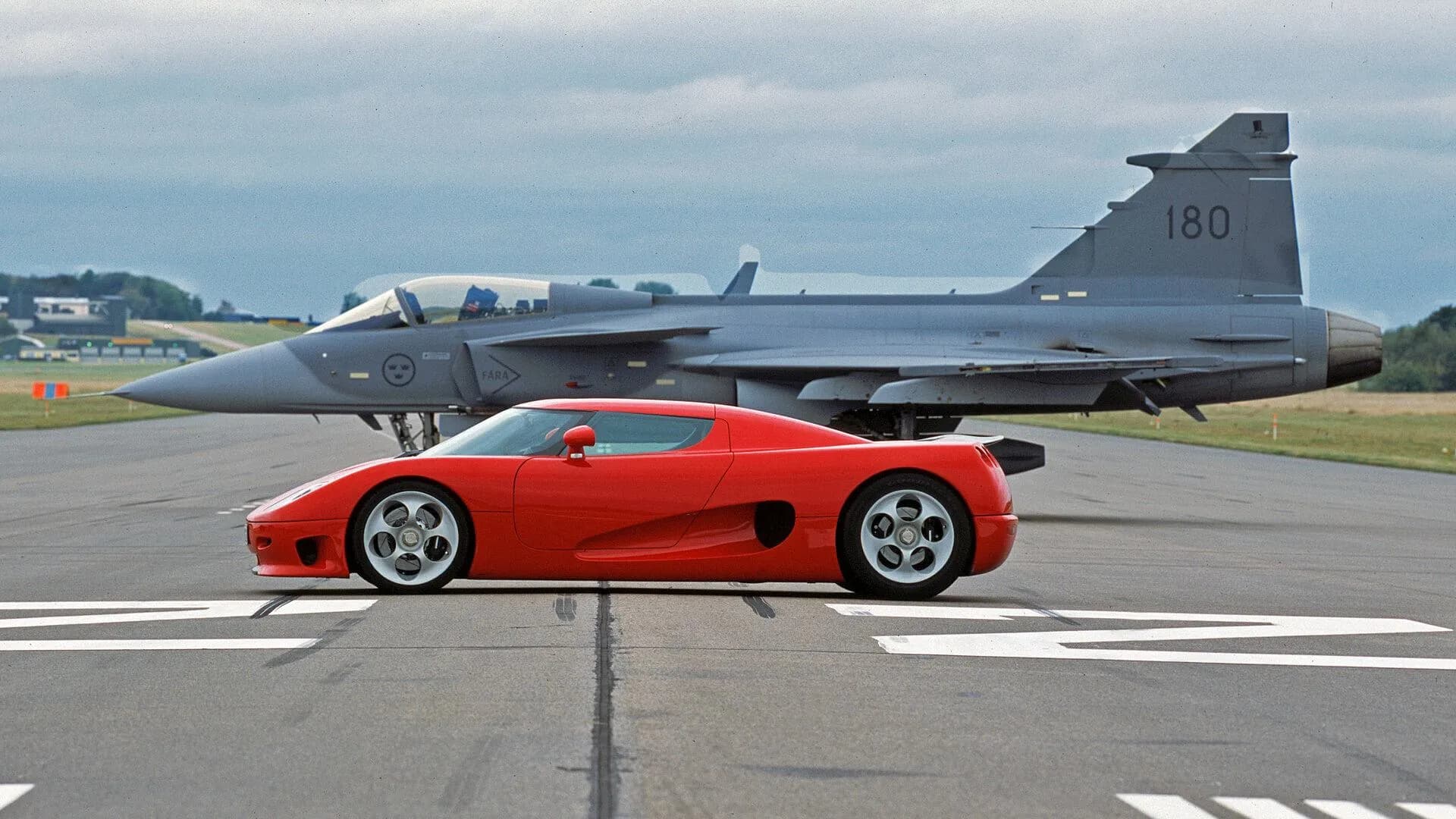
In many ways, Koenigsegg’s interest in aviation feels natural. The company’s headquarters in Ängelholm, Sweden, was previously a base for the Swedish Air Force’s legendary Ghost Squadron.
That history still lives on today. Every Koenigsegg car carries the iconic ghost emblem as a tribute to the fighter pilots who once occupied those hangars.
Technically speaking, the transition also makes sense. Hypercars like the Jesko rely heavily on extreme aerodynamic engineering to remain stable at speeds exceeding 480 km/h (300 mph). Mastering airflow at those speeds is not far removed from the principles used in aircraft design.
More than just a patent?
The patent drawings suggest a compact fuselage with the engine positioned behind the passenger cabin, a configuration designed to optimize airflow around the aircraft. Another intriguing detail is the potential use of deformable wing surfaces instead of traditional flaps to control flight dynamics.
That approach would be very much in line with Koenigsegg’s engineering philosophy: rethinking long-standing solutions with entirely new ideas. For now, the project exists only as a patent rather than a confirmed production aircraft.
However, anyone familiar with Koenigsegg knows that many of the company’s most radical concepts eventually become reality.
AutoNext Take: Koenigsegg has never thought only in terms of cars
What makes this story fascinating is how perfectly it fits the mindset of Christian von Koenigsegg. He has never simply built cars for the sake of building cars. Instead, his work is driven by the ambition to push engineering boundaries as far as possible.
So when every hypercar is sold out, the experimentation doesn’t stop. It simply moves to a different industry. Whether this aircraft will ever take flight remains uncertain. But if there is one engineer capable of shaking up the aviation world the way he did the hypercar market, it is undoubtedly Christian von Koenigsegg.
