Ferrari Luce revealed as Maranello’s first fully electric Ferrari
Yes, Ferrari has gone electric. But not in the predictable way.
Ferrari has finally done it. The first fully electric Ferrari is here, and it is called the Ferrari Luce. But this is not the low, silent EV hypercar many people probably expected. Ferrari has chosen a much more surprising direction.
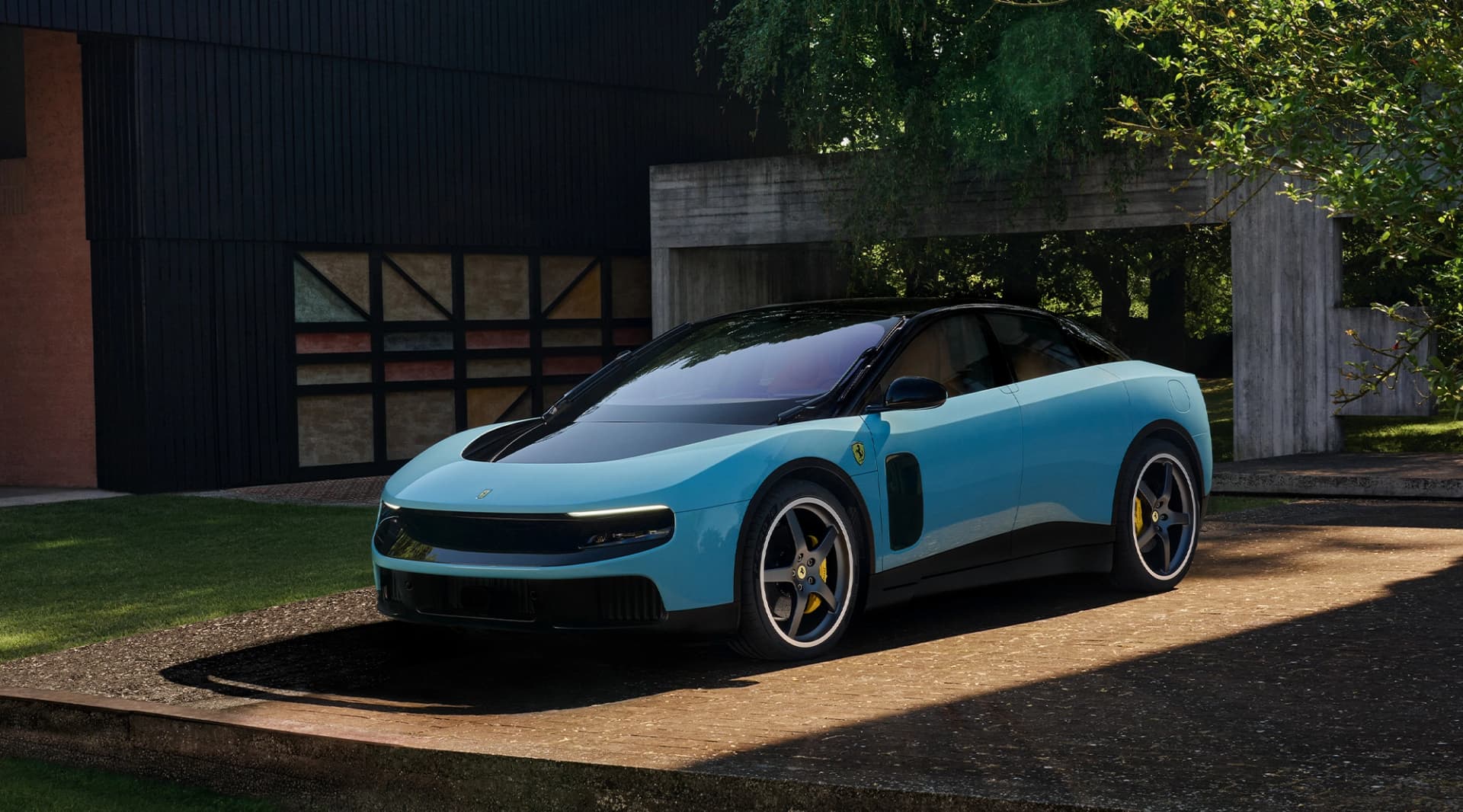
The Luce is a five-seat, four-door, all-electric Ferrari, developed around a dedicated EV platform, four electric motors, active suspension, four-wheel steering and a completely new design language created together with LoveFrom, the creative collective led by Sir Jony Ive and Marc Newson.
Not “the electric Ferrari”, but a new kind of Ferrari
The Luce is not a battery-powered 296. It is not an electric SF90. And it is not a silent F80-style hypercar. Instead, Ferrari has used the freedom of electric architecture to create something it could not have made with a combustion engine: a spacious, high-performance, five-seat Ferrari with the kind of proportions and packaging that would have been impossible with a traditional front-mid-engine layout.
The numbers are serious too: 772 kW, or 1,050 hp, 0 to 100 km/h in 2.5 seconds, 0 to 200 km/h in 6.8 seconds, a top speed of 310 km/h and an estimated range of 530 km. The battery has a gross capacity of 122 kWh, runs on an 800 V architecture and supports fast charging up to 350 kW.
Four motors, one per wheel
Technically, the Luce is one of the most complex Ferraris ever built. It uses four electric motors, one for each wheel. That gives Ferrari full control over torque delivery, regeneration and torque vectoring at every corner of the car. The system is supported by a new Vehicle Control Unit, which integrates powertrain and vehicle dynamics and updates targets 200 times per second.
That sounds very technical, but the idea is simple: make a heavy, powerful EV feel precise, natural and alive. The Luce weighs 2,260 kg, which is not light in traditional Ferrari terms. But Ferrari claims the low-mounted battery gives it a centre of gravity 95 mm lower than the Purosangue, while battery integration improves structural rigidity. In other words, Ferrari is trying to fight EV weight not by denying it, but by controlling it.
Ferrari’s electric sound philosophy is actually interesting
The biggest emotional question around any electric Ferrari is obvious. What does it sound like? Ferrari’s answer is smarter than fake spaceship noise. The Luce uses a precision accelerometer on the axle to capture real vibrations and mechanical texture from the rotating electric components, then filters and amplifies that sound in a way Ferrari compares to an electric guitar amplifier.
That means the sound is not artificially generated from nothing. It is taken from the car’s own mechanics. Whether it feels emotional in real life remains to be seen, but the philosophy is correct. If an electric Ferrari needs sound, it should be functional, responsive and authentic. Not theatrical nonsense played through speakers just because customers expect noise.
The design is the real shock
Designed with LoveFrom, the car uses a very pure, almost shell-like glasshouse, floating front and rear aerodynamic wings, transparent light panels and a smooth, extremely aerodynamic surface language. Ferrari says the Luce has the lowest drag coefficient in the history of Maranello’s road cars, although the exact figure has not yet been disclosed.
It also gets the largest staggered wheels ever fitted to a series-production Ferrari road car: 23 inches at the front and 24 inches at the rear. This is where people will argue. Some will call it brave. Some will call it strange. Some will say it does not look like a Ferrari. But honestly, that reaction may be exactly what Ferrari wanted. A first electric Ferrari could not just look like an old idea with a battery underneath.
Inside: physical controls are back, but smarter
The interior might be the most important part of the Luce. Ferrari and LoveFrom have clearly tried to avoid the lazy EV cabin cliché of “big screen, no buttons, good luck”. Instead, the Luce combines digital displays with physical buttons, dials, toggles and paddles.
There is an e-Manettino for energy and power behaviour, the traditional Manettino for vehicle dynamics, torque-control paddles for progressive power delivery and regenerative braking, and a cockpit focused on tactile interaction.
That is good news. Because Ferrari customers do not just want information. They want control. They want mechanical satisfaction. They want the act of driving to feel deliberate.
Five seats, 597 litres of luggage space and Ferrari performance
This is where the Luce becomes genuinely unusual. It has five seats and 597 litres of luggage space. That makes it far more usable than a traditional Ferrari GT, and arguably more practical than the Purosangue in certain contexts. It is still lower than the Purosangue, but it clearly aims at a different kind of customer: someone who wants Ferrari performance, Ferrari design and Ferrari emotion, but with real everyday flexibility.
Ferrari is not abandoning V6, V8 or V12 models. The Luce sits alongside them. It gives Ferrari a new answer for customers who want an EV, but still want something that feels more special than a luxury SUV or another fast electric saloon.
AutoNext Take
This is the most interesting Ferrari in years. Not necessarily the prettiest. Not necessarily the one we would choose over a 12Cilindri, 296 Speciale or Purosangue. But definitely the most important.
The big question is emotion. Numbers are easy for EVs now. Acceleration is easy. Torque is easy. What is not easy is making the car feel alive after the first launch-control run. Ferrari knows this, and the Luce seems engineered around that problem: sound, torque paddles, physical controls, active dynamics, wheel-by-wheel control and a clear attempt to make the driver part of the process.
Will traditional Ferrari fans accept it? Some will not. But that almost does not matter. The Luce is clearly not only for them. It is for the Ferraristi of tomorrow, and maybe for people who never considered Ferrari before.