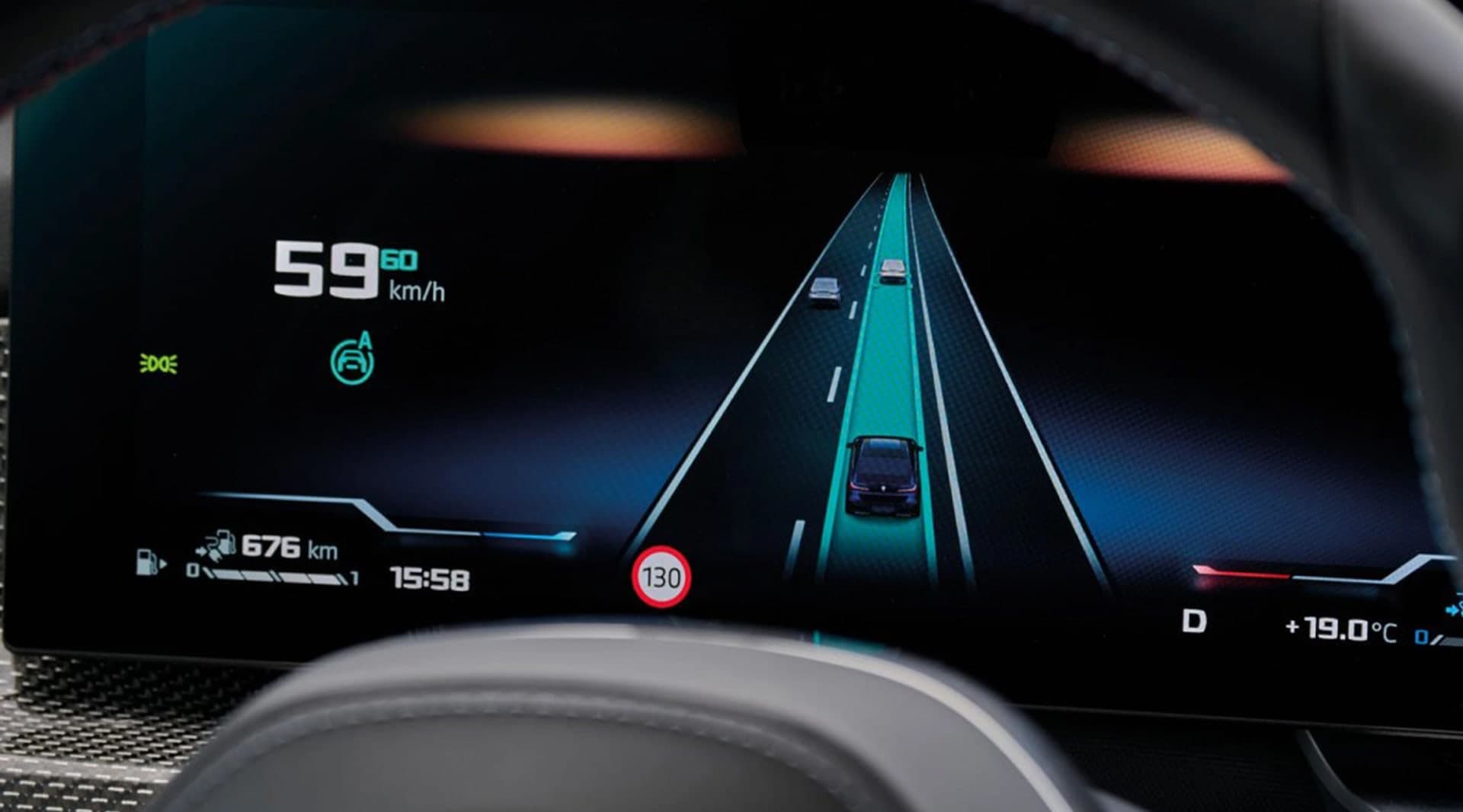
Every new car in Europe beeps at you now, and you are allowed to switch it off
Your car reads road signs with a camera, and it is nowhere near as good at it as you are.
Somewhere on a dual carriageway this week, a perfectly healthy new car told its driver the limit was 80 because a lorry with a plate on its tailgate happened to be in shot. The chime started, the driver looked down instead of ahead, and a piece of safety equipment briefly made the road less safe. That system has been fitted to every new car registered in the European Union since July 2024, it is in your car whether you asked for it or not, and almost nobody has been told how it works. Which is a shame, because it turns out to be a fairly simple machine with a small number of very predictable weaknesses, and understanding those weaknesses is the difference between a feature that quietly helps and a noise you spend four years resenting.
What the regulation actually demands
The rule is Regulation (EU) 2019/2144, the General Safety Regulation, usually shortened to GSR2. Intelligent Speed Assistance became compulsory for new vehicle types on 6 July 2022 and for every new vehicle registered on 7 July 2024, across categories M and N, which covers cars, vans, buses and trucks alike. Countries outside the EU that follow European type approval get it as a matter of course, and because carmakers build one European specification rather than several, drivers in the UK and Switzerland largely have the system too, even though their own governments never mandated it.
What the system is permitted to do is tightly defined, and narrower than the folklore suggests. A manufacturer picks one of four approved approaches: a visual warning followed by a cascading audible chime, a visual warning followed by a cascading vibration, haptic feedback through the accelerator pedal that pushes gently back against your foot, or a speed control function that eases off the engine's power output. Braking appears nowhere on that list. Neither does any ability to stop you exceeding a limit, because the regulation requires that the driver can override the system at any moment simply by pressing the accelerator harder. It is an advisor with a nervous disposition, not a governor.
Where the number on your dashboard comes from
Two sources, arbitrated by software. The forward-facing camera behind your windscreen reads speed limit signs as you pass them. Map data tied to your GPS position supplies a stored limit for the road you are on. When the two agree, the system is confident and usually right. When they disagree, something has to break the tie, and different manufacturers weight the two inputs differently. That is why two cars travelling side by side on the same road can display different limits, and why neither driver is imagining it.
The failure modes are entirely predictable once you know to look for them. A speed plate on the back of a lorry. Signs on a slip road or a parallel service road that are visible from the main carriageway. Roadworks signage left standing after the works finished, or removed before the map vendor caught up. A resurfaced road with a new limit that has not yet been published to your brand's map supplier. And the physical ones: a windscreen that is dirty, misted or iced over the camera housing, or a windscreen that has been replaced without the camera being recalibrated afterwards. That last one deserves more attention than it gets, because the same camera feeds lane keeping and automatic emergency braking, and a miscalibrated one is a problem long before it is an annoyance. It is worth asking your glass fitter to confirm recalibration in writing, and worth checking before your car goes in for its roadworthiness test.
Then there is a whole category of limit that ISA cannot see at all, because it is not written on a sign at the roadside. In France the motorway limit falls from 130 to 110 in rain, dual carriageways drop from 110 to 100, and other roads from 90 to 80, while fog with visibility under 50 metres caps everything at 50. Your car will cheerfully display 130 in a downpour. The same blind spot covers towing limits, which are lower in most European countries and depend entirely on what is hitched to the back of you, and the reduced limits that apply to newly qualified drivers in France, Italy and elsewhere. The number on the sign is not always the number that applies to you, and the car has no way of knowing the difference.
It is not reporting you to anybody
This is the fear that drives most of the anger, and it is misplaced. ISA has nothing to do with enforcement. It does not transmit your speed to police, to road authorities or to your insurer, it keeps no running log of your transgressions, and switching it off is not recorded anywhere that anyone will ever read. It is a warning device that lives entirely inside your car.
The confusion usually comes from a different requirement in the very same regulation. New cars must also carry an event data recorder, which captures a short window of data around a collision: speed, braking, steering input, seatbelt status and similar. It is a crash investigation tool, it does not record your journey continuously, and the regulation requires that the data it holds cannot identify the vehicle or its owner from the recorder alone. Insurance telematics is a third thing again, entirely separate from both, and something you have to actively sign up for. Three different systems, three different purposes, and only one of them beeps at you.
How to switch it off, and why it will be back tomorrow
The regulation insists on two things simultaneously. You must be able to switch the system off for the current journey, and it must switch itself back on the next time you start the car. There is no legal route for a manufacturer to offer you a permanent off, which is why you will not find one buried in the settings no matter how long you look. The reactivation is not a bug and it is not your dealer being unhelpful. It is written into the law.
The route to the switch varies wildly by brand. On many BMWs, pressing and holding the SET button on the cruise control stalk deactivates it until the engine is next shut off. On Volvos it sits in the centre display under the car symbol and quick controls. Volkswagen group cars typically let you assign it to the configurable shortcut button on the steering wheel or dashboard, which reduces the whole operation to one press. Others bury it two or three levels into a driver assistance menu. The useful move is to spend five minutes finding your own car's shortest path while parked, and then practise it once or twice, because hunting through a touchscreen at 50 km/h in traffic is precisely the distraction the system was meant to reduce.
You will find aftermarket modules advertised as permanent ISA deletes, particularly for Volkswagen group cars. They work by intercepting the message on the car's data bus before it reaches the instrument cluster. Before spending money on one, weigh what comes with it. The vehicle was type approved with that system present and functioning, the same camera and software feed several other assistance systems, any warranty conversation about those systems becomes considerably more complicated, and a future buyer or an inspector may take a view. A two-second button press at the start of each drive is a less elegant solution and a substantially cheaper one.
The three systems everyone mixes up
ISA tells you what it believes the limit is. A speed limiter, sometimes badged as a speed cap or cruise limiter, is a ceiling you set yourself, and the car will not accelerate past it until you kick down. Adaptive cruise control drives to a speed you choose and manages the gap to the car in front. They are three separate functions that happen to share a stalk.
Increasingly they are wired together, and this is where the technology finally becomes genuinely useful. Many cars now offer to adopt the ISA-detected limit straight into the cruise control or the limiter with a single tap on the steering wheel. That version of the feature is worth learning properly, because it inverts the relationship. You decide when to accept a detected limit rather than sitting through an alarm about it, and a misread sign becomes something you simply decline instead of something you endure.
When leaving it on genuinely earns its keep
There is a reason to be fair to the thing. Driving in an unfamiliar country is where it pays for itself immediately, because you no longer have to hold a foreign limit structure in your head while also working out which lane you want. Urban limits across Europe have become genuinely hard to track, with 30 km/h zones spreading through city after city and boundaries that move every few hundred metres. And speed creeps upward on long descents without any input from you at all, which is exactly the situation in which a nag is helpful rather than irritating, and one more reason to understand how to control speed on a mountain pass with the gearbox rather than the brakes. The honest summary is that ISA is at its best when you do not know the road and at its worst on the commute you have driven a thousand times.
What to actually do
Six things, and the first one takes five minutes on your driveway.
Find your car's off switch while parked, not while driving, and practise it until it is muscle memory. Assign it to the configurable shortcut button if your car has one.
Learn whether your car can adopt the detected limit into the cruise control or limiter with one tap. If it can, that is the version worth using, and it makes the warning largely redundant.
Update your navigation and map data. Stale maps are the single most common cause of a stubbornly wrong limit, and most brands now push updates over the air or offer them free at a service visit.
Keep the strip of windscreen in front of the camera clean and de-iced, and after any windscreen replacement get written confirmation that the camera was recalibrated.
Remember the limits the car cannot see: wet-weather reductions in France, lower limits when towing, and the restrictions that apply to newly qualified drivers in several countries.
Leave it on when you are driving somewhere unfamiliar. That is the one situation where it is reliably smarter than your assumptions.
Frequently asked questions
Can I be fined for driving with ISA switched off?
No. The legal duty sits on the manufacturer to fit the system and have it approved, not on you to keep it running. The regulation explicitly requires that you be able to switch it off for the journey, so a penalty for doing exactly that would contradict the rule that created it. What has not changed is the speed itself, which remains just as enforceable as it was before any of this existed.
Does switching it off affect my insurance?
No. Nothing about your use of ISA is transmitted to an insurer, and no standard European motor policy asks about it. The only way your driving reaches an insurer is through a telematics or pay-how-you-drive product that you chose and signed, and that is a completely separate arrangement with its own app and its own consent.
Will it actually slow my car down?
Only if your car uses the speed control variant, and even then it eases back the engine's power rather than braking, so what you feel is the accelerator going soft rather than the car checking itself. Pressing harder overrides it immediately and every time, which the regulation requires. If your car simply chimes and flashes at you, it has no ability to change your speed at all.
Mine shows the wrong limit constantly. Is it faulty?
Usually not, and there is an order in which to check. Clean the glass in front of the camera. Update the map data, since an out-of-date map fighting a correct camera reading produces exactly this behaviour. Establish whether the windscreen has ever been replaced and whether the camera was recalibrated afterwards. If the errors are concentrated on one stretch of road you drive daily, that is a map problem rather than a car problem, and most brands and map suppliers have a public feedback form for reporting an incorrect limit. If the errors are everywhere, on every road, in good conditions, then it is worth a dealer visit.
Does my older car need to be retrofitted?
No. The requirement applies to vehicles newly registered from 7 July 2024 onward. Nothing already on the road has to be modified, there is no retrofit obligation, and there is no proposal to introduce one. If your car predates the deadline and has a sign recognition display, that is a feature the manufacturer chose to fit, and you can generally switch it off permanently in the settings.
Why does it beep more in some countries than others?
Sign design, sign density and map quality all vary across Europe, and cameras trained largely on one visual convention read another slightly less well. Countries that changed limits recently, or that use a lot of variable and time-dependent signage, give the map layer more chances to be out of date. Dense urban areas with frequent zone changes are the hardest environment of all, which is why the system feels most accurate on a French autoroute and least accurate crossing a Belgian city.
