The wrong hand on the door handle is what puts a cyclist in hospital
Grabbing the handle with your nearest hand is a movement built to keep your eyes facing forward.
Sit in a parked car and watch what your body actually does. Your hand drops to the handle beside your knee, your shoulders stay square to the windscreen, and the door swings out into a lane you have not looked at once. The whole action takes about a second and requires no head movement at all, which is precisely the problem, because a bicycle approaching from behind at 25 km/h covers seven metres in that second and a modern car door swings out close to a metre. Britain alone records more than 500 cyclist casualties a year from doors opened carelessly, with four or five deaths in a typical year, and police attend only a fraction of these incidents, so the true figure is higher in every country that counts them. What separates dooring from almost every other collision on a European street is that the rider has no way out of it. There are no brake lights, no closing speed to read, no swerve available in the half second they are given. The only person in the situation who can prevent it is sitting inside the car, and the fix costs nothing and takes no extra time.
The far hand does the looking for you
The technique the English-speaking world calls the Dutch Reach is not a checking procedure, it is a physical trick that forces the check to happen. Instead of the hand nearest the door, you reach across your body with the far one: right hand for a door on your left, left hand for a door on your right. Try it once and you feel why it works. Reaching across rotates your torso, pulls your near shoulder back and swings your head towards the window and the door mirror, so the road behind you arrives in your field of view without you having decided to look for it. Your body cannot finish the movement while facing forward. That is the whole mechanism, and it is why instructors prefer it to simply telling people to check the mirror. A mirror check is a decision, and a decision is something you forget on the four-hundredth day of an unremarkable commute. An awkward reach is a habit, and your muscles keep it for you on the days your attention does not. The name, incidentally, is a bit of a fiction: it was coined in the United States in 2016 by a campaigner after a fatal dooring near Boston, and Dutch drivers who have opened doors this way for decades have never had a word for it.
The gap you open into is faster than it was ten years ago
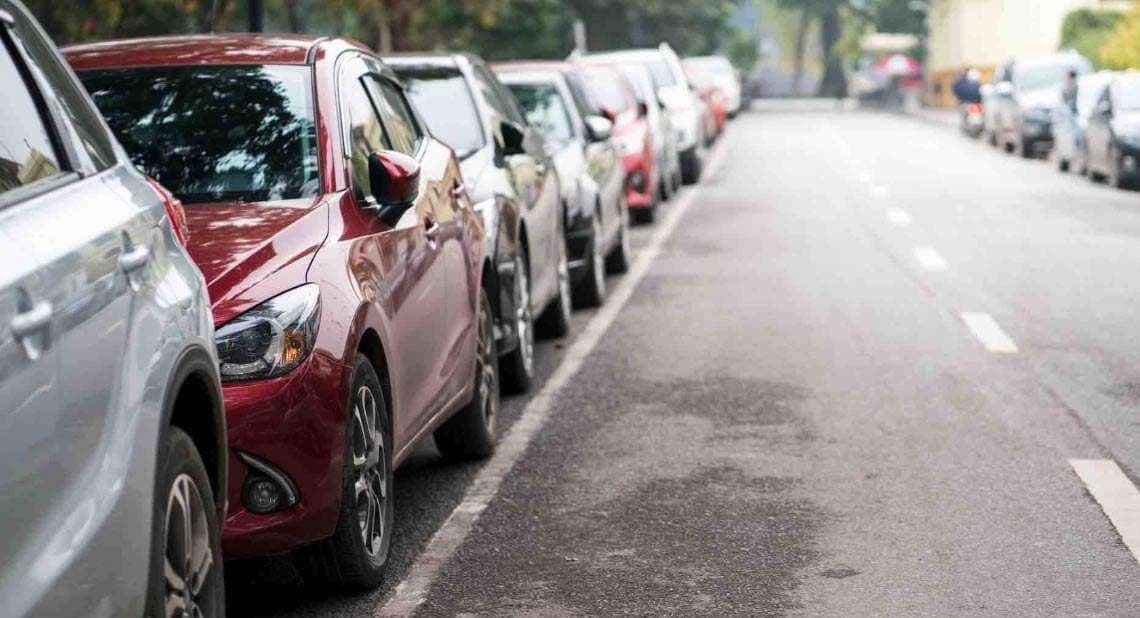
The door zone has always been there, a strip roughly a metre wide running the full length of every row of parked cars in Europe. What has changed is what travels through it. An e-bike keeps assistance up to 25 km/h and a speed pedelec to 45 km/h, and both are ordinary sights on a city street now rather than curiosities, sharing that strip with e-scooters and delivery riders working against a clock. Someone doing 30 km/h covers more than eight metres a second, so a door that opens two metres in front of them leaves nothing at all, not even time to brake. Riders are taught to hold at least a metre clear of parked cars for exactly this reason, but on a narrow European street with a tram line or a bus lane alongside, that metre frequently does not exist and they cannot take it. Where you left the car matters too: parking half up on the kerb to leave room for traffic swings your passenger doors straight out over the pavement instead, which simply moves the problem from cyclists to pedestrians.
Across Europe, the person who opens the door pays
There is no single European rule for this and there does not need to be, because every national code arrives at the same place: opening a door is your responsibility, and endangering somebody with it is an offence. Britain updated its Highway Code on 29 January 2022 so that Rule 239 recommends the far-hand reach by name, and while nobody is fined for skipping the technique itself, opening a door so as to cause injury has long been an offence carrying a fine of up to £1,000. Germany sets out a duty of care when getting in or out of a vehicle, and its penalty schedule prices a careless door at around €40 where another road user is endangered and €50 where there is an actual collision, with the far heavier exposure being a charge of negligent bodily injury if the rider is hurt. Belgium and the Netherlands take the same line and their courts apply it strictly, with the person who opened the door held liable in the overwhelming majority of cases. Two details are worth carrying. That liability follows the person rather than the seat, so a passenger who doors a cyclist answers for it in their own right. And a dooring is a road traffic collision like any other, which means stopping, staying and exchanging details, not driving off because the rider got up.
Nobody ever teaches the passengers
Every driver in Europe sat an exam. Nobody in the back seat sat anything, and rear doors do a disproportionate share of the damage, partly because they open onto the kerb side where the riders and pedestrians actually are, and partly because the people using them are children, guests, taxi passengers and colleagues with no idea which way the traffic runs on that street. A rear passenger also has no useful mirror to check. This is the part of the habit that has to be spoken out loud rather than practised quietly: before anyone gets out on the kerb side, say so, and hold the release for a beat. Rear child locks help less than people assume, because on most cars they only stop the door being opened from the inside, and children old enough to be out of them are precisely the ones who fling a door wide the instant the car stops moving. If you carry passengers regularly, teaching them the far-hand reach does more good than practising it yourself, for the simple reason that you already look and they never do.
Your next car may hold the door for you, and that is not a plan
Exit warning has quietly become common equipment, borrowing the rear side radar already fitted for blind spot monitoring to flash a mirror or a door card when something is closing from behind. The newest implementations go further and briefly hold the latch, so the door will not release into a passing rider at all. Euro NCAP has pulled cyclist dooring into its 2026 assessment protocols, which means the technology is about to spread quickly across the price range. It is a genuinely good development and it is still not the answer. These systems watch a particular set of approach angles and speeds, they behave differently once the ignition is off and the car has gone to sleep, and none of them are fitted to the twelve-year-old hatchback you will borrow, hire on holiday or sell to somebody else. Treat the warning as a second opinion on a check you have already made yourself, which is the right relationship to have with every alert a modern car issues, including the speed limit chime now fitted to every new car in Europe.
What to actually do
This belongs to the same family of small parking habits as leaving your wheels straight when you park: no effort, no cost, and it only pays out on the day something goes wrong. Give it a fortnight and it stops feeling odd.
Take your seatbelt off first, then reach across with the hand furthest from the door. Right hand for a door on your left, left hand for a door on your right.
Let the reach turn you, and use the turn: door mirror first, then over your shoulder at the road itself, because the mirror has a blind spot exactly where a cyclist will be.
Open the door a hand's width and pause for a second before pushing it wide. That gap is a visible signal to anyone approaching, and it costs you nothing.
Say it out loud before passengers get out on the kerb side, every time, including with adults who ought to know better.
Teach children the far-hand reach the way you taught them the seatbelt, as a thing that simply happens rather than a rule to be remembered.
Park close enough to the kerb that your door does not swing into a cycle lane, and where there is a marked lane alongside the parking bay, expect riders to be in it.
When dropping someone off, stop somewhere they can step out onto a pavement rather than into a traffic lane, even if it means going round the block.
If you do hit a rider with a door, stop, stay and exchange details. It is a road traffic collision, and leaving turns a straightforward insurance matter into a criminal one.
Riding rather than driving: hold at least a metre out from parked cars, watch for heads in headrests, wheels turning and brake lights going out, and slow down where you cannot see into the cars.
Do not lean on an exit warning system. Use it as confirmation, not as the check itself.
Frequently asked questions
Is checking my door mirror not enough?
It would be, if you did it every single time, and the honest answer is that nobody does. A mirror check is a conscious decision competing with your phone, your shopping and the meeting you are late for, and it is the first thing to disappear on a familiar street. The far-hand reach removes the decision entirely, because the movement itself puts your eyes where they need to be. There is also a coverage problem: a door mirror is aimed at the traffic lane and has a blind spot close alongside the car, which is exactly where a cyclist filtering past a parked row will be. The reach turns your head far enough to see into it.
It feels clumsy with the seatbelt on. Am I doing it wrong?
You are doing it in the wrong order. Release the belt and let it retract, then reach. With the belt still across your chest the rotation is fought at every centimetre and the whole thing feels like a contortion, which is how most people try it once and give up. Belt off first, reach second, and it becomes one fluid movement that genuinely takes no longer than the way you do it now. In a car with a very wide centre console or a fixed armrest it can stay slightly awkward, in which case the priority is the head turn rather than the hand, so make the shoulder check deliberately and hold it for a full second.
A cyclist hit my door and rode off saying they were fine. Do I need to do anything?
Report it to your insurer, and photograph the door and the position of the car while you are still standing there. Adrenaline is why riders say they are fine, and injuries from being thrown against a door or into the road have a habit of turning up the next morning, along with a claim for a wheel, a frame or a laptop in a rucksack. A notification you file on the day is a straightforward matter for your liability cover. The same claim arriving cold in three weeks, with no record and no photographs, is one you will spend months arguing about. If the rider is visibly hurt or you are unsure, call the emergency number and let it be recorded properly.
Which insurance covers dooring a cyclist?
The compulsory motor liability cover every car in Europe must carry is what pays the injured rider and their bike, because this is damage you have caused to somebody else. Your own door will not be repaired unless you hold comprehensive on top of that. Expect it to be treated as an at-fault claim, with the effect on your bonus-malus or no-claims discount that implies, since the whole point of the rule is that the fault sits with whoever opened the door. Where a passenger opened it, the situation is messier than people assume and can pull in their personal liability cover as well as the car's, which is a conversation for your insurer rather than the roadside.
Is the Dutch Reach actually the law anywhere?
Not as a technique, no. No European country fines you for using the near hand, and Britain's Highway Code recommends the far hand without making it an offence to ignore. What is illegal everywhere is the outcome: endangering or injuring another road user with a door you opened. The law does not care which hand you used, only what happened next, which is a useful way to think about it. The reach is not a rule to comply with, it is simply the most reliable method anyone has found of not ending up on the wrong side of the rule that does exist.