Audi Tradition recreates the Auto Union Lucca: the Silver Arrow that chased 326 km/h on public roads
This machine feels like a reminder of how extreme the past already was.
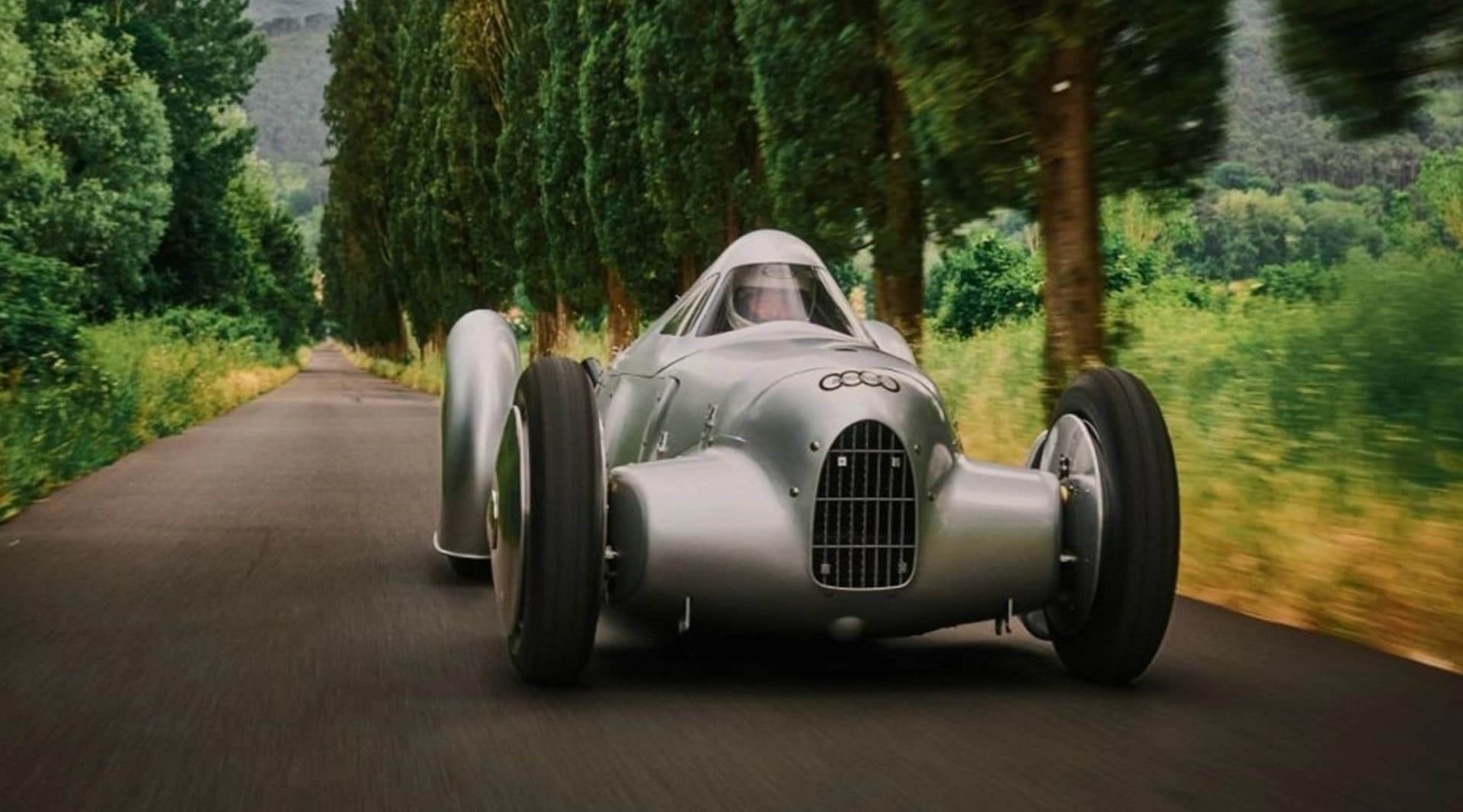
Audi Tradition has recreated the Auto Union Lucca, a spectacular 1930s record car from the Silver Arrow era that once reached 326.975 km/h on a closed public-road section near Lucca in Italy. The original car disappeared into history, but its story has now been brought back to life through a three-year reconstruction project completed in early 2026.
The fastest road racing car in the world
On 15 February 1935, Hans Stuck drove the streamlined Auto Union record car on a straight section of autostrada near Lucca.
Over two averaged flying-start mile runs, the car achieved 320.267 km/h, while timing equipment recorded a top speed of 326.975 km/h during one of the runs. At the time, this made the car what Auto Union proudly described as the fastest road racing car in the world.
To put that into perspective, this was 1935.
No carbon brakes.
No stability control.
No modern tyres.
No second chances.
Just a narrow strip of road, a brave driver, a 16-cylinder engine and an aerodynamic body shaped by the most advanced thinking of its time.
A Silver Arrow built through pressure
The Auto Union Lucca was born in the middle of one of motorsport’s most intense engineering rivalries.
In the 1930s, speed records were not side stories. They were national, technical and commercial statements. Auto Union and Mercedes-Benz were locked in a battle for prestige, with drivers such as Hans Stuck, Bernd Rosemeyer and Rudolf Caracciola becoming icons of pure speed.
After Mercedes raised the bar in late 1934, Auto Union’s engineers responded quickly. Using knowledge from wind tunnel work at the Berlin-Adlershof Aeronautical Research Institute, they developed a closed-cockpit aerodynamic body for their record car, a radical step in European racing car design at the time.
The result was called a Rennlimousine, literally a racing sedan, although that term hardly captures how dramatic it looked. Its long tail, closed canopy, teardrop wheel arches and smooth silver bodywork made it look more like a machine from science fiction than a conventional racing car.
The recreated Lucca
Audi Tradition commissioned British specialists Crosthwaite & Gardiner to recreate the car using historical photos, archive material and period documentation. After more than three years of work, the one-off reconstruction was completed in early 2026.
The recreated Auto Union Lucca is powered by a 6.0-litre supercharged 16-cylinder engine from the Auto Union Type C, producing 520 PS at 4,500 rpm. Audi chose this engine because it is visually interchangeable with the original five-litre unit, while also improving durability for modern demonstration runs.
The car weighs 960 kg, is finished in cellulose silver and was measured in Audi’s wind tunnel with a drag coefficient of 0.43.
That number might not sound revolutionary by modern production-car standards, but for a recreated 1930s racing machine with this level of authenticity, it is an extraordinary reminder of how advanced Auto Union already was.
From Lucca to Goodwood
After its unveiling in Lucca, the recreated car will make its first public dynamic appearance at the Goodwood Festival of Speed in July.
Goodwood is one of the few modern events where cars like this can still be seen, heard and understood in motion, even if only at a safe distance from the kind of record attempt it was originally built for.
There was a time when cars like the Auto Union Lucca chased speed on public roads with almost no protection, no safety margins and no room for mistakes. Today, we recreate that era carefully, respectfully and with far more control.
AutoNext Take
This car was created for one reason: to go faster than anything else on the road. That purity is almost impossible to find today.
The recreated Lucca is also a strong move for Audi because it shows that the brand’s performance history did not begin with quattro or the R8. It goes much deeper, into an era where aerodynamics, lightweight construction and high-performance engines were already defining the future.
Of course, this is not a car that will chase records again. It will live in demonstrations, collections and heritage events. But maybe that is enough. Because sometimes a car does not need to prove anything anymore.