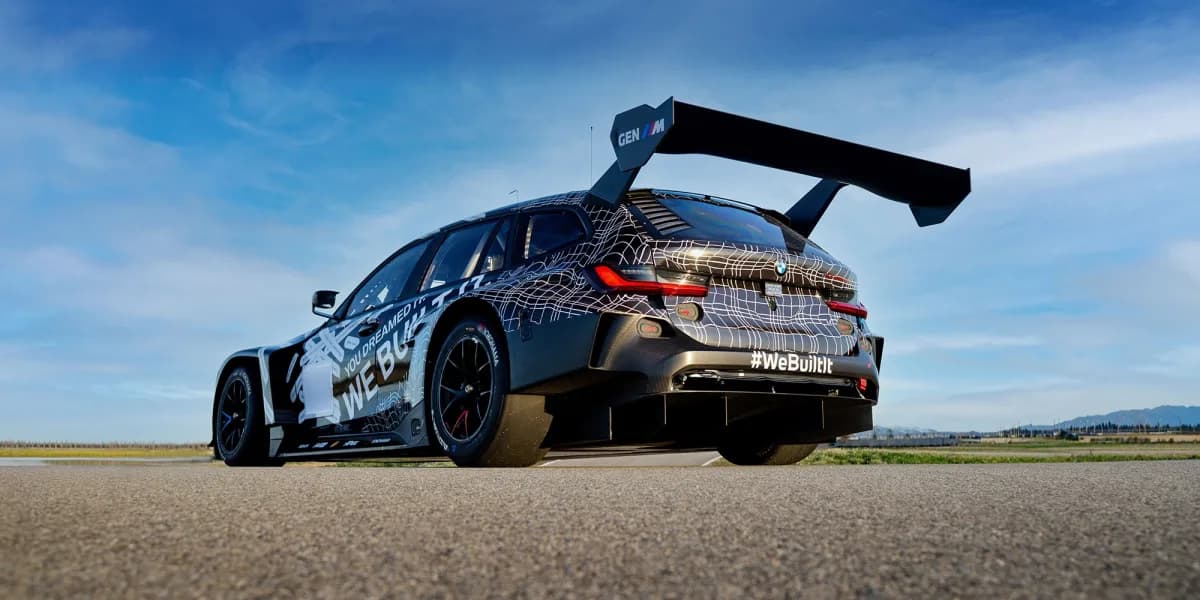
BMW Turns April Fools Joke Into Reality: M3 Touring 24H to race as a GT3 on the Nurburgring
From joke to race project
Sometimes a race car starts with a serious engineering program. Sometimes it starts with a joke. The BMW M3 Touring 24H clearly belongs in the second category. The response from fans was unexpectedly massive: more than a million people saw the post and engagement was far higher than what BMW M Motorsport usually sees on its social channels.
What started as a joke suddenly became a serious project. In the summer of 2025 BMW gave the green light to development, and only eight months later a real race car was ready: the BMW M3 Touring 24H, built with one clear goal: Competing in the 2026 Nürburgring 24 Hours.
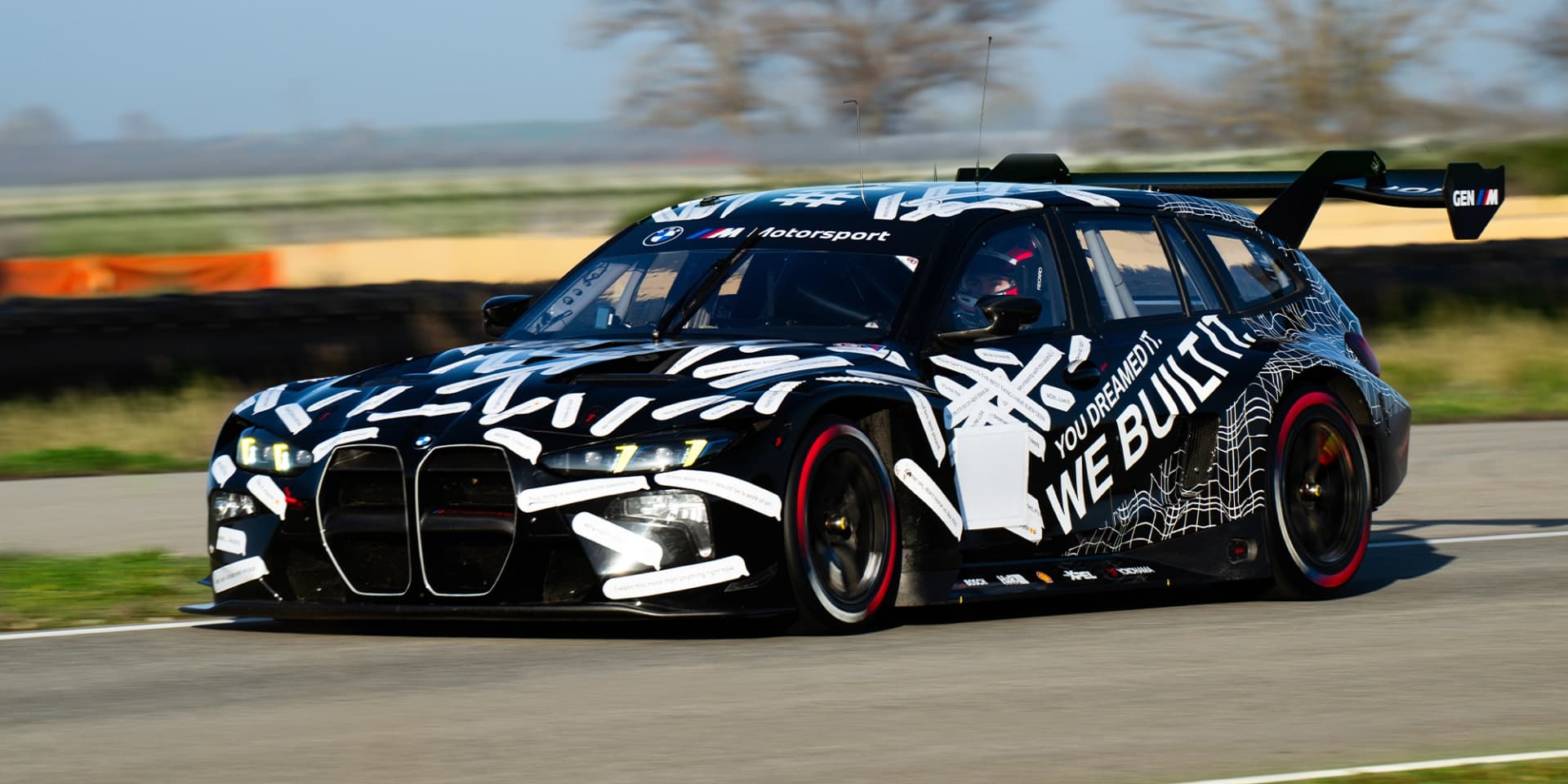
A Touring turned into a GT3 race car
Technically speaking, the M3 Touring 24H is not an entirely new platform. BMW took a clever approach: the car uses the same technical foundation as the BMW M4 GT3 EVO, but with the body shell of the M3 Touring. This means that beneath the station wagon body sits a proper GT3 racing machine.
Key specifications include:
Engine: 3.0-liter inline-six P58 M TwinPower Turbo
Power: up to 590 hp
Torque: up to 700 Nm
Gearbox: X-Trac 6-speed racing transmission
Brakes: 390 mm discs with 6-piston calipers at the front
Specific output: 197 hp per liter
Performance is therefore almost identical to the M4 GT3 EVO. The main difference lies in the body shape.
Why a station wagon is actually an aerodynamic challenge
Designing a race car around a station wagon body style creates several unexpected aerodynamic challenges. The long Touring roofline introduces three major issues:
1. Increased drag
The longer and higher roofline generates additional turbulence. This increases drag and can reduce both top speed and aerodynamic efficiency in high-speed corners. On a track like the Nürburgring, with its long straights, that is a serious disadvantage.
2. Reduced rear wing efficiency
Because of the body shape, the rear wing sits closer to the roof and rear window. As a result, the wing receives less clean airflow and produces less downforce.
3. A disturbed aerodynamic balance
With less downforce at the rear, the aerodynamic balance shifts too far towards the front. That can result in:
a less stable rear end
oversteer at high speeds
reduced driver confidence
Clever aerodynamic solutions
BMW M Motorsport therefore had to get creative to make the Touring shape work at race level. The key solution involved repositioning the rear wing. Engineers used the wing from the M4 GT3 EVO but mounted it on a newly developed swan-neck mounting structure.
This allowed the wing to be positioned:
200 mm further rearward
32 mm higher
These numbers may sound small, but aerodynamically they are extremely important. By increasing the distance from the roof, the wing receives cleaner airflow, improving its efficiency and generating more downforce. Additional aerodynamic work included:
improved airflow towards the rear wing
elimination of lift at the rear edge of the roof
a new combined design of spoiler and wing
The goal was to restore an aerodynamic balance comparable to the BMW M4 GT3 EVO.
A body that is almost entirely new
Although the base remains an M3 Touring, a large portion of the bodywork had to be completely redesigned. Most exterior panels are made from CFRP (carbon fiber reinforced plastic), the same material used in GT3 race cars.
Carbon fiber offers three major advantages:
extremely lightweight
very strong
easy to replace during races
Many parts were also designed according to the same mounting and replacement concept used in the BMW M4 GT3 EVO, allowing teams to quickly swap damaged components during endurance races.
Newly developed body components
A large portion of the exterior was redesigned, including:
body shell
front and rear doors
roof
rear side panels
tailgate
rear bumper
all windows
An interesting detail: the rear doors are no longer functional doors, but simply trim panels. This reduces weight and increases the structural rigidity of the chassis.
Built in record time
Another remarkable aspect of the project is the development speed. From the moment the production body shell was modified until the final rollout, the entire process took only 16 weeks.
This was possible because BMW reused technology from:
the BMW M4 GT3 EVO
the BMW M Hybrid V8 hypercar
The same internal development environment and simulation tools used for those race programs were also applied to the M3 Touring 24H.
The race: Nürburgring 24 Hours
The goal of the project is clear: competing in the 2026 Nürburgring 24 Hours. The car will run in the SP-X class, a category intended for experimental or special vehicles.
BMW will enter the car as a full factory effort, with Schubert Motorsport operating the program. The team has extensive experience at the Nordschleife and previously won the DTM team championship in 2022 and 2024.
The four BMW M works drivers are:
Connor De Phillippi
Ugo De Wilde
Jens Klingmann
Neil Verhagen
A race car built for the fans
On the side of the car you’ll find a clear slogan: “You dreamed it. We built it.”
It is not just a marketing phrase, but a direct reference to the fan reactions following the original April Fool’s post. BMW decided to build the project largely because fans asked for it. Even the design reflects the campaign, with the hashtag #WeBuiltIt prominently displayed on the roof.
AutoNext Take
The BMW M3 Touring 24H is one of the most unusual race projects in recent years. Not because it is the fastest car on the grid. But because it combines:
fan enthusiasm
clever engineering
and a healthy dose of humor
A station wagon transformed into a Nürburgring endurance racer is not something you see every day. But if BMW M Motorsport has proven anything with this project, it’s this: even an April Fool’s joke can eventually turn into a real race car.