BYD Formula X, if the Denza Z was a warning shot, this is the full assault
Impressive ambition, but still searching for identity...
Just when you thought BYD had made its point with the Denza Z, it doubled down. Because on that same stage in Beijing, under the more radical Fangchengbao banner, something even more extreme quietly stole the spotlight: the Formula X.
A fully electric, roofless, carbon-bodied concept that doesn’t just flirt with supercar territory, it dives headfirst into hypercar theatrics. And unlike the Denza Z, which still carries a certain level of production realism, the Formula X doesn’t even pretend to be sensible.
A concept, yes. But not an irrelevant one
It would be easy to dismiss the Formula X as “just another concept car,” a design exercise meant to generate headlines and little more. That would be shortsighted.
Because even without confirmed specs, pricing or final production intent, the Formula X reveals something far more important: how aggressively BYD is pushing its performance identity across multiple brands at once.
Where Denza positions itself as premium and globally viable, Fangchengbao clearly takes on the role of the disruptor, the brand that can go further, louder, and more experimental without restraint.
Design: when subtlety is no longer the goal
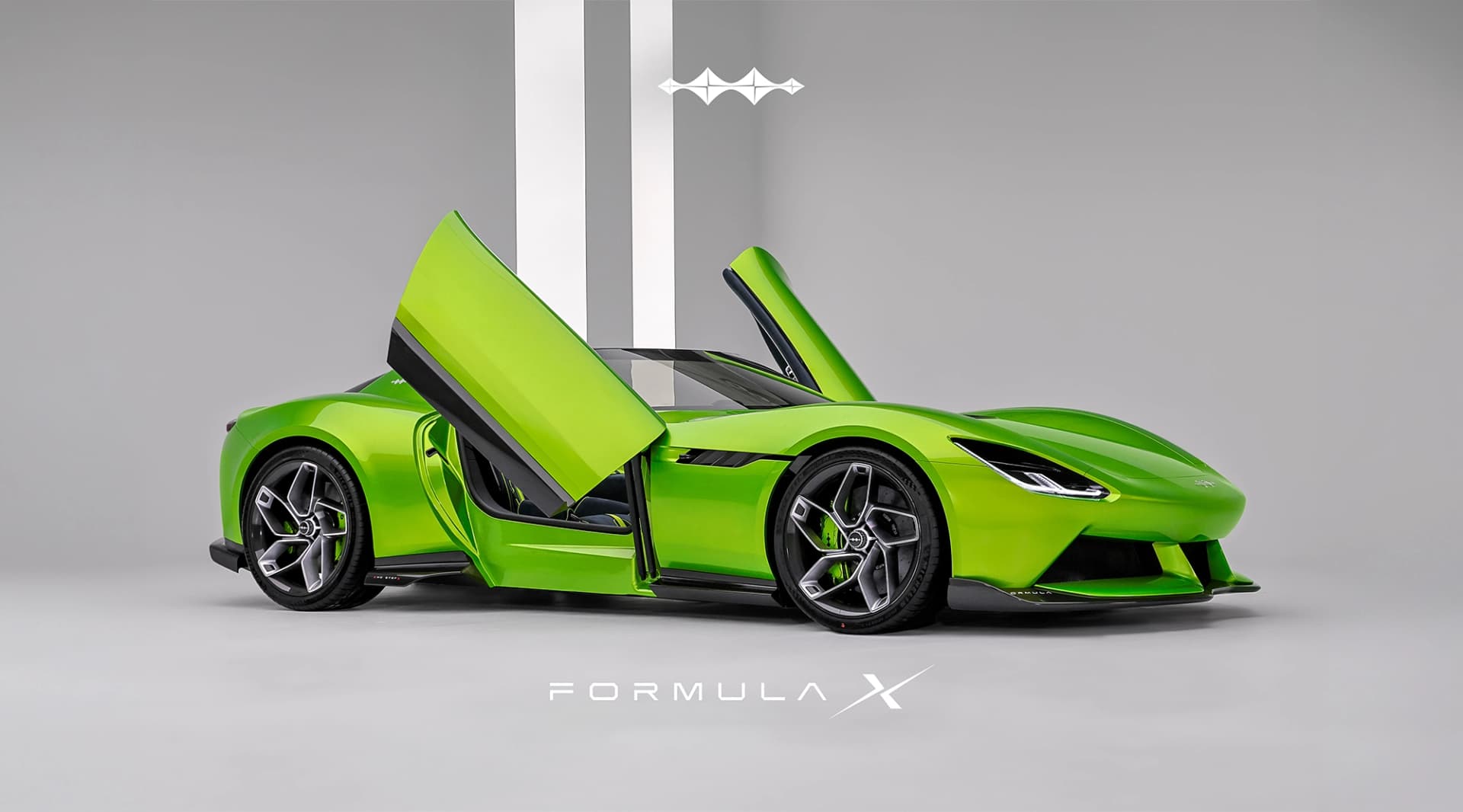
Visually, the Formula X abandons any notion of restraint. Built around Fangchengbao’s “Life Metal” philosophy, the car sits impossibly low, with proportions described as a “hunting leopard stance” a phrase that sounds like marketing, but actually reflects what you see: tension, aggression and forward motion in every surface.
Nineteen air vents, a sculpted aerodynamic package, active rear aero and dramatic lighting signatures all point in one direction. Performance, at any cost. Then there are the doors (a theatrical combination of gullwing and scissor mechanisms) because at this level, drama is part of the product.
And perhaps most telling of all: a full carbon fibre body, not just for weight reduction, but as a signal. This is not a concept built to impress. It’s built to provoke.
Interior: the “battle cockpit” says everything
Step inside, and the message becomes even clearer. Fangchengbao calls it a “battle cockpit”, and while that might sound exaggerated, the execution backs it up: a driver-focused layout, integrated racing seats, a four-point harness, physical controls, and a retractable steering wheel.
No oversized screens dominating the experience. No attempt to soften the edges. Just a clear focus on driving, or at least the idea of it. In a market increasingly dominated by digital interfaces and comfort-driven EVs, this feels like a deliberate counter-move.
Context: BYD is building a multi-layered empire
If the Denza Z was already a bold move into Europe’s premium performance space, the Formula X shows that BYD is not relying on a single strategy. Instead, it’s building a stacked ecosystem:
BYD for scale and global dominance
Denza for premium positioning and European expansion
Yangwang for extreme performance and halo hypercars
Fangchengbao for experimental, aggressive, boundary-pushing concepts
We’ve seen legacy groups attempt this before. Few have executed it this fast. And even fewer with this level of clarity between brands.
The bigger shift: Europe is being challenged on emotion, not just tech
For years, the narrative around Chinese cars focused on price, efficiency and technology. That narrative is outdated. With cars like the Denza Z and now the Formula X, China is entering the one territory Europe has always dominated: Emotion.
And while the Formula X may never reach production exactly as it stands, it doesn’t need to. Because its role is already clear. It pushes the boundary of what people think Chinese performance cars can be.
AutoNext Take
Let’s be honest. The Formula X is visually striking, conceptually bold, and strategically important. But it also raises the same question we asked with the Denza Z: Where does this ultimately lead?
Because while BYD is clearly building the hardware (and doing it at an incredible pace) the challenge now shifts to something far more difficult:
Consistency
Brand identity
Long-term desirability
Cultural relevance.
European performance brands are not defined by one model. They are defined by decades of storytelling. And that’s the gap China still needs to close. So yes, the Formula X is impressive. Yes, it shows how far things have come. But until that ambition translates into a coherent, long-term brand story, it remains exactly what it is: A powerful signal. Not yet a legacy.