Citroën Saxo VTS turns 30: the small French hot hatch that never thought small
A great driver’s car does not need to be big. It just needs to feel alive.
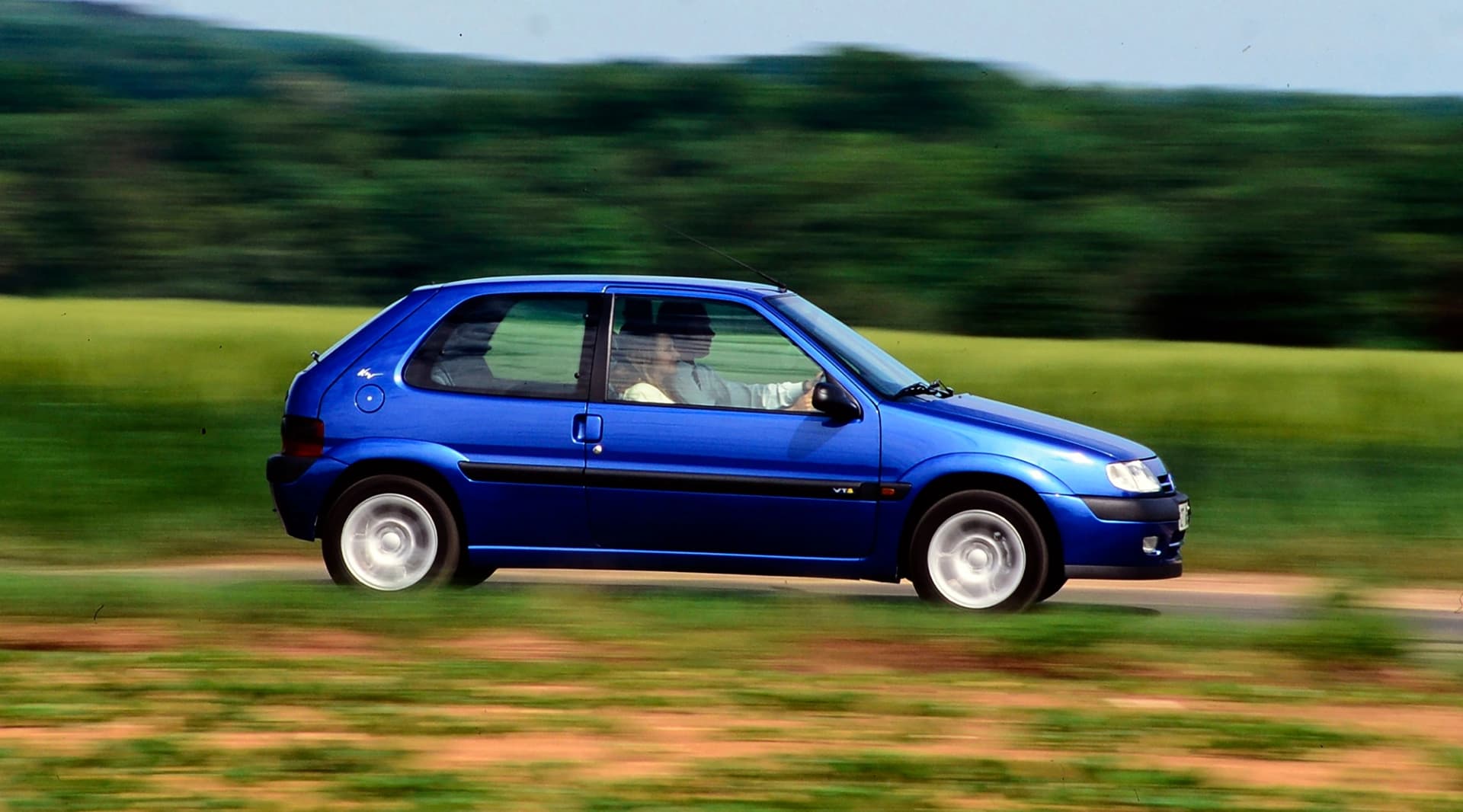
Launched in 1996 and produced until 2003 at Citroën’s Aulnay-sous-Bois factory, the Saxo VTS was never about luxury, status or excessive power. It was about lightness, balance and pure driving fun, wrapped in a compact French hatchback that proved you did not need hundreds of horsepower to create something genuinely memorable. Thirty years later, Citroën is celebrating the anniversary of a car that still represents one of the greatest formulas in affordable performance
From AX Sport to Saxo VTS
To understand the Saxo VTS, you need to look at what came before it. The Citroën AX had already shown that the brand knew how to build a lightweight, playful and surprisingly quick small car. Models such as the AX Sport and AX GTi built a strong reputation among enthusiasts thanks to their low weight and lively handling, proving that Citroën could do far more than comfortable family cars and clever suspension systems.
When the Saxo arrived in 1996 as Citroën’s new entry-level model, it had to carry that spirit forward. The first sporty step came with the Saxo VTR, powered by a 1.6-litre 8-valve engine producing 90 hp. But the real successor to the AX GTi arrived later that year with the Saxo VTS 16v, fitted with the 1.6-litre TU5J4 engine producing 120 hp. On paper, that may not sound extreme today. In reality, it was exactly the right amount. Because the Saxo VTS weighed just 935 kg.
The magic of 120 hp and 935 kg
The best hot hatches are rarely about raw numbers, and the Saxo VTS is the perfect example. With 120 hp at 6,600 rpm, a redline of 7,300 rpm, a short-ratio 5-speed manual gearbox and a top speed of 205 km/h, the VTS offered real performance in a package that remained affordable and usable. But the reason people still talk about it today is not just the engine.
It was the chassis. The Saxo VTS had the kind of front-end precision and rear-end playfulness that made it feel alive at normal road speeds. It was light, responsive and honest, with steering that made you trust the car almost immediately. On a twisty road, it could embarrass much more powerful machinery simply because it carried speed so naturally.
A design that stayed relatively discreet
Part of the charm of the Saxo VTS was that it did not try too hard. The styling was sporty, but never ridiculous. The widened arches, specific bumpers, side skirts, alloy wheels, chrome exhaust tip and subtle 16V badging gave it the right amount of presence without turning it into a caricature.
Interestingly, the sporty body kit was one of the first assignments of Gilles Vidal at Citroën, long before he became one of the most influential French automotive designers of his generation. The result was simple but effective: a small hatchback with just enough muscle to signal intent.
In 1999, the Saxo received a facelift with almond-shaped headlights, a domed bonnet and larger chevrons in the grille, modernising the car without erasing its character.
A true training ground for drivers
The Saxo VTS was not only a road car. It became one of the most important grassroots competition cars of its generation. Citroën Sport built an entire ecosystem around it, with the Saxo Cup, Saxo Challenge, Saxo Rallycross and Saxo Glace giving amateur and semi-professional drivers a relatively accessible entry point into motorsport. The fact that many series used the production engine only reinforced what enthusiasts already knew: the chassis was the real weapon.
Names such as Patrick Henry, Yoann Bonato, Marc Amourette and Pierre Llorach developed their skills through Saxo competition, while Sébastien Loeb and Daniel Elena became Junior WRC World Champions in 2001 with the Saxo Super 1600. That tells you everything about the car’s importance. The Saxo VTS was not just fun. It was formative.
AutoNext Take
We love cars like this because they remind us that performance does not need to be complicated.
The Citroën Saxo VTS was never the fastest car in the world, but it understood something that many modern performance cars have forgotten: lightness, balance and feedback can create more joy than power alone ever will. That is why this anniversary matters.
Not because the Saxo VTS was perfect, and not because nostalgia should make us blind, but because it represents a type of car that has almost disappeared from the market. Affordable, lightweight, mechanical hot hatches used to be the gateway drug into car culture. Today, that gateway is becoming narrower, more expensive and often less emotional.