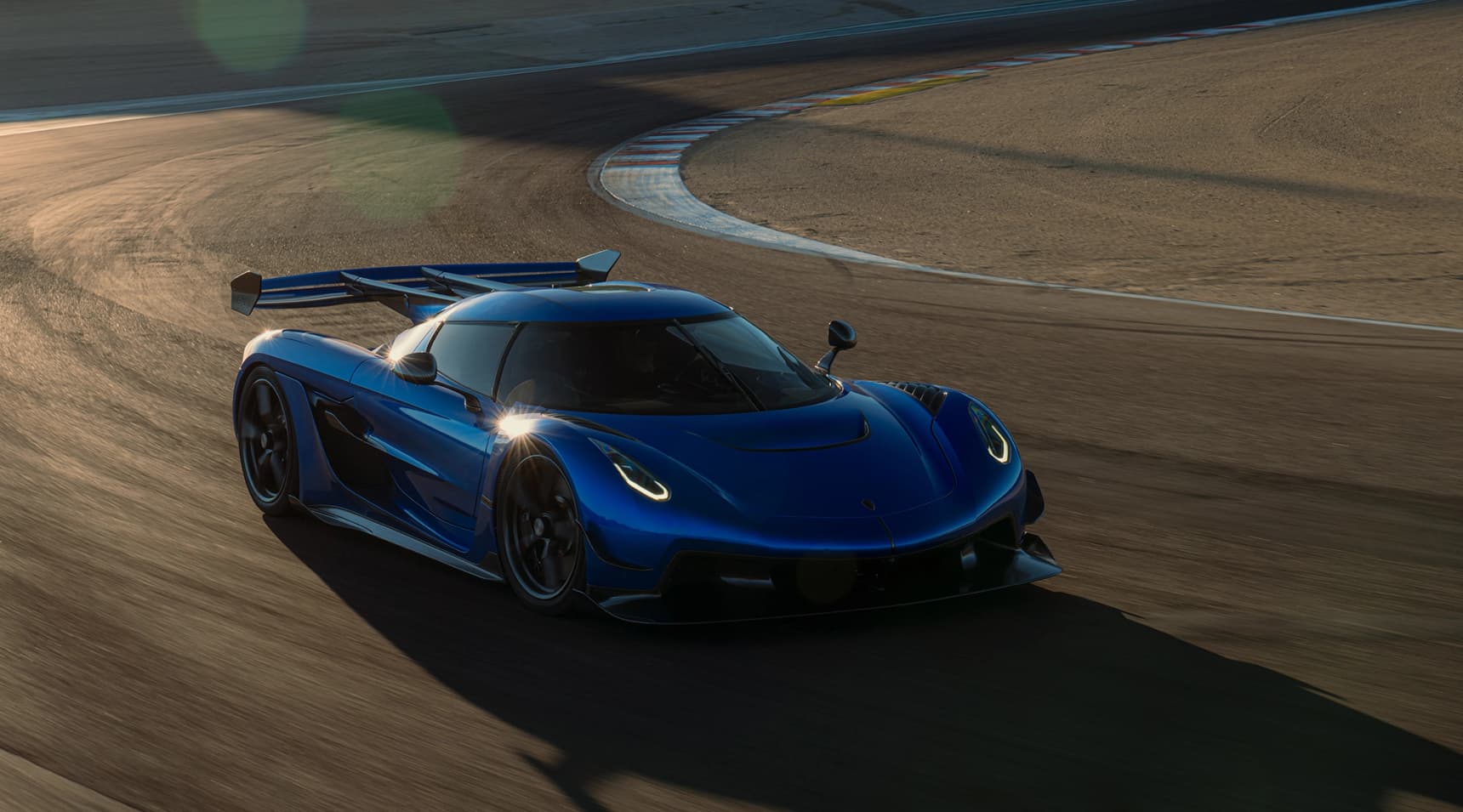
Eight engineering ideas Koenigsegg invented that the car world still cannot match
A company with fewer than 300 people, from a small Swedish town, quietly changed how cars are built
Koenigsegg has never produced more than a few dozen cars in a single year. Its factory in Angelholm employs fewer than 300 people. And yet, over the past three decades, it has developed a list of engineering firsts that manufacturers with far greater resources have either taken years to replicate or still cannot match at all. This is not a company that builds impressive cars. It is a company that builds things that did not exist before.
Engine with no camshaft
The Freevalve TFG engine deletes the camshaft entirely. Each valve is controlled by its own pneumatic actuator, allowing the engine management system to open and close valves independently for every cylinder, at any point in the rev range. The result is a 2.0-litre three-cylinder unit producing 600 hp (447 kW) from an engine weighing just 70 kg. No other production engine operates this way.
A gearbox that can skip every gear
The Jesko Light Speed Transmission is a 9-speed unit designed to shift between any two gears in 20 to 30 milliseconds. That includes non-sequential jumps: from 9th directly to 2nd, for example. A conventional dual-clutch transmission can only shift to an adjacent gear in sequence. No other production transmission can replicate this behaviour.
No traditional gearbox at all
The Regera has no conventional transmission. It uses a single fixed gear ratio of 2.73:1, a hydraulic coupling, and three electric motors to deliver 1,500 hp (1,119 kW) directly to the wheels. By eliminating the traditional gearbox, Koenigsegg cut drivetrain losses in half. The system is called Regera Direct Drive, and nothing like it exists in another production car.
Wheels with exactly one metal part
In 2012, Koenigsegg introduced the Aircore wheel: the world's first hollow one-piece carbon fibre wheel for a production car. Each wheel weighs 6 kg. The only metal component is the tyre valve. Across all four corners, Aircore saves 20 kg compared with conventional forged wheels, reducing unsprung mass and rotational inertia simultaneously.
Doors that rotate outward and upward at the same time
Koenigsegg invented the Dihedral Synchro-Helix door mechanism in 1994. When the door opens, it rotates 90 degrees outward and upward simultaneously, following a helical path that requires no additional clearance above or beside the car. Thirty-two years later, no other carmaker has built a door system that works the same way.
800V before anyone else
The Regera launched in 2015 with an 800-volt battery architecture. At the time, no other production car ran on 800V. Tesla, Porsche with the Taycan, and Hyundai with the Ioniq 5 all adopted the architecture years later, positioning it as a major technological leap. Koenigsegg had already done it, quietly, in a 1,500 hp (1,119 kW) hybrid hypercar.
The lightest V8 crankshaft ever put in a production car
The Jesko's twin-turbocharged V8 uses a flat-plane crankshaft weighing 12.5 kg, 5 kg lighter than the crankshaft in the Agera. That reduction raised the engine's redline to 8,500 rpm. It remains the lightest V8 crankshaft ever fitted to a production car.
Slipperier than most saloons, faster than anything else
The Jesko Absolut has a drag coefficient of 0.278, lower than most family saloons, achieved after 3,000 hours of aerodynamic analysis. The result is a theoretical top speed of 532 km/h (330 mph) on E85 fuel. No production car has a higher calculated top speed.
AutoNext Take
What makes this list remarkable is not the number of innovations but the spread of them. Koenigsegg has not found one clever idea and exploited it across a product range. It has reinvented the engine, the gearbox, the drivetrain, the wheel, the door, the battery, and the body, often at the same time. The companies that followed, Porsche, Tesla, Hyundai, had engineering departments many times larger and still needed years to catch up on a single item from this list.
Christian von Koenigsegg is often described as a visionary. That framing undersells what is actually happening in Angelholm. This is not vision. This is engineering at a level that the rest of the industry has spent thirty years trying to understand.
