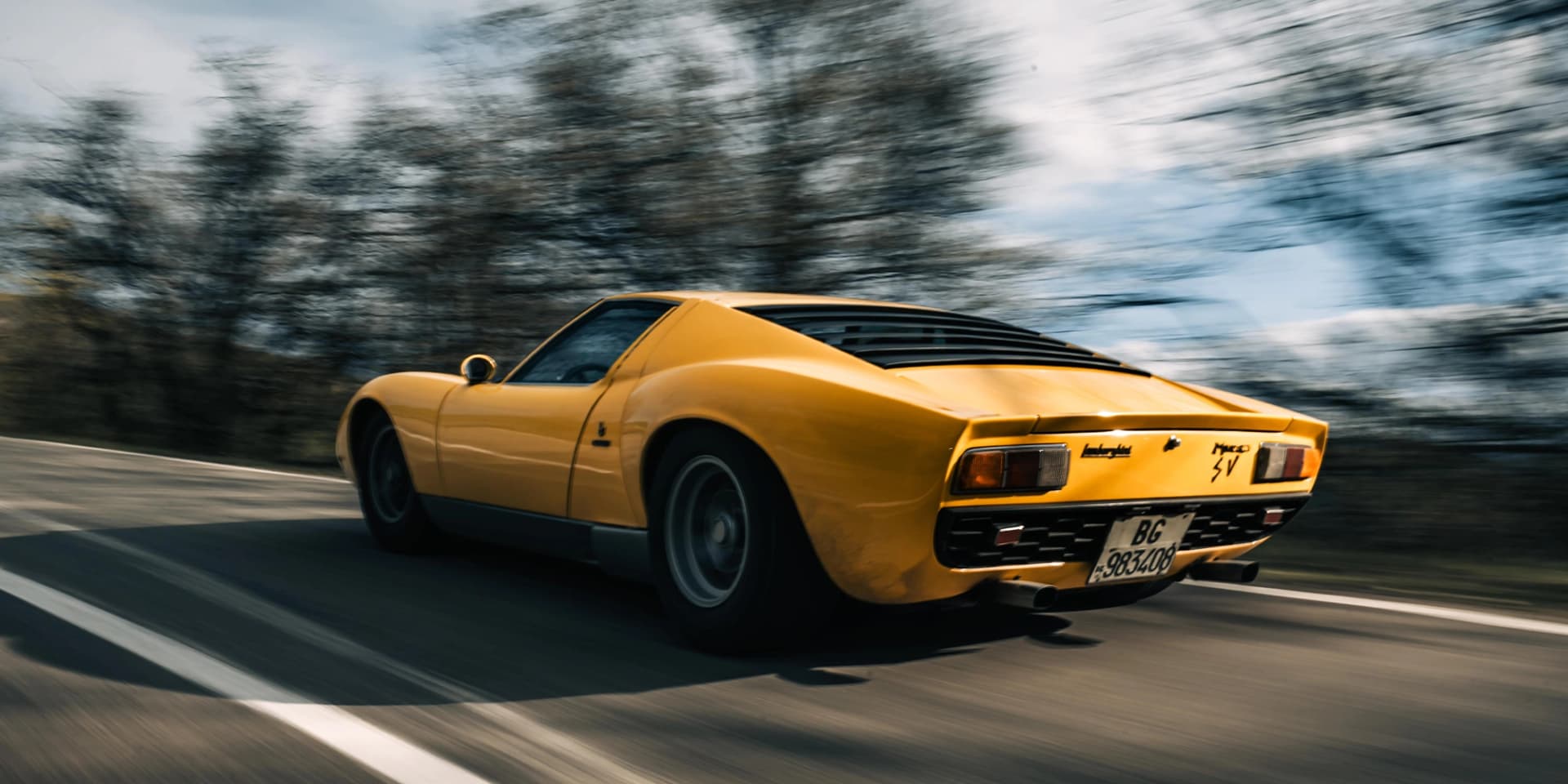
Lamborghini Miura turns 60: the car that invented the supercar
Some cars become icons. A very small number change the direction of the entire automotive industry.
In 2026, Lamborghini celebrates 60 years of the Miura, the car widely regarded as the first true supercar in history. When it made its debut at the Geneva Motor Show on March 10, 1966, the Miura was not just another fast Italian GT. It introduced a completely new idea of what a high-performance road car could be.

The Miura was the moment Lamborghini became Lamborghini
When the Miura arrived, Lamborghini was still a young company. Founded only three years earlier, it had already shown ambition with the Lamborghini 350 GT, but the Miura was something else entirely. This was the car that established the values that would shape the brand for decades:
boldness over convention
engineering without compromise
beauty driven by performance
the courage to do what rivals would not
It was developed by a young team including Gian Paolo Dallara, Paolo Stanzani, and test driver Bob Wallace, who pursued an idea inspired more by racing prototypes than traditional road-going GTs. Ferruccio Lamborghini immediately understood the potential and approved further development. That decision changed automotive history.
A radical layout that rewrote the rulebook
What made the Miura so revolutionary was not only its styling, but its architecture. At its heart was a 3.9-liter V12, mounted transversely behind the driver. That layout fundamentally changed the weight distribution and created a driving experience that was unlike anything else available in the mid-1960s. Today that sounds normal for an exotic supercar. In 1966, it was radical.
The Miura’s V12, originally connected to the engineering work of Giotto Bizzarrini and refined for road use by Paolo Stanzani, became the heart and soul of the car. Depending on the version, output ranged from 350 hp in the original P400 to 385 hp in the later P400 SV, with top speed eventually exceeding 290 km/h. For the period, those numbers were extraordinary. The Miura was effectively the fastest production car in the world.
Just as important was the sound. Lamborghini’s V12 did not just deliver speed. It delivered theatre, character and emotion. That remains a core part of Lamborghini’s identity even now, from the Countach to the Aventador and into the hybrid era of the Lamborghini Revuelto.
Bertone and Gandini gave it one of the greatest designs ever made
If the engineering made the Miura revolutionary, the design made it immortal. The body, created by Marcello Gandini at Bertone, remains one of the most celebrated shapes in automotive history. Low, impossibly wide for its time, and only around 105 cm tall, the Miura looked more like a concept car than something ready for the road.
Its signature elements are still unforgettable:
the dramatic low silhouette
the famous pop-up headlights with “eyelashes”
the side air intakes behind the doors
the compact proportions enabled by the engine layout
Even today, the Miura still looks shockingly fresh. That is the hallmark of truly great design. It does not age; it simply becomes more important.
Lamborghini also understood early that exclusivity meant individuality. The Miura was offered in a surprisingly broad and expressive color palette, anticipating the personalization culture that has now become central to modern exotic brands.
More than a fast car: a cultural object
The Miura’s impact extended far beyond the road. It appeared in films, on magazine covers, and in pop culture at a time when the automobile was becoming a global symbol of status, freedom and design. Its role in The Italian Job helped cement its legend, but the Miura’s cultural relevance was already much bigger than cinema.
It helped create the modern fantasy of the supercar: low, dramatic, emotionally excessive, technically daring and visually unforgettable.
That is why the Miura remains so important. It was not merely a successful Lamborghini. It defined the genre that would later include icons such as the Lamborghini Countach, Ferrari F40, McLaren F1, and countless others.

The evolution: P400, P400 S and P400 SV
The Miura evolved significantly during its production run from 1966 to 1973, with 763 units built according to Lamborghini’s official figures.
The original P400 was the purest interpretation. It was lighter, simpler and already astonishingly quick. The later P400 S introduced more refinement, more comfort and extra power, making the Miura easier to live with without losing its edge.
The final P400 SV is the version many collectors consider the most complete. With 385 hp, a wider rear axle, improved drivability and a separate lubrication system for the engine and transmission, it represented the Miura at its most mature and most capable.
There were also special cases and one-offs, including the 1968 Miura Roadster, one of the most fascinating open-top experiments in Lamborghini history.
AutoNext Take
Calling the Miura the first supercar is not just good marketing. It is historically accurate. Before the Miura, there were fast GTs, exotic coachbuilt machines and racing-influenced road cars. But the Miura brought together mid-engine architecture, dramatic design, V12 power, limited production, and pure emotional excess in a way that established the formula every later supercar would follow.
The Miura reminds us where the emotional center of the supercar world began. It was bold. It was irrational. It was technically brave. And sixty years later, it still feels like a car from the future. That may be the clearest sign of its greatness.