Mercedes-Benz introduces Steer-by-Wire in the EQS. The future of steering?
A technological milestone that could redefine the relationship between driver and machine.
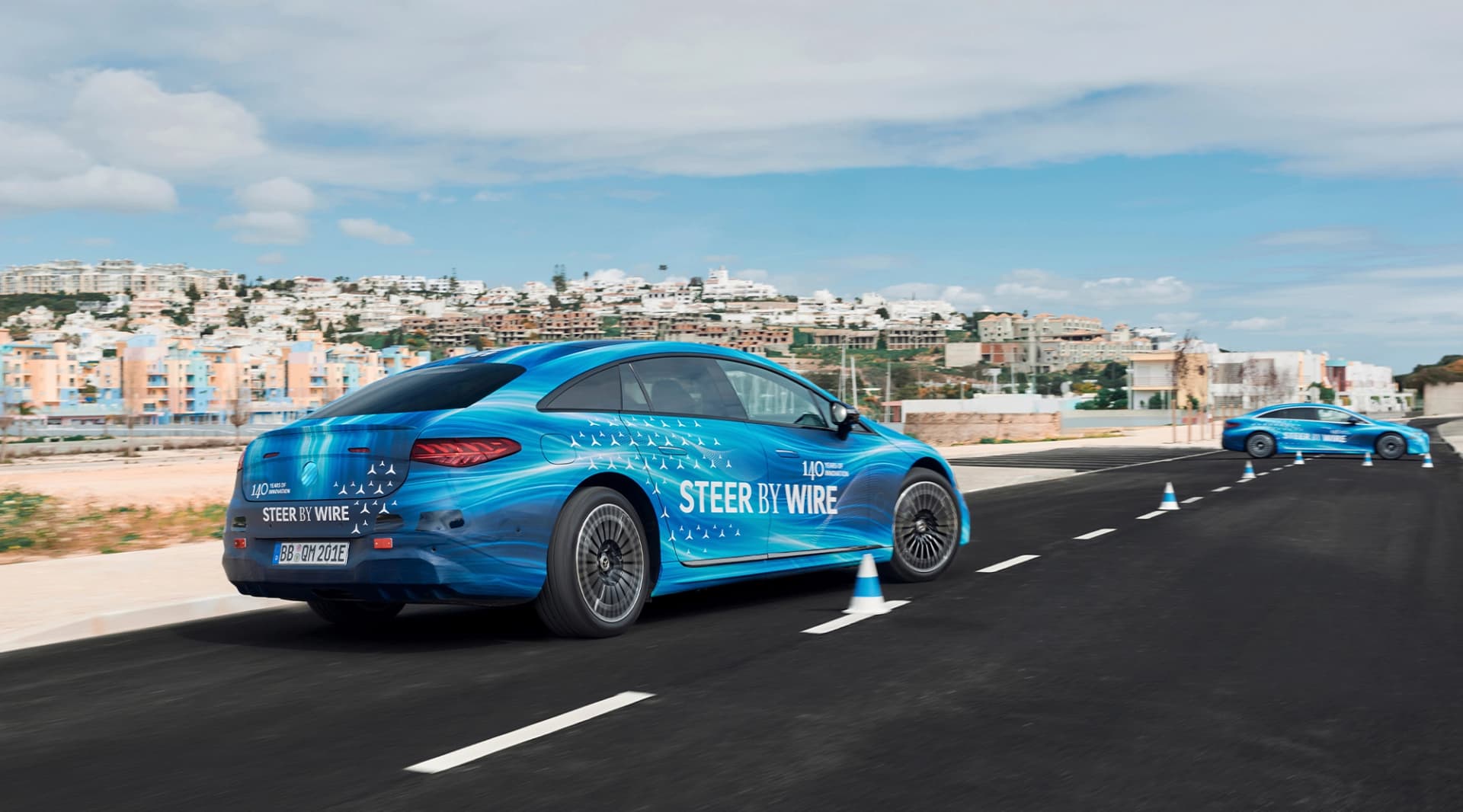
For more than a century, one mechanical connection has defined how drivers interact with their cars. Turn the steering wheel, and the front wheels respond. But that fundamental principle is about to change. With the latest generation of the Mercedes-Benz EQS, Mercedes-Benz is introducing steer-by-wire technology, eliminating the traditional mechanical connection between the steering wheel and the front axle.

What exactly is steer-by-wire?
In a conventional steering system, the steering wheel is mechanically connected to the front wheels through a steering column and rack. With steer-by-wire, that mechanical link disappears.
Instead, steering inputs are translated electronically via sensors and control units, which then command the wheels through actuators. This allows engineers to fully control steering characteristics through software. The result, according to Mercedes-Benz, is a steering experience that feels more precise, more intuitive and almost effortless.
Because the steering ratio can be adjusted dynamically, the car can respond differently depending on the situation. At low speeds, steering becomes extremely direct, making manoeuvring and parking easier. At higher speeds, the system becomes more stable and composed, improving overall driving confidence.
A new kind of driving experience
Removing the mechanical link between steering wheel and wheels brings several additional benefits. Road vibrations and impacts that would normally travel through the steering column can now be filtered out entirely. That means uneven surfaces no longer translate into unwanted steering feedback.
The system also works in close coordination with the EQS’s 10-degree rear-axle steering, allowing the vehicle to combine agility in tight urban spaces with stability at highway speeds. According to Mercedes-Benz engineers, this combination helps reconcile two driving characteristics that often conflict: comfort and sportiness.
A redesigned steering wheel and interior
Steer-by-wire doesn’t just change how the car drives. It also changes how the cabin looks and feels. Because the steering column is no longer required in the traditional sense, the EQS can feature a flatter and more compact steering wheel design. This creates a more open feeling in the cockpit and improves visibility of the driver display.
Getting in and out of the vehicle also becomes easier, reinforcing what Mercedes-Benz calls its signature “Welcome home” interior philosophy. However, this new steering wheel design required a significant rethink of safety systems.
Rethinking the airbag system
Without the traditional circular steering wheel rim, Mercedes engineers had to develop a completely new airbag architecture. In the new EQS steering wheel, the airbag relies on an internal support structure and a specially designed folding pattern to deploy correctly.
The system ensures that the airbag expands in a controlled and predictable manner, even without the upper rim of a traditional steering wheel. Despite the radical design changes, Mercedes insists that all safety standards remain fully uncompromised.
Safety through redundancy
One of the biggest questions surrounding steer-by-wire technology is reliability. If there is no mechanical link, what happens if the electronics fail? Mercedes-Benz addresses this with a redundant system architecture.
Multiple sensors, control units and signal paths ensure that steering commands are always transmitted. Even in the unlikely event of a major failure, the vehicle can still maintain lateral control thanks to the rear-axle steering and targeted braking interventions through the stability control system.
Before reaching production, the system reportedly underwent more than one million kilometres of testing, both on proving grounds and on public roads.
AutoNext Take
From a purely engineering perspective, the advantages are obvious: improved manoeuvrability, customizable steering behaviour, fewer vibrations and more flexibility in vehicle design. Yet emotionally, it remains a controversial step.
Many enthusiasts (ourselves included) still feel that steering should maintain a direct mechanical connection between driver and road. That tactile link has been a defining element of driving for over a century.
With a conventional steering wheel, drivers may eventually adapt. But when combined with a compact or yoke-style steering wheel, the idea of a fully digital steering interface still feels slightly unsettling.