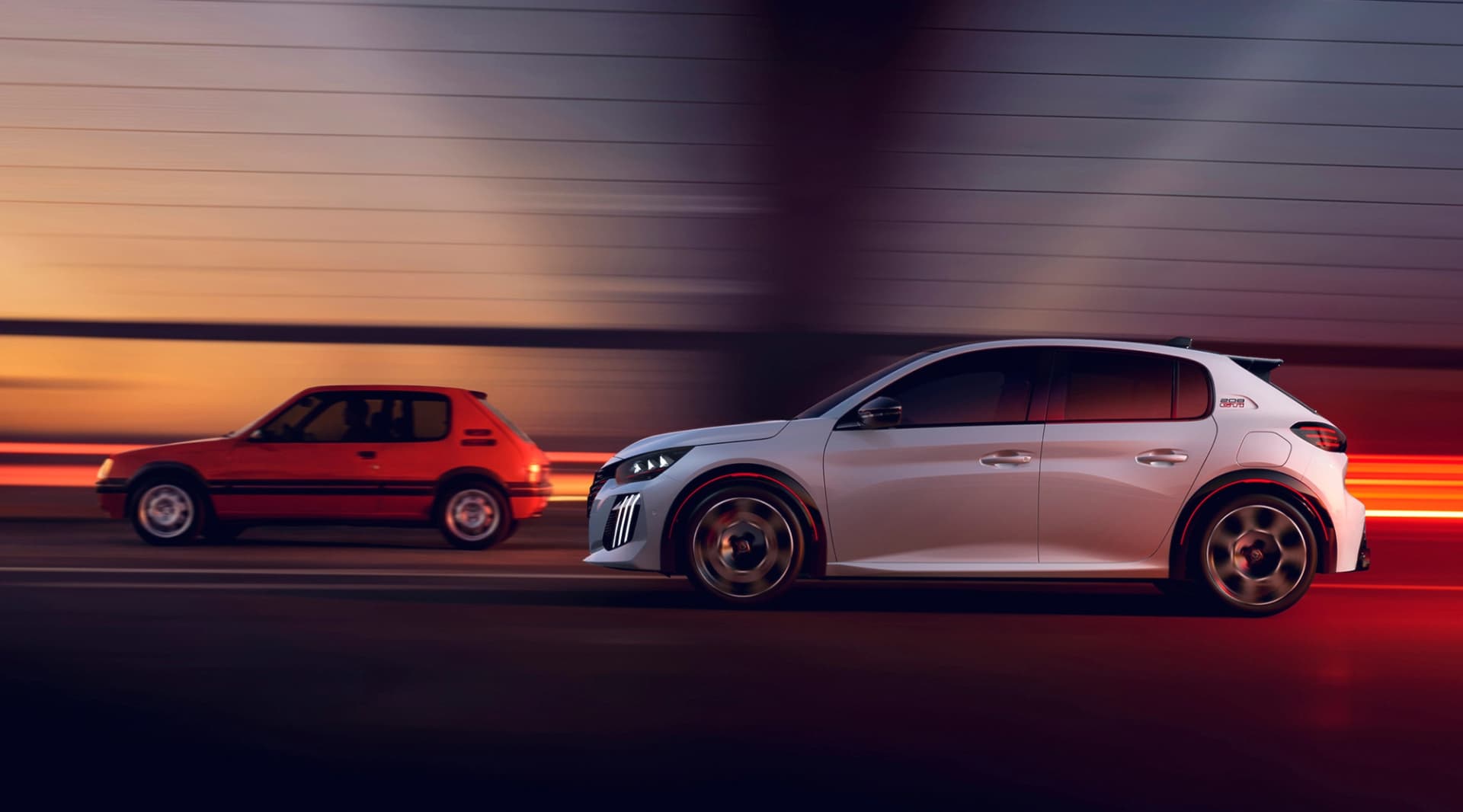
Peugeot's e-208 GTi is the electric hot hatch the badge deserves
A badge with four decades of expectations, and a motor built to meet them
Peugeot chose Le Mans to bring the GTi badge back into its lineup, a decision that is either carefully calculated or quintessentially French. Most likely both. The e-208 GTi was revealed at the 24 Hours race on 12 June 2026, alongside three examples painted in French tricolors and a brand marking its 100th year of motorsport involvement at the same circuit. The setting was deliberate: Peugeot Sport has been racing at Le Mans for a century, and launching a performance car named after its most celebrated road car lineage in that context is exactly the kind of statement that carries weight.
The GTi name had been absent from Peugeot's lineup since the 308 GTi was discontinued in 2021. Five years is long enough for a badge to become either genuinely missed or quietly forgotten. The e-208 GTi arrives with a clear argument for the first category: 207 kW and 345 Nm of torque, a mechanical limited-slip differential, and a 54 kWh battery developed to sustain performance under load rather than to deliver a headline range figure alone.
Five seconds to 100, and the numbers that matter more
The headline figure is 5.5 seconds to 100 km/h from the single front-mounted M4+ motor. For this segment, that is sharp, but the sprint time is not the most important number on the sheet. The 80-120 km/h acceleration takes 3.2 seconds, which is the figure that defines real-world driving: fast motorway merges, committed overtakes, and the pull out of a long corner. Top speed is limited to 180 km/h, a practical cap rather than a performance statement. The car weighs 1,545 kg, which is honest for an EV of this size, and the power-to-weight ratio of 5.5 kg/kW is the best in its segment according to Peugeot.
The 54 kWh battery (51 kWh usable) offers up to 375 km of WLTP range on the optional Hankook Ventus S1 Evo3 tyres, or 352 km on the standard Michelin Pilot Sport 4S. The Michelins are worth specifying for the grip they deliver at the limit, which is part of what makes the suspension setup feel complete. DC fast charging peaks at 100 kW, reaching 20-80% in under 30 minutes. AC home charging runs at 7.4 kW for a full charge in around four hours and forty minutes. Neither figure sets a new benchmark, but both are appropriate for a car that prioritises how it drives over how quickly it tops up.
The engineering argument behind the GTi name
Peugeot Sport developed the e-208 GTi's chassis at its Satory facility outside Paris, and the work goes beyond ride height. The suspension is lowered 30mm, with the front track widened 56mm and the rear 27mm. The steering has been retuned for sharper response, and bespoke hydraulic bump stops and a revised rear anti-roll bar are fitted. A revised cooling system ensures the motor delivers its full 207 kW under sustained load, preventing the power reduction that makes performance EVs feel inconsistent on a demanding road or circuit. Christophe Auriault of Peugeot Sport framed it directly: performance should be constant.
The mechanical limited-slip differential is the single most important chassis element for the driver. It allows the front wheels to distribute torque actively through corners, which is the difference between a hot hatch that is merely fast and one that rewards a committed entry. The 18-inch alloy wheels are styled after the perforated pepperpot design of the original 205 GTi, a detail that will not be lost on anyone who grew up reading about the car that defined what a performance hatchback could be for a generation of European drivers.
The price puts it next to Alpine, which is where it belongs
The e-208 GTi starts at €42,900 in France. In the UK, pricing is £34,995 before the government grant. That puts it in direct conversation with the Alpine A290 GTS+, a car it will be compared to for the length of its production life. Both are front-wheel drive electric hot hatches built in France, targeting the same buyer. The difference is that Peugeot brings the GTi name with four decades behind it, and Alpine brings a motorsport brand that exists to make one argument about performance. Which argument wins depends on who is driving.
Seven exterior colors are available at launch, including Elixir Red, Agueda Yellow, Miramar Blue, and Perla Nera Black. Both the car and the battery carry an 8-year, 160,000 km warranty through Peugeot Care, and a Free2Move Charge Pass provides access to nearly one million charging points across Europe. Orders opened on 12 June 2026, with first deliveries expected before the end of the year.
AutoNext Take
The e-208 GTi matters because Peugeot did not use the badge as a shortcut. The mechanical LSD, the widened tracks, the chassis work from Peugeot Sport: these are the decisions of a team that understood what the GTi name means to the people who will spend €42,900 on it. The reveal at Le Mans, during a centenary of motorsport involvement, was not subtle. But it was honest.
The test will come when the first independent driving reviews land. Performance EVs that look right on paper sometimes disappoint when the steering loses connection to the road. The brief here was clearly to build a driver's car, not just a quick one. If Peugeot has delivered that, the GTi badge earns its return. If not, no amount of pepperpot alloys will cover the gap.