Can you pay by bank card at any EV charger?
Your bank card is a right, not a bargain
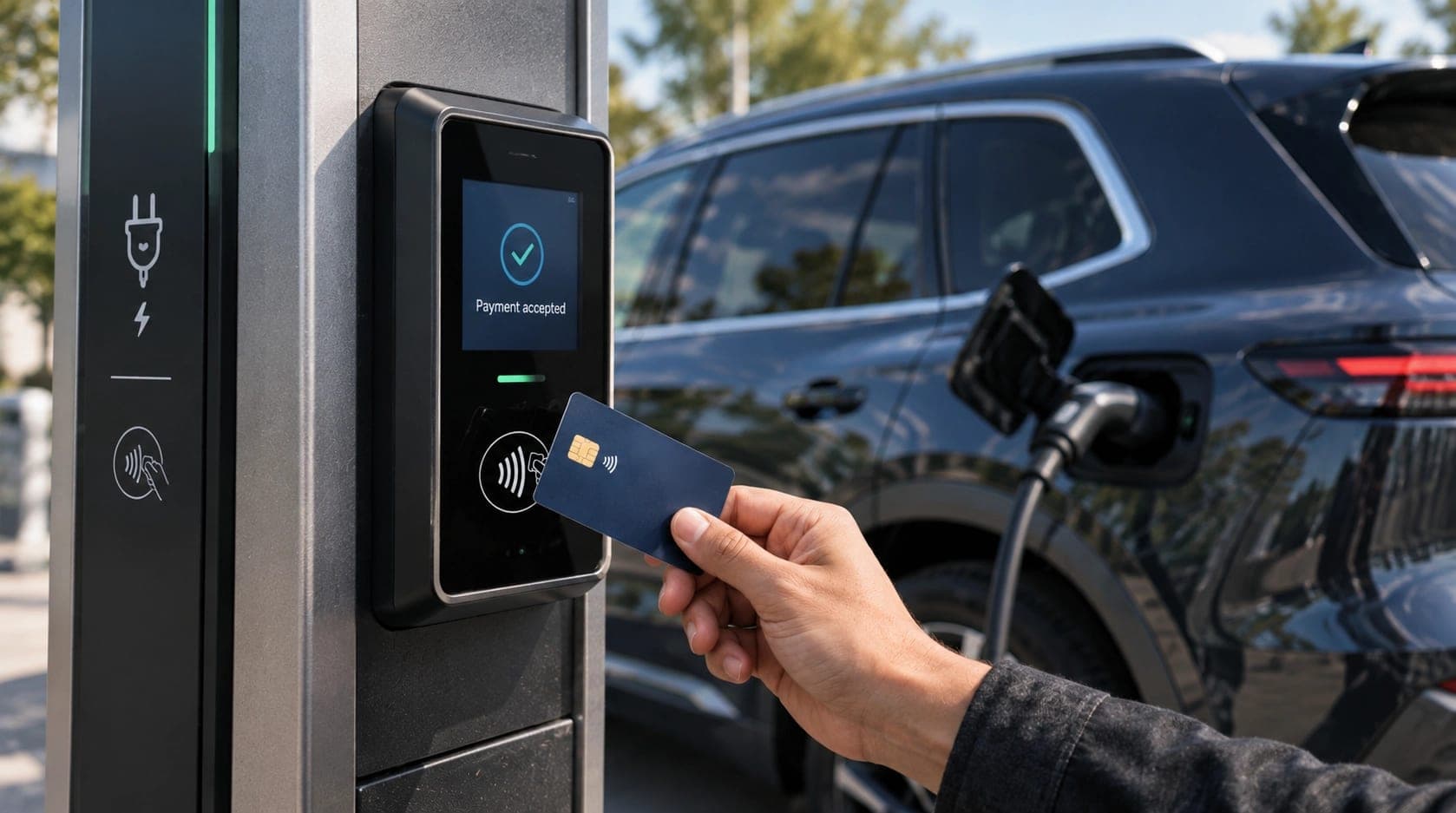
Since 13 April 2024 every new public charging point in the EU has to let you charge without an app, an account or a subscription. That comes from the EU's AFIR rules, which apply word for word in all 27 member states. At a fast charger of 50 kW or more it means a card reader or contactless terminal, and a price per kWh displayed before you plug in. What the rules do not do is make the card the cheapest way to pay. As a backup, the bank card in your wallet is a great safety net. As your default, it is often an expensive habit.
The short version
Every new EU charger of 50 kW or more since 13 April 2024 must take a bank card.
It must show the price per kWh, and any fee per minute, before you plug in.
The card price may be higher than in the operator's own app: up to 62 percent in an ADAC check.
Keep the app or card of your usual network, and use the bank card as the backup.
Which chargers must take your card
The rule covers chargers put into service from 13 April 2024. At 50 kW or more that means a card reader or a contactless terminal, and one terminal may serve a whole group of chargers. Below 50 kW, the operator may send you to a payment web page through a QR code instead, but never to a compulsory app or account. Chargers built before April 2024 do not have to change, with one exception: from 1 January 2027 every charger of 50 kW or more along Europe's main motorway network must have a card reader too, however old it is.
Germany goes further. Since 1 July 2024 every new public charging point there, slow AC posts included, must accept a contactless debit or credit card.
The price has to be on the charger
At a charger of 50 kW or more the price must be based on the kWh you take. The only thing the operator may add is a fee per minute to stop people leaving a full car on the charger, and both figures must be shown at the station before you start. Below 50 kW the operator has more freedom, and session fees or pure per-minute tariffs are allowed. Charging card providers must also show every price element before the session starts, and they may not add a surcharge for charging in another country.
In practice, if a fast charger shows a price per kWh on its screen or a sticker, that is what you pay by card. If it only shows a QR code, it was either built before April 2024 or it is quietly below 50 kW, which, as our piece on AC charging speeds explains, happens more often than the sign on the pole suggests.
Why paying by card can cost more
The rules forbid operators from treating drivers who pay directly differently from charging card providers, but they allow different price levels when the difference is proportionate and justified. In July 2025 the ADAC compared card prices at German motorway fast chargers with the same operators' contract tariffs without a monthly fee. The card was 7 to 62 percent dearer. EWE Go asked 52 cents per kWh with its own card and 84 cents by bank card, EnBW 59 against 87.
So the rules guarantee a way to pay, not a price. The cheapest kWh at a given charger is usually still the operator's own app or a contract card, and the bank card is what you use when those fail.
Card payment does not always work yet
A 2025 benchmark by NKL, the Dutch knowledge platform for charging infrastructure, planned 4,020 charging sessions at 402 charging points in the Netherlands. Paying without a charging card worked at only about 53 percent of them, and the invoiced price matched the announced price in only half of the cases. Then there is the hold: before the power flows, the operator reserves an amount on your card. The ADAC found holds of up to 150 euros, released only after several days.
On a debit card with a low balance, that can block more than the charge itself costs. Arriving on 3 percent and counting on the card reader, on a trip where you have not preconditioned the battery, is how a legal right turns into a long evening.
Plug & Charge, cables and per-minute fees
With Plug & Charge, the session starts as soon as the cable goes in and bills whichever contract is stored in the car, at that contract's price. The AFIR rules give you the right to decline it at any such charger and pay ad hoc or with another contract. Since 14 April 2025 every public DC charger must also have a fixed cable. And because a per-minute fee keeps running while charging slows above 80 percent, going to 100 percent at a fast charger is almost never worth it on such a tariff.
How to pay less at the charger
Carry two ways to pay: the app or card of the network you use most, and a contactless bank card as backup.
Before you plug in at a fast charger, check the price per kWh and any fee per minute on the station.
Compare with the operator's own app before paying by card. The difference can be large.
Use a credit card rather than a debit card with a low balance: the hold can reach 150 euros.
Photograph the price screen before you start and keep the session confirmation.
Never plan a trip on the assumption that card payment will work. Keep a second charger within reach.
Abroad, check your charging card's roaming price. Providers may not add a cross-border surcharge.
Frequently asked questions
Do I still need a charging card in Europe?
Not legally at fast chargers built since 13 April 2024, and from 2027 not at fast chargers on the main motorway network. In practice it still helps: the operator's own contract price is usually lower, and card payment still fails at many chargers.
Does the card rule apply to slow street chargers?
Yes, but below 50 kW the operator may offer a QR code or web payment instead of a card terminal. Germany goes further and requires a contactless card reader on every public charger commissioned since 1 July 2024.
Is the card price allowed to be higher than the app price?
Yes, if the difference is proportionate and justified, which is how the ADAC found gaps of up to 62 percent. The rules guarantee the payment method and a visible price, not the level of that price.
Can a fast charger bill me per minute?
Only as a fee on top of a price per kWh, and both must be shown at the station before you start. Below 50 kW, per-minute and per-session tariffs are allowed.