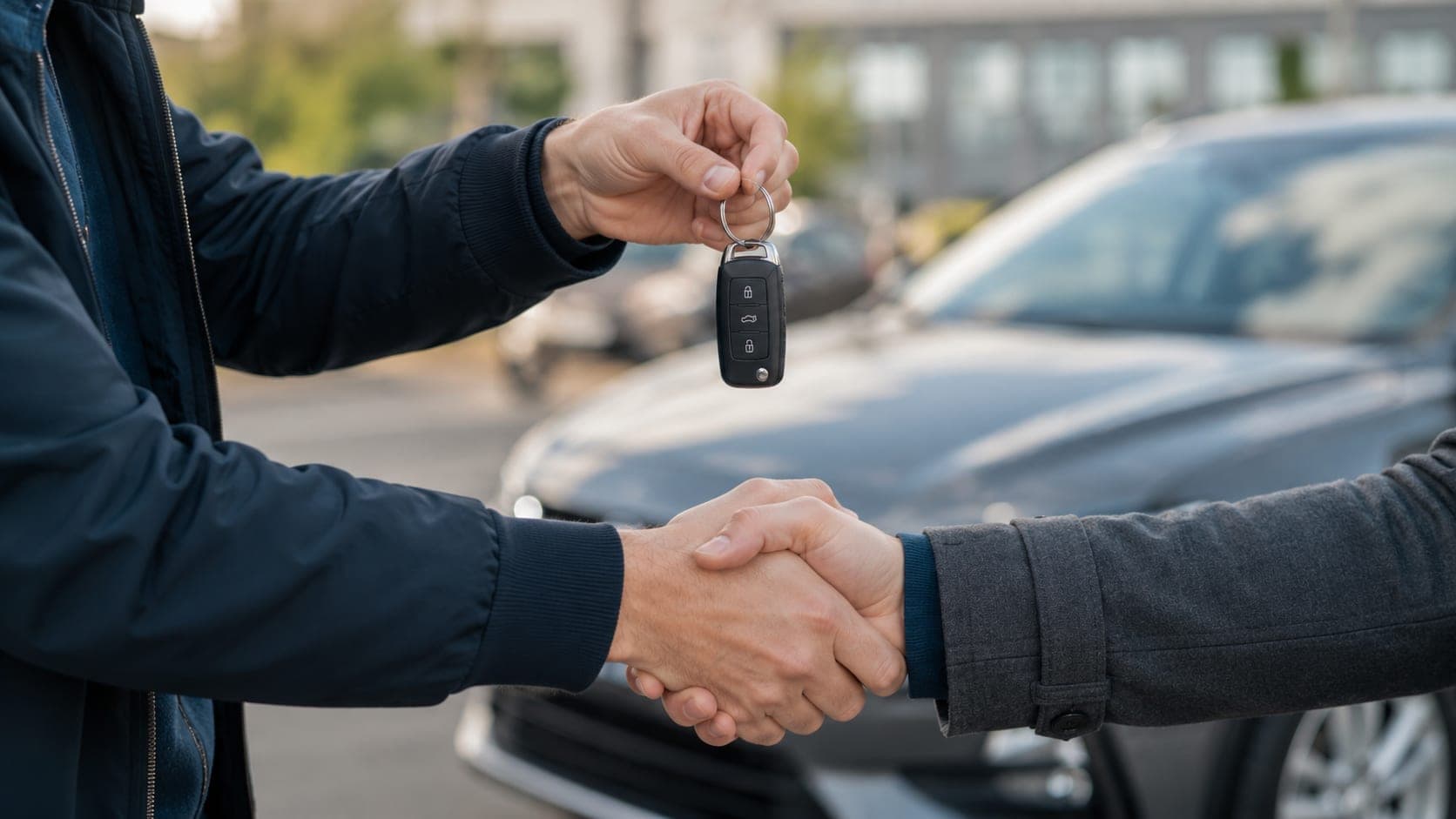
The private sale does not end when the buyer drives away
A registry decides when the car stopped being yours, and a registry does not care how firm the handshake was.
Selling privately instead of trading in is usually worth somewhere between ten and twenty percent of the car's value, which on an ordinary family hatchback is a decent holiday. What you take on in exchange is paperwork and risk. The stories that end badly almost all share one of two shapes: the money looked like it had arrived and had not, or the buyer never put the car into their own name, so the speeding fines, the road tax and the insurance obligation stayed with the seller for months afterwards. Neither of those is bad luck, and neither is really about judging character. Both come down to the order in which things happen on the day. The money clears into your account, then the contract gets signed, then the keys change hands, and the registration is dealt with before either of you goes home.
Gather the documents before you write the advert
A complete folder sells a car faster and at a higher price than a clean engine bay does, because it is the only thing that turns your description into something a stranger can verify. Put together the registration certificate, the full service history with invoices, a valid roadworthiness certificate, both keys, the locking wheel nut adaptor, the radio or key code card, the handbook and any second set of wheels. Then add the piece your own country requires. In Belgium, a Car-Pass is compulsory for every sale of a Belgian-registered used car, private sales included, it costs a shade under eleven euros, it stays valid for two months, and a buyer who never receives one can ask a court to unwind the sale. In France, a car more than four years old needs a roadworthiness test less than six months old on the day of sale, plus a certificat de situation administrative less than fifteen days old proving there is no lien or opposition registered against it. In the Netherlands the mileage history lives in the RDW register that any buyer can check for free with your plate, so assume they have already looked. Germany keeps no such register, but the full run of inspection reports does the same job on paper, and buyers there expect to see it.
Presentation is cheap, misrepresentation is expensive
Spend an afternoon on it. Wash it properly including the wheel faces and the door shuts, clean the glass inside as well as out, empty every cubby, and get rid of the smell rather than covering it with an air freshener, because a strong scent reads as a cover-up. Photograph it outdoors in even light, never in direct midday sun, from all four corners plus the interior, the boot, the engine bay and the instrument cluster showing the mileage. Then, and this is the part sellers skip, photograph the faults as well: the kerbed alloys and scuffed sidewalls, the stone chips, the tear in the seat bolster. Listing the flaws in the advert costs you nothing, filters out the viewings that were never going to end in a sale, and removes the buyer's best negotiating lever on the day, which is the discovery of something you did not mention. While you are down at wheel level, set the tyre pressures to the door sticker figures. A buyer who finds the car sitting at the right pressures with no warning light on has learned something about the previous owner before turning a wheel.
Price it against the market, not against what you paid
What you owe on the car, what you paid for it and what the options cost when new are all irrelevant to a buyer. The only useful reference is what comparable cars are actually listed at right now: same model and engine, similar year, similar mileage, and crucially in your own country, since used values differ substantially across Europe. Look at ten of them, ignore the two outliers at each end, and place yourself honestly within the range according to condition and history. Then leave a small, deliberate margin for negotiation rather than a large one, because an over-ambitious price mostly buys you weeks of silence followed by the same discount you would have taken in the first week. Comparing the live listings on AutoNext is the quickest way to see where your car really sits.
Write a contract, even for a three thousand euro car
Two copies, both signed, one each. It needs the full names and addresses of both parties, the identity document numbers, the chassis number, the plate, the exact mileage on the day, the agreed price, the method of payment, and the date and time the car was handed over. That last detail is the one that earns its place, because it is what settles a fine or a toll charge that lands weeks later for an offence committed at four in the afternoon by a car you handed over at eleven in the morning. Sellers in Germany routinely use the free ADAC private sale template, which contains an explicit clause excluding the two year liability for defects that private sellers are allowed to exclude there. Be clear about what such a clause can and cannot do. Nowhere in Europe does any wording protect a seller who knew about a serious fault and hid it, and in most countries hidden defect rules survive a sold as seen clause. The honest version is also the safer one: write down the faults you know about, have the buyer sign next to them, and the argument is over before it starts.
The test drive is when the car is most exposed
Arrange to meet somewhere public and busy in daylight, a supermarket car park rather than your driveway, and take someone with you. Before anyone drives, photograph the buyer's licence and identity document with your phone, and check that your insurance actually covers a stranger at the wheel, which varies enormously: in the Netherlands and Belgium cover generally follows the car, while in Germany and elsewhere it can depend on the policy and the named drivers. Sit in the passenger seat for the whole drive and keep your own keys, phone and the car's documents on you rather than in the car. Never hand over the keys for a solo test drive, however awkward it feels to say so, and never leave the registration certificate lying in the glovebox during a viewing. A car that leaves without you is a car you are relying on goodwill to see again.
Getting paid, which is the part fraudsters actually work on
One rule covers most of it: the keys and the papers move when the money is visible in your own account, in your own banking app, refreshed by you. Not a screenshot, not a transfer confirmation email, not a message from a bank. This is far easier than it used to be, because banks across the euro area are now required to offer instant euro transfers that arrive within seconds, and to check that the account name matches the account number before the payment goes through, so a buyer can pay while standing next to you and you can watch it land. Cash is still legal for a private sale in most of Europe, though national ceilings vary and an EU wide limit of ten thousand euros applies from July 2027 to payments where one party is acting professionally. If you take cash, count it inside a bank branch and pay it in immediately, since counterfeit notes and a bag of paper are both older tricks than the internet. Refuse cheques, bank drafts, PayPal and any escrow, shipping agent or transport company the buyer introduces, and treat an overpayment followed by a request to refund the difference as fraud every single time, because that is what it is.
The plate, the registration and the road tax
This is the step that separates a clean sale from six months of correspondence, and it works differently in every country. In Belgium the plate belongs to you rather than to the car, so it comes off and either transfers to your next vehicle or gets cancelled, and until that cancellation is registered you keep paying road tax and keep an insurance obligation. The cancellation route has changed recently, so check the current DIV procedure rather than assuming the old counter still applies. In the Netherlands the transfer happens at an RDW recognised counter with both of you present, the buyer needs identification and the transfer code from the registration documents, and you leave holding the vrijwaringsbewijs, which is the single piece of paper that proves you were no longer the keeper. In France you complete the declaration of sale on the ANTS portal within fifteen days, hand the buyer their copy of the certificat de cession and the registration certificate marked as sold and dated. In Germany the safest option by far is to go to the registration office together, and if the buyer insists on doing it themselves, send the Veraeusserungsanzeige to the registration office and to your insurer the same day, because a buyer who never re-registers can leave you carrying the vehicle tax and the insurance premium for up to a year, along with their parking tickets.
The half hour after the buyer leaves
Cancel or transfer the insurance once the registration change is confirmed, not before, and never the other way around. Then think about your data, which almost nobody does. A modern car holds your paired phone contacts, your call history, your home address in the navigation, saved garage door codes, toll and charging account details and, increasingly, a digital key on your phone. Do a factory reset of the infotainment system, delete every paired device, and log into the manufacturer's app to remove the car from your account, since leaving it there can mean the new owner's movements still appear on your phone, or worse, that you retain remote unlocking rights you no longer have any business holding. Take the toll transponder off the windscreen, retrieve anything you registered to the plate such as city access permits or resident parking, and keep your copy of the contract, the payment proof and the transfer paperwork for at least a year. Then have a look at what your money buys next.
What to actually do
Seven steps, in this order, and the order is the whole point.
Build the document folder first: registration certificate, service history, valid inspection, both keys, and whatever your country demands, such as a Car-Pass in Belgium or a certificat de situation administrative in France.
Photograph the faults as well as the car, and list them in the advert. It costs nothing and removes the buyer's strongest bargaining chip.
Meet in a public place in daylight, photograph the buyer's licence, keep your keys and documents on you, and never let the car go out on a test drive without you.
Take payment as an instant bank transfer and confirm it in your own banking app before anything else happens. No screenshots, no cheques, no PayPal, no shipping agents, and an overpayment with a refund request is always fraud.
Sign two copies of a contract that records the mileage, the price, the known faults and the exact date and time of handover.
Deal with the registration the same day: hand in or transfer the plate in Belgium, go to the RDW counter and keep the vrijwaringsbewijs in the Netherlands, declare the sale on ANTS within fifteen days in France, and file the Veraeusserungsanzeige with the registration office and your insurer in Germany.
Wipe your data before you wave goodbye: factory reset the infotainment, delete paired phones and digital keys, and remove the car from the manufacturer's app account.
Frequently asked questions
Do I have to give any guarantee as a private seller?
The two year legal guarantee that applies across the EU binds professional sellers, not private ones, which is a large part of why a private car is cheaper than the same car on a forecourt. That is not the same as no responsibility at all. Hidden defect rules exist in most European legal systems and they survive a sold as seen clause, and no jurisdiction protects a seller who knew about a serious fault and stayed quiet. Declare what you know in the contract and you are on solid ground.
Can I sell a car that still has finance on it?
Not cleanly until the agreement is settled, because until then the finance house has a claim on the vehicle and a careful buyer will find it. Ask your lender for a settlement figure, settle it out of the sale proceeds, and get written confirmation that the claim is released before you hand anything over. In France this shows up directly on the certificat de situation administrative, which is exactly why buyers ask for one.
Should I repair a known fault before selling, or discount for it?
Fix the cheap things that make the car feel neglected, such as a blown bulb, a wiper that smears or a service that is overdue, since each of those invites a much larger deduction than it costs to put right. For anything expensive, get a written quote, declare the fault, and discount by roughly the quoted amount. A documented fault with a price attached is far easier for a buyer to accept than a vague one they have to imagine the cost of.
Is an instant buying service worth the lower price?
Sometimes, and it is worth being honest with yourself about what you are buying. The difference between their offer and a private sale price is the price of certainty: no viewings, no test drives, no payment risk, and the registration handled by someone who does it daily. If the car is old, unusual, or the sort of thing that attracts time wasters, that can be money well spent. If it is a mainstream car in good condition with a full history, the private route usually pays for the afternoon it costs you.
Anything different about selling an electric car privately?
Two things. First, buyers now ask for a battery state of health readout, so have one done and show it, because a documented figure removes the single largest unknown and protects your asking price. Second, the digital side matters more: hand over every charging cable and adaptor, transfer or close any charging subscriptions tied to the car, and be scrupulous about deleting digital keys and removing the vehicle from your app account. Buyers will also ask how it was charged and look at how the tyres have worn, so a fresh set on a car with worn edges is one of the few pre sale expenses that reliably pays for itself.