Bugatti W16 Mistral “Caroline”: a hypercar inspired by flowers, family and the end of an era
Sometimes, the most fascinating automotive stories are not about raw performance.
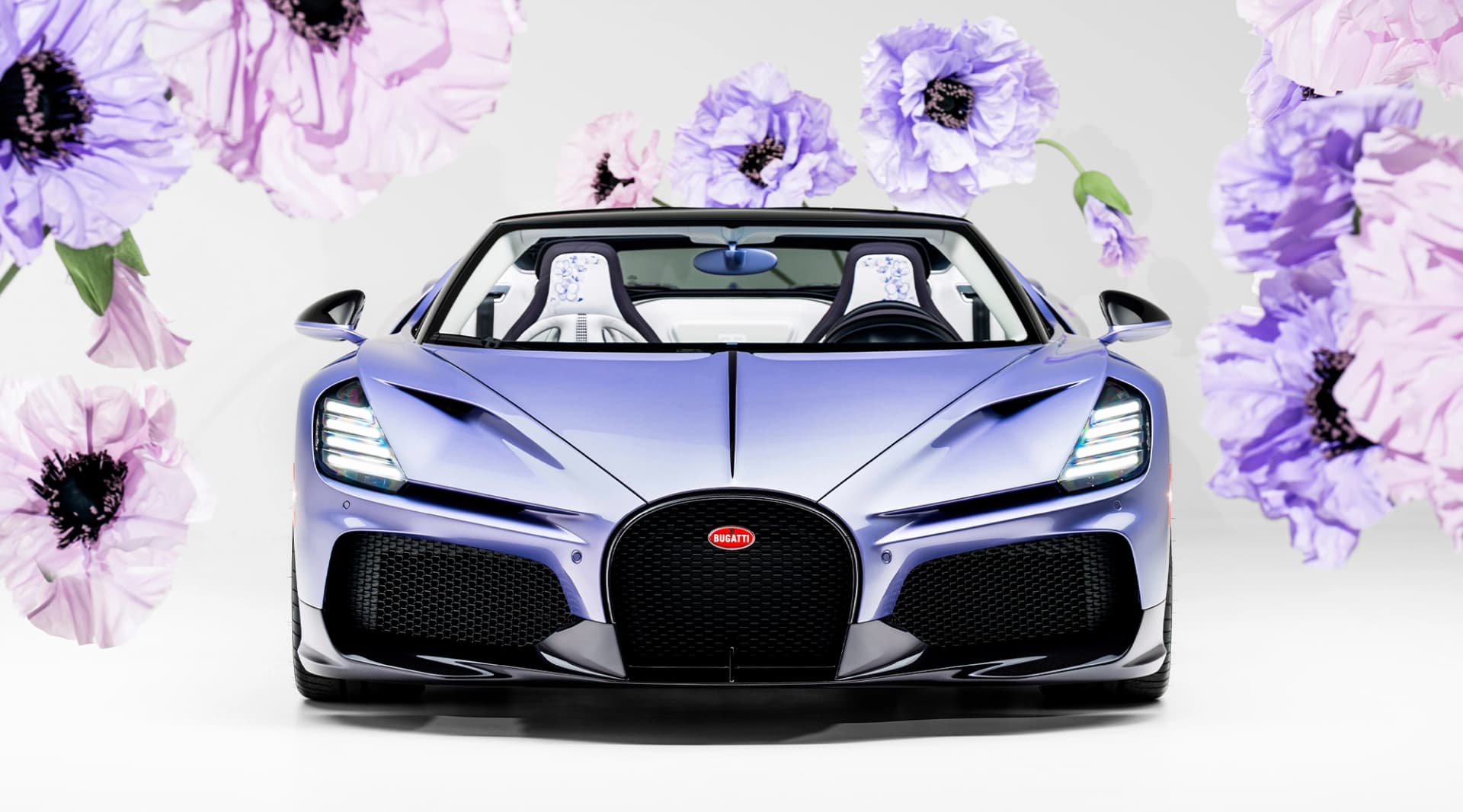
They are about emotion, craftsmanship and deeply personal narratives. That is exactly the case with the Bugatti W16 Mistral “Caroline”, one of the most delicate and poetic creations ever produced through Bugatti Sur Mesure. Created at the marque’s historic headquarters in Molsheim, this unique roadster represents both a tribute to family and the closing chapter of one of the most legendary engines in automotive history. The Bugatti W16.
The final open-top chapter of the W16 era
The W16 Mistral already occupies a special place in Bugatti’s modern history. It is the final road-going model powered by the quad-turbocharged W16 engine, the extraordinary powertrain that defined Bugatti’s modern renaissance through cars like the Bugatti Veyron and the Bugatti Chiron.
With more than 1,600 horsepower in its most extreme form, the W16 Mistral is not only the fastest open-top Bugatti ever built, it is also the last opportunity for collectors to experience the sound and fury of the W16 in a pure roadster. But the example named “Caroline” goes far beyond performance. It is a one-of-one automotive artwork.
A hypercar inspired by flowers and haute couture
Every Sur Mesure Bugatti begins with a personal story. For the owner of this W16 Mistral, that story was deeply emotional: the car was created as a tribute to his daughter, Caroline.
From Bugatti’s atelier in Molsheim to its design studio in Berlin, the brand’s Color & Material Finish team, led by Sabine Consolini, translated that vision into a unique design language. The inspiration came from an unexpected source, flowers.
Specifically, the lavender fields of Provence, Parisian gardens and the refined elegance of haute couture fabrics and colors. These influences shaped the entire identity of the car.

A lavender hypercar unlike any other
The exterior of the W16 Mistral “Caroline” is finished in a bespoke Lavender paint, developed through an extensive process of mixing, testing and refining dozens of tones. The final shade creates a fascinating visual effect.
Depending on the light, the car shifts between bluish violet and reddish purple, giving the bodywork a shimmering, almost organic character. Below the main body surfaces, exposed Violet Carbon fiber adds depth and contrast to the design.
One of the most spectacular details appears at the rear. The deployable rear wing becomes a hand-painted canvas, featuring intricate floral artwork executed in layers of lilac and iris tones. At the center of this composition, the name “Caroline” appears in Bugatti’s signature typography, a quiet but powerful tribute.
A cockpit that feels like haute couture
Inside the cabin, the floral theme continues in remarkable detail. The interior combines Blanc and Minuit leather, violet accents and matching Violet Carbon elements to create a serene yet expressive atmosphere. But the real craftsmanship appears in the embroidery.
Each headrest features a hand-stitched floral motif, composed of thousands of threads layered in different tones. The process behind these details involved:
hand sketching
digital embroidery mapping
precision stitching
meticulous quality control
Across the door panels, petals appear to drift through the cabin like flowers carried by the wind. At the center of the interior sits another iconic Bugatti detail: the Dancing Elephant, encased in tinted glass within the gear selector. It is a subtle reminder of Bugatti’s long tradition of blending engineering with art.

AutoNext Take
Creations like the Bugatti W16 Mistral remind us that automotive history is also built on emotion and craftsmanship. This car represents something bigger than a single commission. It is one of the final expressions of the W16 era, a mechanical masterpiece that defined Bugatti’s modern identity for nearly two decades.
Projects like “Caroline” feel like a final celebration of what made the W16 legendary. In a world increasingly dominated by software and electrification, that kind of mechanical theatre might soon become something truly rare.