The Sultan of Brunei once commissioned a one-off Jaguar XJ220 redesigned by Pininfarina
Few stories are as extraordinary as the legendary car collection of Sultan Hassanal Bolkiah and his brother Prince Jefri Bolkiah.
During the late 1980s and 1990s, the two men quietly assembled what is widely believed to be the largest private car collection in the world, filled with hundreds of Ferraris, Bentleys, Rolls-Royces and Aston Martins. Among those cars was something even the most seasoned collectors had never seen before. A completely unique Jaguar XJ220 redesigned by Pininfarina.
When one Jaguar XJ220 simply wasn’t enough
The Jaguar XJ220 was already one of the most spectacular supercars of the 1990s. Powered by a twin-turbo V6 and capable of reaching more than 340 km/h, it was briefly the fastest production car in the world. But for the Brunei royal family, rarity alone was never enough.
Between 1992 and 1995, no fewer than twenty XJ220s were delivered to Brunei. That fleet included:
18 standard production cars
The 1993 Le Mans class-winning XJ220-C
And one completely bespoke Pininfarina-designed road car
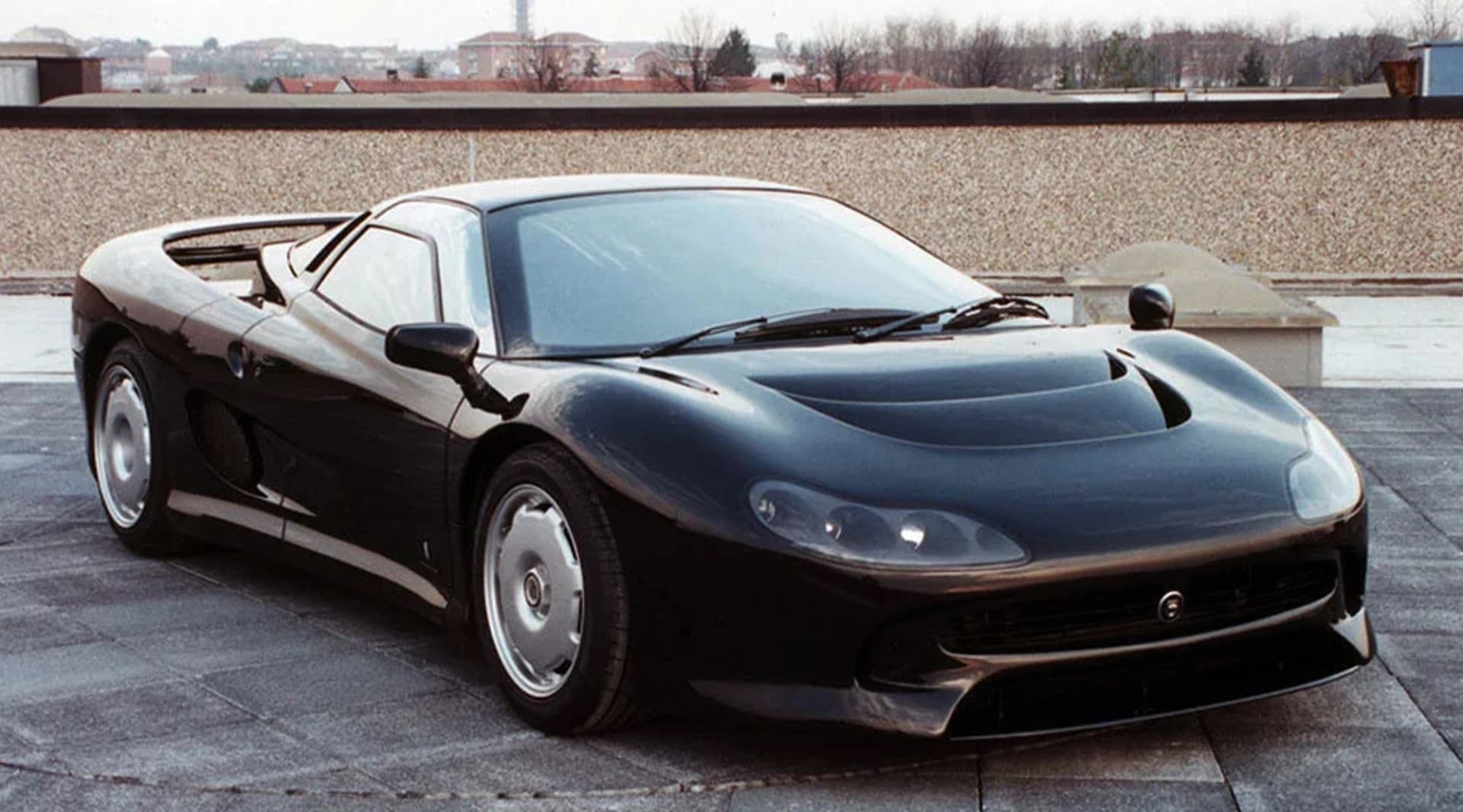
That last car became known as the Jaguar XJ220 Pininfarina Speciale, and it remains one of the most mysterious supercars ever created.
A completely redesigned XJ220
The project was built on a 1992 chassis but underwent a complete transformation. Externally, Pininfarina redesigned almost every visible element of the car.
The front gained larger and more aggressive air intakes, while the original pop-up headlights were replaced by four exposed lenses on each side hidden under clear covers. Two massive semi-elliptical cooling vents were carved into the front lid, giving the car an even more dramatic appearance.
The cockpit area was reshaped and tapered more sharply toward the rear, and the side windows were redesigned into a two-piece configuration. At the back, the transformation became even more striking.
Pininfarina designed a large double-vane rear spoiler and integrated a full-width lighting strip across the rear of the car, something that feels remarkably modern even today. Body panels were produced by Coggiola in Turin, and the car was finished in a unique dark green metallic paint, paired with a green-and-black interior.

An interior unlike any other XJ220
Inside the cabin, almost nothing from the production XJ220 remained. The seats, dashboard, centre console, steering wheel and door panels were all completely redesigned.
White-faced instruments were placed inside a sweeping binnacle that flowed into an angled centre console, housing the switchgear. Materials were equally exclusive: a combination of green and black leather with charcoal Alcantara, giving the car an atmosphere that felt closer to a bespoke grand tourer than a raw supercar.
Technology inspired by Formula 1
The engineering behind the project was handled by Italtecnica, a Turin-based firm known for prototype work with companies such as Ferrari, Maserati and Bertone. The car retained the XJ220’s aluminium honeycomb monocoque chassis with double wishbone suspension, Bilstein dampers and AP Racing brakes.
But several technical upgrades made the Brunei special even more unique. Most notable was the installation of a Formula-1-style paddle-shift gearbox developed by Williams F1. The car also received:
power-assisted steering
improved cooling systems
revised electronics
Under the rear deck sat the familiar 3.5-litre twin-turbo V6, producing 542 horsepower and 645 Nm of torque. In other words: despite the luxury and exclusivity, it remained every bit the performance monster the XJ220 was known for.
AutoNext Take
Stories like this remind us how fascinating the past of the automotive world can be. In the 1990s, before digital configurators and global platform sharing, ultra-wealthy collectors could still commission true one-off supercars from legendary design houses.
Projects like the Pininfarina XJ220 Speciale represent the end of that era. Today, such a car would be almost impossible to homologate. Which makes this unique Jaguar not just rare, but also a fascinating snapshot of a completely different time in automotive history.