Ford GT Mk IV Conquers the Nürburgring With a Blistering 6:15.977 Lap
The Green Hell has become the ultimate benchmark for performance cars.
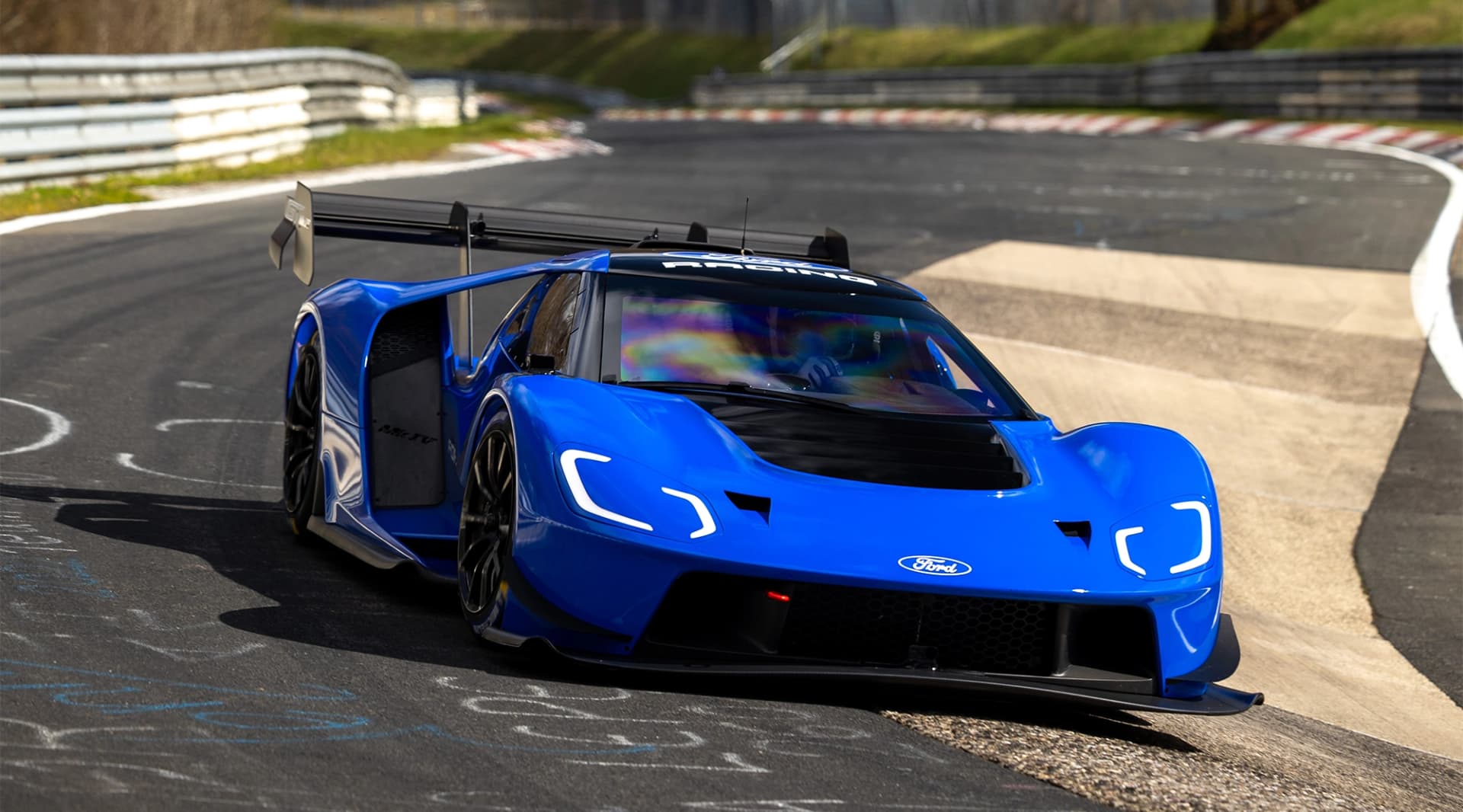
From hypercars to electric prototypes, manufacturers continuously return to the Eifel mountains to chase lap times, prestige and bragging rights. Now, Ford Motor Company has written a new chapter in that history. With a blistering 6:15.977 lap, the Ford GT Mk IV has officially become the fastest American OEM vehicle ever to lap the Nürburgring Nordschleife and the third fastest car of any type to ever tame the circuit.

A lap time that rewrites American performance history
Driven by Frédéric Vervisch, the Ford GT Mk IV completed the Nordschleife in 6 minutes and 15.977 seconds, immediately placing it among the fastest machines ever recorded on the circuit. The result carries several remarkable distinctions.
First, it makes the Ford GT Mk IV the fastest car ever built by an American manufacturer around the Nürburgring. Second, it becomes the fastest purely internal-combustion-engine vehicle to ever lap the Nordschleife, beating modern hybrid and electric hypercars that increasingly dominate performance benchmarks.
And perhaps most impressively, the lap time places the GT Mk IV third overall in Nürburgring history, behind only two of the most extreme prototype machines ever built: the Porsche 919 Hybrid Evo and the Volkswagen ID.R.
That means Ford’s track-only hypercar is now quicker than machines such as the Lotus Evija prototype and even the radical Xiaomi SU7 Ultra Prototype. In a world where electrification increasingly dominates performance headlines, seeing a pure combustion machine reach the Nürburgring podium feels almost rebellious.
The ultimate evolution of the modern Ford GT
The Ford GT Mk IV represents the final and most extreme version of the modern Ford GT program. Production is limited to just 67 units worldwide, making it one of the rarest track-only hypercars ever offered by an American manufacturer.
Each car is powered by a heavily reworked twin-turbocharged EcoBoost V6 engine producing more than 800 horsepower, paired with a bespoke racing gearbox and advanced Adaptive Spool Valve suspension developed by engineering partner Multimatic.
The chassis itself is entirely redesigned compared to the road-going Ford GT. A longer wheelbase, a completely new carbon-fiber long-tail body, and a massive increase in aerodynamic downforce transform the Mk IV into something much closer to a prototype race car than a road-derived supercar.
In fact, the car’s performance is so extreme that it does not qualify as a production vehicle under Nürburgring regulations, placing it instead in the prototype category. Yet that classification does little to diminish the achievement. If anything, it highlights how far Ford’s engineers pushed the concept.
The driver who knows the Green Hell best
Extracting the absolute potential from a car like the Ford GT Mk IV requires more than just engineering brilliance. It also requires a driver capable of navigating the Nürburgring’s notoriously unforgiving layout.
That role fell to Belgian racing driver Frédéric Vervisch, a seasoned Nürburgring specialist and factory driver for Ford. Vervisch is a two-time winner of the Nürburgring 24 Hours and previously celebrated victory at the Rolex 24 at Daytona with the new Ford Mustang GT3 program.
After completing the record-setting laps, Vervisch described the GT Mk IV as “an absolute weapon”, praising its immediate response, immense aerodynamic grip and confidence-inspiring stability through high-speed sections such as Flugplatz and Kesselchen.
A final chapter for the Ford GT legacy
The timing of the record feels particularly meaningful. The Ford GT Mk IV arrives ten years after the modern Ford GT returned to racing and won its class at the 24 Hours of Le Mans, a historic victory that echoed the original Ford GT40 program of the 1960s.
That program famously defeated Ferrari at Le Mans and established Ford as a global motorsport powerhouse. Six decades later, the GT Mk IV serves as a reminder that Ford’s racing DNA remains deeply embedded in the brand.
And while the modern Ford GT era is now coming to an end, the Nürburgring record ensures the program concludes with a moment that feels perfectly aligned with its legacy.
AutoNext Take
Moments like this Nürburgring lap remind us that raw mechanical performance still has a powerful emotional pull. What makes the Ford GT Mk IV story particularly compelling is its timing.
While many manufacturers are shifting entirely toward electrified performance, Ford chose to conclude its flagship supercar program with a track-only machine that celebrates the limits of internal combustion engineering.
In a way, the GT Mk IV feels like a closing chapter for an era of automotive performance, a final statement of what combustion-powered hypercars can achieve when engineers are allowed to pursue absolute speed without compromise. And when that statement happens on the Nürburgring Nordschleife, the world is listening.