The Lola T70 Returns: A Motorsport Legend Reborn for Road and Track
Some cars don’t just belong to motorsport history, they helped write it.
Few machines illustrate that better than the Lola T70, one of the most iconic racing prototypes ever produced by Lola Cars. Now, more than half a century after its debut, the legendary machine is making a remarkable comeback.

A car that defined an era of motorsport
When the original Lola T70 debuted in the mid-1960s, it quickly became one of the most formidable race cars of its generation. Powered by American V8 engines and wrapped in a lightweight British chassis, the car dominated endurance racing and the legendary Can-Am Championship.
The T70 also secured victory at the 24 Hours of Daytona in 1969 and was famously driven by motorsport icons such as Mario Andretti. Perhaps most famously, the car became part of automotive pop culture when Steve McQueen used it during filming of the legendary movie Le Mans.
Two versions: one for the track, one for the road
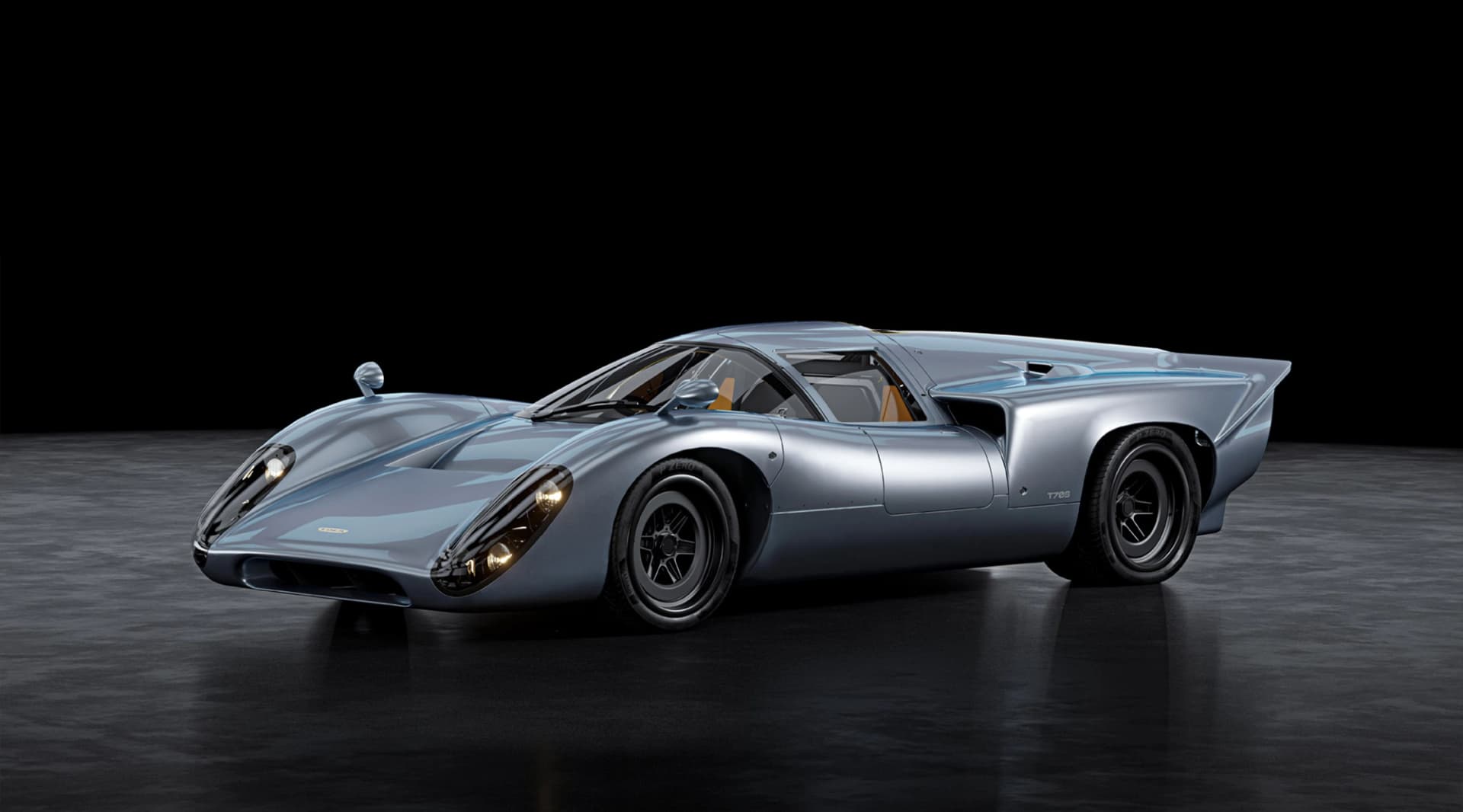
The reborn T70 will be offered in two distinct variants. The track-focused T70S stays closest to the original racing machine. It uses a 5.0-liter Chevrolet small-block V8 producing around 530 horsepower, paired with a period-correct transaxle transmission and a fully adjustable double-wishbone suspension.
Performance figures are extraordinary even by modern standards: the car can sprint from 0 to 100 km/h in just 2.6 seconds and reach a top speed of roughly 325 km/h. Owners will also receive an FIA Historic Technical Passport, allowing the car to compete in official historic motorsport events.
Alongside the race version, Lola will also produce the T70S GT, a road-going interpretation of the classic racer. This variant uses a larger 6.2-liter Chevrolet V8, delivering around 500 horsepower and enabling a 0–60 mph time of 2.9 seconds with a top speed close to 200 mph. Unlike the pure race version, the GT adds small concessions to comfort, including climate control, additional storage and a gearbox optimized for road driving.
Built with modern engineering and sustainable materials
Although the new T70 models remain visually faithful to the original, they are far from simple replicas. Lola developed the cars using original archival drawings, supplemented with high-resolution scans of historic examples to ensure authenticity.
Every component has been re-engineered using modern manufacturing techniques, ensuring the cars meet contemporary standards of precision and reliability. Interestingly, Lola has also integrated advanced sustainable materials into the construction.
The lightweight body uses a proprietary Lola Natural Composite System, combining plant and basalt fibers with a resin derived from renewable sugar-cane waste. The company claims this material offers greater strength than fiberglass and improved damage resistance compared to traditional composites. Magnesium components are also produced using solar-powered electrolysis from seawater, a process that reportedly reduces carbon emissions significantly.
Only 16 cars will ever exist
Exclusivity is central to the project. Lola will build just 16 units in total, making the T70S and T70S GT among the rarest continuation models ever produced.
For collectors and historic racing enthusiasts, that combination of authentic heritage and modern engineering is likely to prove irresistible.
AutoNext Take
Projects like the reborn Lola T70 remind us that heritage still plays a powerful role in car culture. Interestingly, we’re seeing a growing number of manufacturers revisiting their past.
From continuation models and restomods to faithful recreations of legendary race cars, brands are increasingly recognizing the value of their own history. What makes the Lola project particularly fascinating is the balance it tries to strike.
The car looks almost identical to the original, preserving one of the most beautiful racing designs ever created. Yet underneath, it benefits from modern materials, updated engineering and even sustainability innovations. In other words, the reborn T70 doesn’t just celebrate the past. It quietly shows how historic motorsport icons can evolve for the future without losing their soul.