Manthey Porsche completes Nürburgring 24 on synthetic eFuel
This might be one of the most important stories of the 2026 Nürburgring 24 Hours.
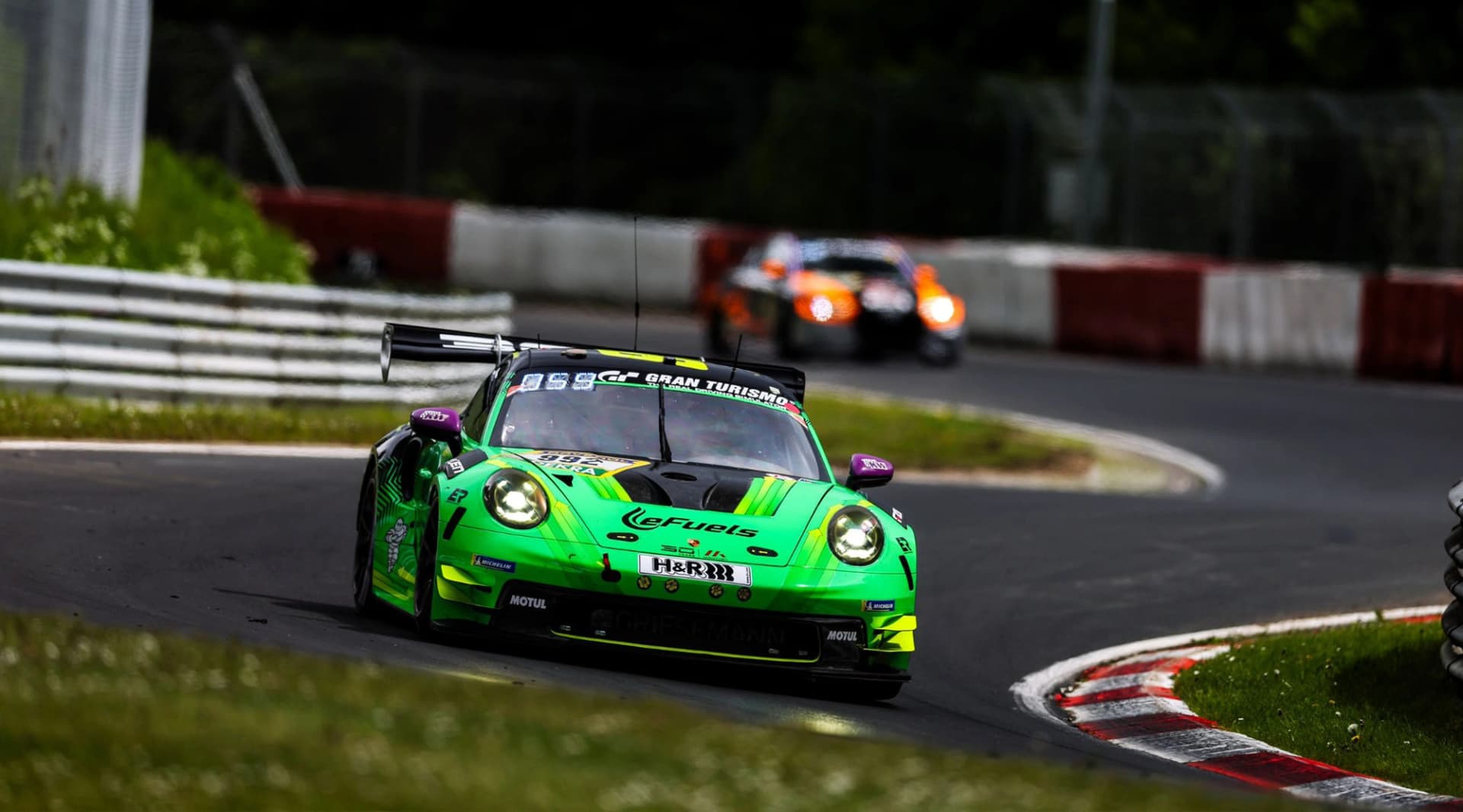
Manthey and the Griesemann Gruppe completed the full 24-hour endurance race with the #992 Porsche 911 GT3 Cup MR running on synthetic eFuel Race 98, an eMethanol-based fuel made from green hydrogen and captured CO₂. The car finished 56th overall after completing 128 laps of the Nordschleife, according to the final classification.
Fossil-free fuel in the Green Hell
The fuel used by the Manthey-Griesemann Porsche was produced as part of the DeCarTrans project, a research initiative at TU Bergakademie Freiberg funded by Germany’s Federal Ministry for Digital and Transport. The organisers describe it as an eFuel based on eMethanol made from green hydrogen and captured CO₂, designed to work in existing combustion engines without technical modifications.
The appeal of synthetic eFuel is not only that it can reduce fossil dependency. It is that it could, in theory, keep existing combustion engines alive without rewriting the entire vehicle. For racing, heritage cars, remote transport, aviation and maritime use, that is a serious discussion.
The car finished despite trouble
The result was not clean or easy. Manthey says the #992 car completed its first 24-hour race at the Nürburgring after a nearly three-hour repair stop in the early morning hours, still crossing the line in 56th overall.
Anyone can run a special fuel in perfect conditions. The real test is whether the whole package survives when the race becomes messy, long and brutal. The Nürburgring always does that. Weather, traffic, curbs, darkness, repairs, heat cycles and pressure expose weakness very quickly.
Porsche had been preparing for this
This did not come out of nowhere. Porsche has been using eFuels in the Porsche Mobil 1 Supercup since 2024, with the 911 GT3 Cup cars running on synthetic fuel in one of the brand’s highest-profile one-make series. Porsche described that step as a way for the roughly 510 hp GT3 Cup field to compete potentially almost CO₂-neutral across the fuel value chain.
Important nuance: synthetic fuel is not magic. The engine still burns fuel. There are still emissions at the exhaust. And eFuel only makes sense environmentally if the production chain uses renewable energy, captured carbon and realistic scaling.
Right now, eFuel is still scarce and expensive. Even the Nürburgring organisers noted that biofuels are already more widely available, while eFuels remain far rarer. So no, this does not mean every petrol car suddenly has a clean future. But it does mean the combustion engine conversation is more complex than “dead or alive”.
AutoNext Take
This is exactly the kind of motorsport story we should pay attention to. Not because eFuel is suddenly the answer to everything. It is not. Scale and cost remain massive questions, and synthetic fuel will probably never be the cheapest solution for ordinary daily transport.
But for racing? For classic cars? For high-performance combustion engines? For aviation and maritime sectors where batteries are not always realistic? This matters.