Spain adopts Germany's emergency corridor on 1 October, minus the driving ban
Real Decreto 518/2026 changes six things at once, and gives nobody a transition period
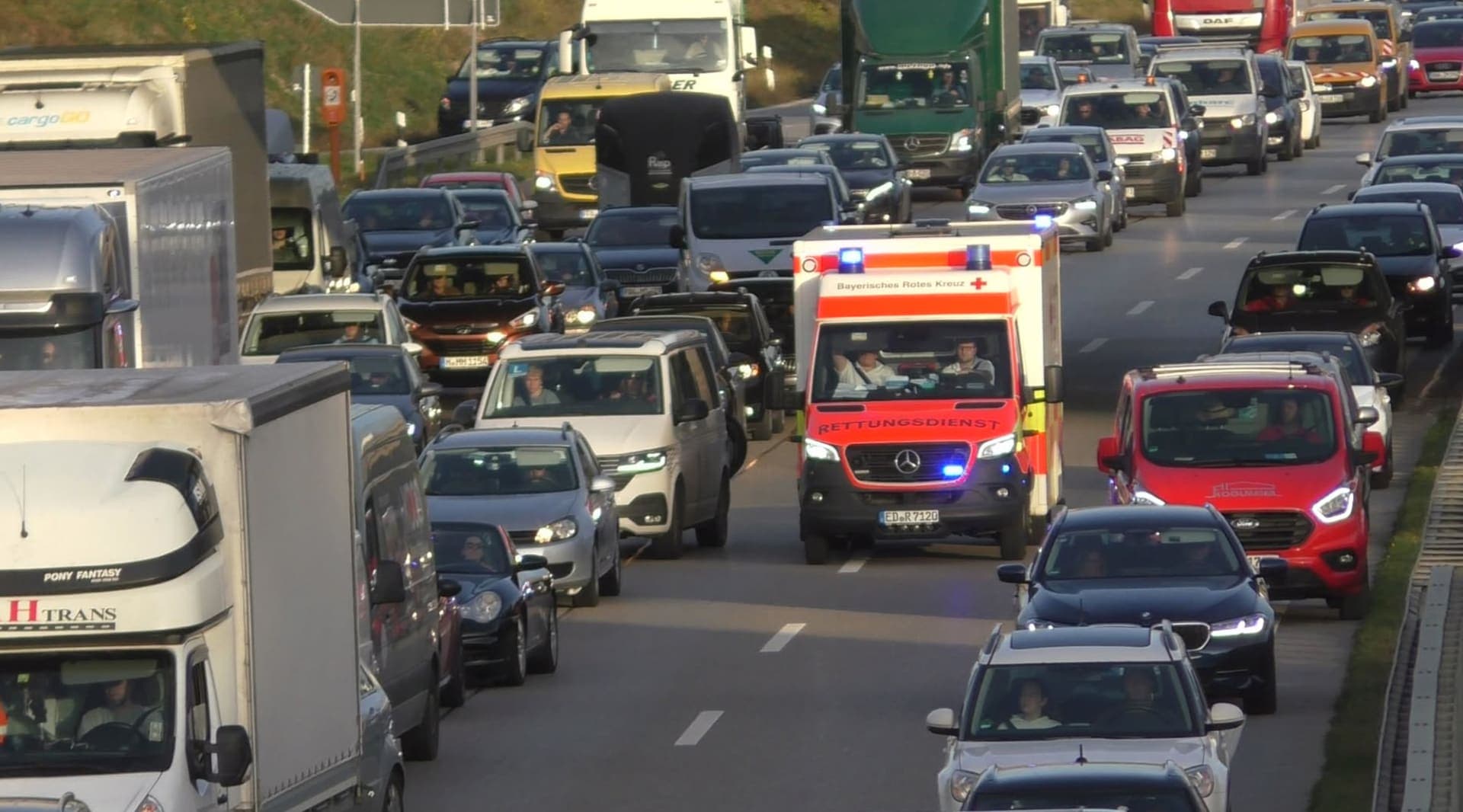
Spain's Council of Ministers approved Real Decreto 518/2026 on 24 June, and its third final provision sets the start date at 1 October 2026. From that day, drivers on Spanish motorways and dual carriageways must open a corridor for emergency vehicles the moment a jam slows traffic to walking pace. There is no general transition period, and the professional drivers who lose their seat belt exemptions get no grace either.
Two lanes means a corridor down the middle, three lanes means hard left
The geometry depends on how many lanes run in your direction. On a two-lane carriageway the corridor forms in the centre, with the left lane pushing as far left as it can and the right lane pulling towards the shoulder. On three lanes or more, the gap opens between the leftmost lane and the one immediately beside it, so the left lane goes left and everything else goes right. The trigger is walking pace or a full stop, and the DGT is explicit that stopping in a jam remains legal. What changes is where you stop.
A new red phase before the flashing amber carries €200 and four points
Spanish junctions currently allow a flashing amber for drivers at the same moment pedestrians get a green, which leaves the driver to settle priority in a fraction of a second. From 1 October that combination is banned. A fixed red must run before the flashing amber appears, and town halls have to reprogram their junctions to produce it. Driving through that new red is treated exactly like running a conventional one: €200 and four licence points. A council that misses the deadline does not suspend the law.
Overtaking a cyclist now costs 20 km/h, and five metres in the same lane
The 1.5 metre lateral gap has been Spanish law since the 2022 reform and it stays. The new obligation is a speed one: on interurban roads, passing a cyclist means dropping at least 20 km/h below the posted limit, so 70 km/h on a 90 km/h road. Where there is more than one lane in your direction you must change lanes completely rather than squeeze past, and hold five metres to any cyclist ahead of you in your own lane. Reckless overtaking of a cyclist has cost €200 and six points since 2022.
E-scooters get a minimum age of 15, motorcyclists get compulsory gloves
The decree treats personal mobility vehicles as vehicles rather than toys. Riders must be at least 15, helmets become compulsory, and lights and reflective elements are required at night or in poor visibility. Motorcyclists need gloves on interurban roads and closed footwear everywhere, and may use the right shoulder in congestion where it is permitted, at up to 30 km/h. Snow gets its own clause: on motorways, overtaking is banned and the right lane becomes compulsory, leaving the left free for emergency vehicles and snowploughs.
Belgium has required the reddingsstrook since October 2020, at up to €174
Spain is late rather than radical. Belgium has required the reddingsstrook since 1 October 2020, on any road with at least two lanes in one direction and inside built-up areas too, with fines reaching €174. Germany writes the same manoeuvre into paragraph 11 of its road traffic code, and the wording matches Spain's lane for lane: leftmost lane hard left, everything else to the right. What Spain has not copied is the German consequence.
AutoNext Take
Germany is the evidence that the manoeuvre is not the hard part, the penalty is. The Rettungsgasse was already German law when ignoring it cost €20, and drivers ignored it. On 19 October 2017 the minimum went to €200 with two licence points and a one-month driving ban, and behaviour moved, because losing your licence for a month is a cost a driver can actually feel. Enforcement weeks come and go without denting the annual figures; a permanent penalty is what changes habits. Spain has landed on €200, and the DGT's standard discount for paying within 20 days halves it. €100 for failing to let an ambulance through is not a deterrent, it is a processing fee.
The prediction is simple and testable: Spain will have to attach licence points to this, or raise the figure, within two summers. Meanwhile the traffic light change is the one that will catch foreign drivers first, because it is invisible until you are already at the line, and hundreds of junctions are being reprogrammed to a single national deadline. If you are driving down to the Costa Brava in October, expect a fixed red where a flashing amber used to let you creep through. €200 is a steep price for a rule you did not know had changed, and Spain collects from non-resident drivers at the roadside.