Spania GTA Spano E&D aims to be Spain's first 400 km/h car
Three people in a Valencia workshop want to take a record Spain has held since 1953
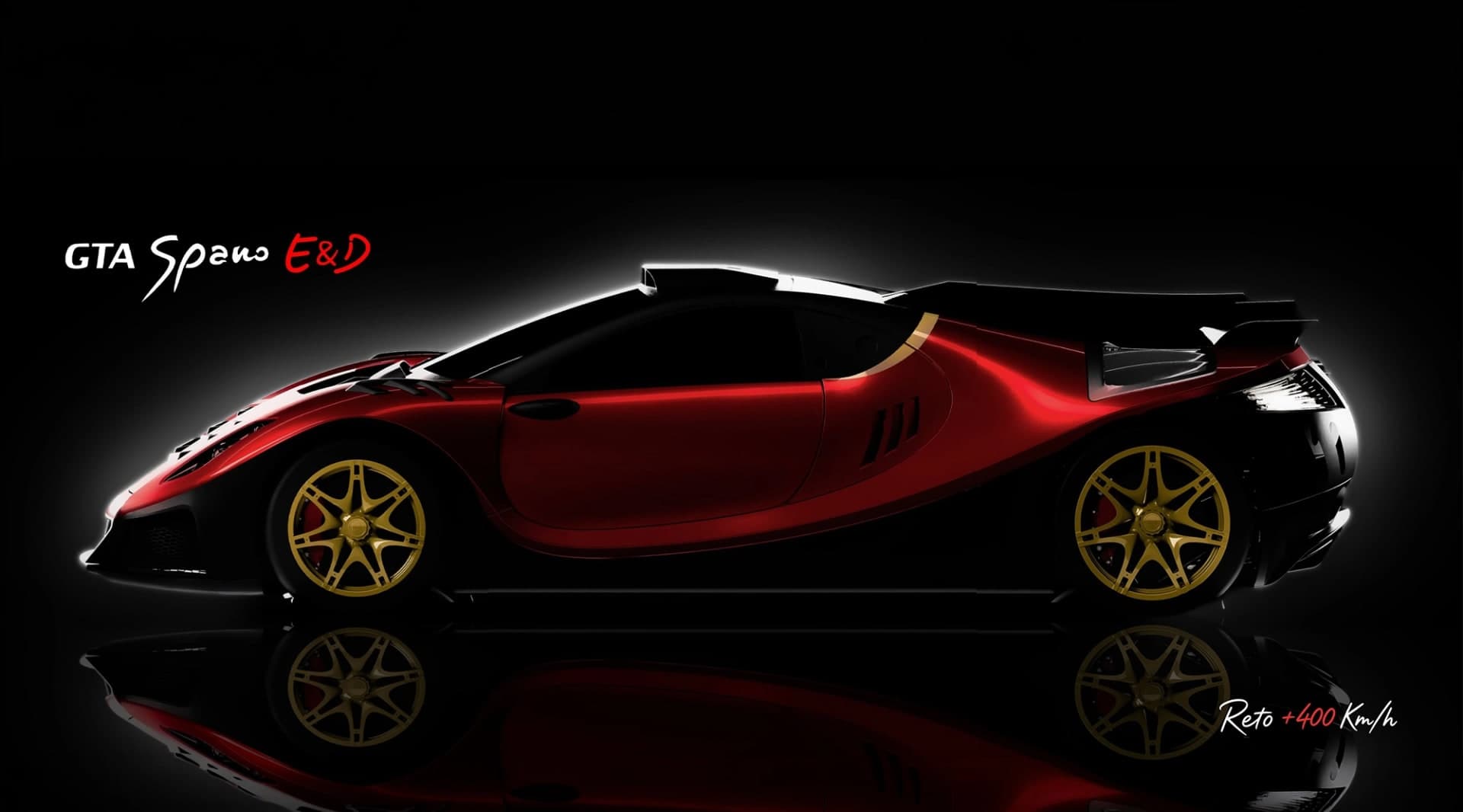
Spania GTA has published the first full image of the GTA Spano E&D, a one-off it is building to become the first Spanish car to pass 400 km/h. The Valencia company posted the red-and-black side profile on 28 September. It is the clearest look yet at a project founder Domingo Ochoa has documented, post by post, since 2025.
The GTA Spano E&D claims 1,400 hp from a 7.9-litre Ilmor V10
Spania's specification lists a twin-turbo 7.9-litre V10 from Ilmor with three engine maps of 900, 1,200 and 1,400 hp, and torque capped electronically at 1,200 Nm. Power goes through an eight-speed Tremec dual-clutch gearbox to Michelin slicks on 19- and 20-inch forged centre-lock wheels. The chassis is carbon fibre, Kevlar and honeycomb, the dry weight 1,100 kg, which gives the top map 1.27 hp per kilo. An FIA-spec roll cage, airjacks and a fire system are fitted, and Spania states plainly that the car cannot be type-approved for European roads.
Pegaso's Z-102 set its 243 km/h mark at Jabbeke in 1953
On 25 September 1953, a supercharged Pegaso Z-102 averaged about 243 km/h over the flying kilometre on the Jabbeke motorway in Belgium, taking the record from Jaguar's XK120. No Spanish car has since made a comparable claim on the world stage, and Spania has built its whole project around that lineage. The E&D picture went online three days after the record's 73rd anniversary. The gap it has to close is not small: 400 km/h is 157 km/h faster than the Pegaso ever went.
Spania showed a 900 hp Spano at Geneva in 2013
The original GTA Spano appeared in 2009 with a supercharged V10 and returned to the 2013 Geneva Motor Show as a 900 hp production car, promised in a limited run of 99. How many were built has never been clear. Ochoa has since written that a bank took over the original factory and that the October 2024 floods in Valencia hit what was left. Drawers that survived both still held dashboards for Spanos that were never assembled, one of them right-hand drive, and those parts are now being fitted to the E&D.
Domingo Ochoa builds the E&D with his son Ethan in a team of three
Ochoa describes the technical team as three people: himself, his son Ethan and a third colleague, with outside help on aerodynamics. Their CFD work claims around 15 percent less drag than the original Spano, despite ten radiators and separate cooling ducts for the turbos and fuel pumps. Five active aerodynamic systems are still in development. At 400 km/h the car would be travelling at about Mach 0.32, a figure Ochoa quotes himself, and a speed that only a handful of hypercars have ever reached.
Spania sells the E&D as a collector's piece before a date is set
Spania has not named a date, a venue or a timing authority for the run. It already pitches the E&D as a collector's piece whose value will rise with its story, the same argument that has carried other small-maker one-offs to auction. Built to one purpose and unable to use a public road, the car will need a long closed runway or test track and a certified two-way average before any record means anything.
AutoNext Take
Spain deserves a car like this, and the Ochoas have earned the right to build it. A company that lost its factory to a bank and its stores to a flood is still fitting salvaged dashboards to a 1,400 hp car with a team of three, and the engineering sheet reads like a serious attempt: Ilmor power, a Tremec gearbox, Motec electronics and a drag target backed by simulation. Revived names have made records stick before when the numbers were real.
A render cannot carry that proof, and Spania knows it. If the E&D posts a certified two-way run past 400 km/h before the end of 2027, it will be the most important Spanish performance car since the Pegaso, and Jabbeke's 1953 record will finally have company.