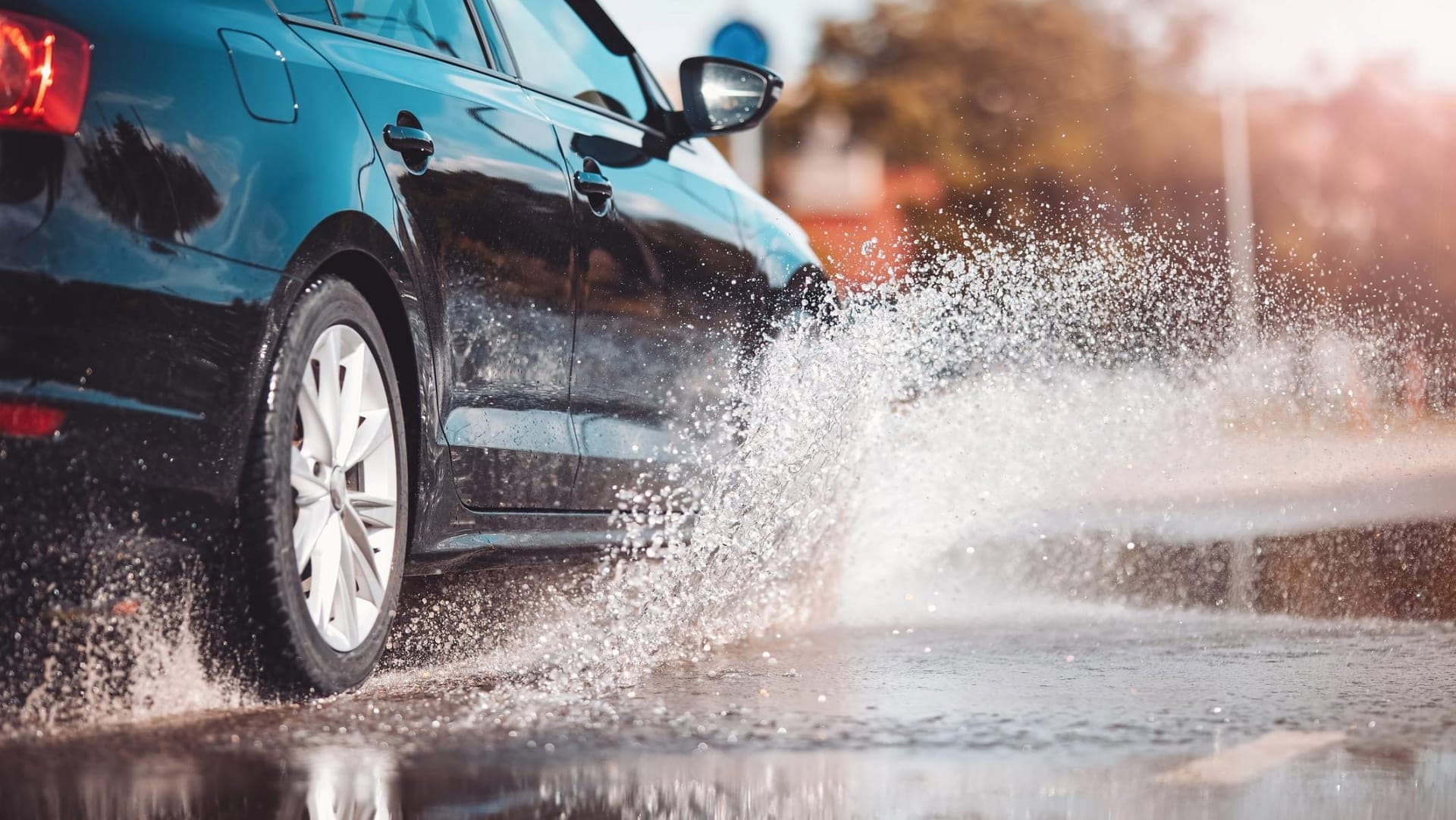
The first rain after a dry spell is more slippery than a downpour
Three dry weeks turn a road into a chemistry experiment, and the first shower is what sets it off.
Every kilometre driven leaves something behind on the tarmac. Engine oil misted out of ageing seals, diesel slopped down the side of an overfilled tank, rubber worn off tyres, brake and clutch dust, exhaust soot, and in late summer the pollen and dry grit that blows in off the fields. In dry weather none of it goes anywhere. It bakes into a thin, invisible film that sits mostly where traffic sits: in the last fifty metres before a junction, across the entry to a roundabout, in the wheel tracks of a queue. Then the first shower arrives and lifts that film into a fine emulsion, thinned just enough to move but nowhere near enough to be washed away. For roughly the first ten to fifteen minutes of rain the road is genuinely at its most treacherous of the entire year, and the sting is that it does not look dramatic. A downpour warns you. A drizzle after three dry weeks does not.
Why a light shower beats a downpour
Grip on a dry road comes from rubber keying into the microtexture of the surface, the sharp grit in the asphalt you can feel with a fingertip. Anything that fills those peaks costs you grip, and the mixture a first shower creates fills them beautifully: oil and diesel that will not dissolve in water, suspended in just enough of it to spread. The result behaves like a very thin lubricant. Keep raining and the problem solves itself, because within ten or fifteen minutes enough water is flowing across the camber to carry the film into the gutter, which is why a road in a steady downpour is often more predictable than the same road in a drizzle. The trap is that your eyes and your instincts are calibrated the other way round. Heavy rain looks dangerous, so you slow down. A grey afternoon with the wipers on intermittent looks like nothing at all, and most drivers carry their dry-road speed and their dry-road following distance straight into it.
Where the film collects
It is not spread evenly and it is not random. It builds up where vehicles stand still or crawl with engines idling, so the worst of it is on the approach to a set of traffic lights, across the give-way line at a roundabout, in bus lanes and at bus stops, and on the exit road from a filling station. Painted road markings are worse again, because paint and thermoplastic have far less texture than asphalt, and so are steel manhole covers, expansion joints on bridges and tram rails, each of which goes properly slippery the moment it is wet. Add the surfaces that were already marginal: freshly laid asphalt still carrying its bitumen film, older concrete polished smooth by years of traffic, and the shaded stretch under a line of trees that stays damp long after everything else has dried. From late August onward there is one more, and it is the one that catches people out on roads they know: the first fallen leaves, which turn into a slick mat with roughly the friction of wet ice once they have been crushed and rained on.
How to drive the first ten minutes
Do the slowing down before you arrive, not once you are committed. Double your following distance to at least four seconds, which is a great deal more space than it sounds and gives you room to lose speed gently rather than suddenly. Separate your inputs: brake while the car is straight, release the brake, then steer. Braking and cornering at once asks a single contact patch for two things at the same time, and on a greasy surface that is where the car lets go first. Feed the wheel rather than flicking it, and squeeze the throttle away from a junction instead of stepping on it, particularly in anything with a lot of torque low down. If the traction or stability light flickers on the dash, that is not a fault, it is the car telling you the grip you are asking for is not there and that whatever you were doing needs doing more gently. Leave motorcyclists and cyclists a wide berth too: the painted lines, drain covers and tram rails that make you twitch are the things that put them on the floor.
Aquaplaning, and the one thing not to do
Once the rain has been falling a while the danger changes shape. The film is gone, and the problem is now standing water lying in the ruts heavy traffic has worn into the lane, usually in the outside lane of a motorway and along the crown of an older road. Aquaplaning is the point at which the tread can no longer clear water fast enough and the tyre starts to ride on a wedge of it. The warnings are subtle: the steering goes light and vague, the noise under the car changes to a hiss, and in a front-wheel-drive car the revs may rise slightly as a driven wheel spins up. The response is to do almost nothing. Ease off the accelerator smoothly, keep the wheel exactly where it is, and do not brake, because a wheel you have just locked or a car you have just turned will both go somewhere you did not intend the instant the tyres bite again. As the speed falls the tread starts clearing water and the weight comes back through the steering. Only then adjust your speed and your line. This is also the reason to switch cruise control off in heavy rain: a system holding a set speed keeps asking for power at precisely the moment you want it taken away.
Being seen is half the job
In spray, the car behind is not looking at your bodywork, it is looking for your lights, and this is where a very common assumption goes wrong. Daytime running lights are at the front only. A car showing DRLs and nothing else has no lit rear lamps at all, which on a wet motorway behind a lorry makes it effectively invisible from the one direction that matters. Automatic headlights will not save you either, because they read ambient brightness rather than rain, and a grey, wet afternoon is often bright enough that they stay off. Reach over and switch dipped beam on by hand whenever the wipers are going. The rear fog light is a different tool: it is meant for visibility below 50 metres, it genuinely dazzles the car behind at any other time, and it is worth checking you have switched it off once the spray clears. Then clean the glass. A windscreen with a greasy inner surface fogs first, holds the mist longest and turns oncoming headlights into a starburst, and an outer surface with a film on it is what makes wipers judder and smear.
Ten minutes on the driveway before the weather turns
Wiper blades are a consumable, and the rubber hardens in exactly the heat that has just given you a dry summer. If they judder, smear or leave a band across your eyeline, replace them rather than nursing them through to spring, and clean the blade rubber and the glass with detergent first, because a surprising number of blades take the blame for a dirty windscreen. Fill the washer bottle with proper screenwash rather than water, both for the detergent and because plain water will freeze in the pipes within a couple of months. Then the tyres, which is where all of this ends up. Wet braking distances and resistance to standing water fall away sharply below about 3 mm of tread, long before the legal minimum of 1.6 mm, so measure now while replacing them is a choice rather than an emergency, and check the age of the rubber while you are down there. Set the pressures cold against the plate in the door shut, remembering that the warning light on the dashboard is a late alarm rather than a gauge. Finally, walk round the car with the lights on and check every bulb, and get into the habit of demisting with the air conditioning switched on, since its real job is drying the air rather than cooling it.
What to actually do
Seven habits, and the first one costs you nothing but a lifted foot.
When the first drops land after a dry spell, drop your speed and stretch the gap to at least four seconds before you reach the next junction, not after it.
Brake in a straight line, then steer. Keep the two apart on a greasy surface.
Switch dipped headlights on by hand. Daytime running lights leave you dark from behind in spray, and automatic lights read brightness, not rain.
Treat painted lines, manhole covers, tram rails and the first fallen leaves as ice, and neither brake nor turn on top of them.
Turn cruise control off as soon as water is standing on the road.
If the steering goes light, lift off gently and hold the wheel still. Do not brake.
Check tread depth and wiper blades now, at the end of summer, rather than in the first November storm.
Frequently asked questions
Is light rain really more dangerous than heavy rain?
For grip in the first minutes after a dry spell, yes, and that is the part drivers find hardest to believe. The two conditions simply fail in different ways. A light shower on a contaminated surface takes grip away quietly, at speeds that felt entirely safe five minutes earlier, and gives you no visual warning that anything has changed. Heavy rain takes away your view, throws spray off the vehicle in front and floats your tyres on standing water, but it announces itself loudly enough that almost everybody slows down for it. The useful conclusion is not that one is safe and the other is not. It is that your speed should drop the moment the road goes from dry to damp, rather than waiting for the weather to look serious.
How do I know I am aquaplaning and not just driving on a wet road?
You feel it through the steering before you see anything. The wheel goes light and disconnected, small movements stop producing a response, and the tyre noise changes from a rumble to a hiss or a slap. In a car with a driven front axle the revs can flare a little as a wheel loses load. The three things that make it likely are speed, water depth and tread depth, and the only one available to you at that moment is speed, which is why the recommended reaction is to ease off the accelerator and wait rather than to steer or brake your way out of it. If it happens more than once on a journey you are going too fast for the standing water, and if it happens at moderate speed, your tyres are telling you something about how much tread they have left.
My car has ABS and stability control. Doesn't that cover it?
They manage the grip that exists, they cannot manufacture more. On an oily film, ABS detects the wheels locking earlier and releases brake pressure earlier, so the car stays steerable but the stopping distance grows, sometimes dramatically. Stability control can cut power and brake an individual wheel to pull the car back into line, but only within the friction the surface is offering, and both systems are working at the very end of the sequence rather than the start of it. Every metre of stopping distance you save is bought before they ever activate, by carrying less speed. If a wet-road crash does happen and the car is badly damaged, the conversation about what it was worth is a separate headache you would rather not have.
How deep is too deep to drive through?
Moving water is far more dangerous than still water, and the usual guidance is not to enter flowing water more than about 10 cm deep or standing water more than about 15 cm, and never any water where you cannot see the road surface or judge what the flood has washed into it. If you decide to go through, do it at walking pace in a low gear with the revs held steady, keep to the highest part of the road, and wait rather than meet an oncoming vehicle whose bow wave will wash over your bonnet. Afterwards, dry the brakes with a few light applications while moving slowly. The real risk is not the electronics, it is the air intake, which on many modern cars sits lower than owners assume. Water drawn into an engine destroys it in an instant, and that is rarely treated as a mechanical failure by a warranty or a comprehensive policy.
Does an electric car behave differently in the wet?
In three ways worth knowing. Torque arrives instantly and in full, so pulling away onto a greasy junction spins the driven wheels far more easily than in a comparable petrol car, and a gentle right foot matters more, not less. Lift-off regeneration is braking applied to the driven axle only, so a strong regenerative lift on a slippery surface can unsettle the car in a way ordinary engine braking would not, which is why EVs back the regeneration off and blend the friction brakes in as soon as the driven wheels start to slip. And the extra mass gives you more momentum to shed through the same four contact patches, which puts more work through the tyres and makes their wet grip rating the specification to read first. Expect the range figure to fall in sustained rain as well: pushing water out of the way costs energy.
