How far can you drive once the fuel light comes on?
Your range display is cautious on purpose
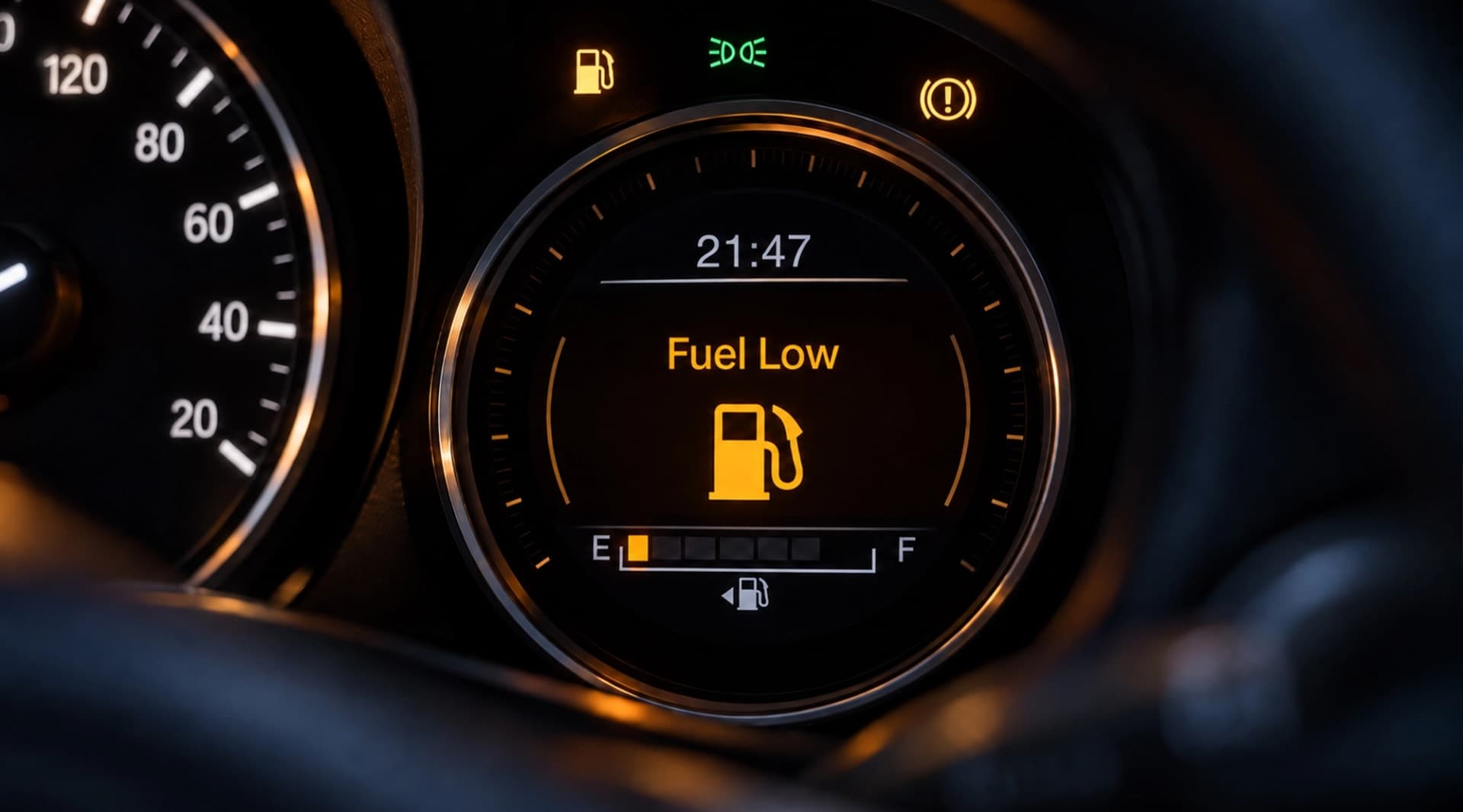
There is no European rule for when the fuel light comes on, and every carmaker sets its own trigger. The order of magnitude is similar, though. Volkswagen's manual for the Golf puts the reserve at about 5 of its 50 litres, the RAC estimates 10 to 15 percent of the tank across the market, and the ANWB's average is 7 to 8 litres, enough for about 50 km in most cars. Better still, the range figure next to the light is tuned to hit zero before the tank does. That margin is real, but it is not a plan.
The short version
The light usually comes on with 5 to 8 litres left, roughly 50 km of driving.
Range displays under-promise: in an ADAC test, cars went 8 to 60 km further than shown.
Running dry can damage the catalytic converter, and a diesel may need its fuel system bled.
On a motorway, most countries treat an empty tank as avoidable rather than a breakdown, and fine it. The Netherlands does not.
How much fuel is left when the light comes on
The light is a fixed trigger, and your manual usually says how much fuel it stands for. In the Golf that is 5 litres, so at a motorway consumption of 7 litres per 100 km the light is worth about 70 km, and at 10 litres per 100 in town nearer 50. On many cars the symbol starts flashing when even less remains, which the RAC calls the final warning. Volkswagen's own advice is not to wait for either: refuel while the tank is still a quarter full.
Why the range display is so cautious
The range figure is a forecast. It divides the fuel the car thinks is left by the consumption it has just seen, so it is most optimistic after a steady cruise and most pessimistic after a traffic jam, and it cannot know whether the next 30 km run downhill or into a headwind. Carmakers tune it to hit zero before the tank runs dry. When the ADAC drove five very different 2019 cars, from a Smart Forfour to a Mercedes S-Class, until they stopped, every one went 8 to 60 km further than its display had promised.
The ADAC's verdict: the figures are good enough to act on, not to plan around. In practice, 40 km on the display is a reason to take the next exit, not a promise that the one after will do.
What running dry actually damages
Not the part most people think. The old warning that the in-tank pump needs fuel around it to keep cool is, as we have explained before, largely overstated on a modern car. Volkswagen's manual names the real risk: as the level drops, the fuel supply turns irregular, especially on hills, the engine misfires and unburnt fuel reaches the exhaust, where it can damage the catalytic converter or the diesel particulate filter. And once the engine stops, so do the power steering, the brake servo and every driver assistance system.
Diesels have a second problem. A common-rail system that has drawn in air will not simply restart once you add fuel. Opel's manual describes the routine: switch the ignition on three times for 15 seconds to prime the system, then crank for no more than 40 seconds at a time with at least 5 seconds in between, and call a workshop if it still will not start. A petrol car usually fires after a few seconds; a diesel run dry can cost you an afternoon.
Running out on the motorway: the fines
Whether an empty tank counts as a breakdown depends on where you are. Germany and Belgium say no: fuel is your responsibility, and the hard shoulder is for emergencies. In Germany a car stranded on the Autobahn counts as parked after three minutes, which costs 70 euros and a point. Belgium fines it 116 euros. France only allows stopping on the hard shoulder in absolute necessity, and a dry tank does not qualify: 35 euros. The Netherlands went the other way: after a court ruled that running out of fuel is an emergency, the ANWB tells its members there is no fine at all.
Whatever the country, the safe routine once the engine falters is the same as for any breakdown on the motorway: hard shoulder, hazard lights, high-visibility vest, warning triangle and everybody behind the barrier. Breakdown services such as the ANWB treat an empty tank as a breakdown even where the police do not.
Electric cars: what happens at zero percent
An electric car does not switch off like a phone at zero. In September 2025 the ADAC drove six of them, including a VW ID.3, a Tesla Model Y and a Kia EV6, around a test track until each one stopped. The first warning came at 15 to 20 percent, power was reduced once the range fell into single figures, and at zero most cars showed a turtle symbol and moved onto an emergency reserve, the buffer every pack keeps below the zero on the display. On that reserve, all six covered another 15 to 20 km before they could no longer hold 50 km/h.
Do not count on it. The cars were new, the track flat and the weather mild, and in winter, on a hill or with an older battery, that reserve may barely exist. Once it is gone you need a flatbed truck, because most electric cars must not be towed on their own wheels.
What to do when the fuel light comes on
Look up the reserve in your manual once, so the light means a number, and refuel at a quarter tank, as Volkswagen advises.
Use the range display to decide where to stop, never whether to stop.
On the motorway, take the next exit when the display shows a few dozen kilometres. Filling up off the motorway is cheaper anyway.
If the engine starts to stutter, use your momentum to reach the hard shoulder: steering and brake assistance stop with the engine.
Stranded: hazard lights, vest on before you open the door, warning triangle, everybody behind the barrier, then call your breakdown service.
Diesel run dry: after refuelling, switch the ignition on a few times to prime the system and keep each start attempt short.
Electric car with a range in single figures: eco mode, heating down, leave the motorway and drive gently to the nearest charger.
Frequently asked questions
Does the fuel light come on at the same point in every car?
No. There is no standard, and each carmaker sets its own trigger. The RAC's rule of thumb is 10 to 15 percent of the tank, and the ANWB's average is 7 to 8 litres. The figure in your own manual is the one to trust.
Is it bad for the fuel pump to drive on reserve?
Now and then, no. On a modern car the pump-cooling warnings are overstated. Running completely dry is the real risk: misfires can push unburnt fuel into the catalytic converter or particulate filter, and a diesel may need its system bled before it restarts.
Can you be fined for running out of fuel on the motorway?
In many countries, yes, because an empty tank counts as avoidable rather than as a breakdown. Belgium fines it 116 euros, Germany 70 euros and a point, France 35 euros. The Netherlands is the exception: a court classed it as an emergency, so no fine follows.
My electric car shows zero percent. How far can I still go?
In the ADAC's test, six new cars on a flat track in mild weather managed another 15 to 20 km at reduced power. In winter, uphill or with an older battery, the reserve can be much smaller, so treat zero as zero and stop somewhere safe.