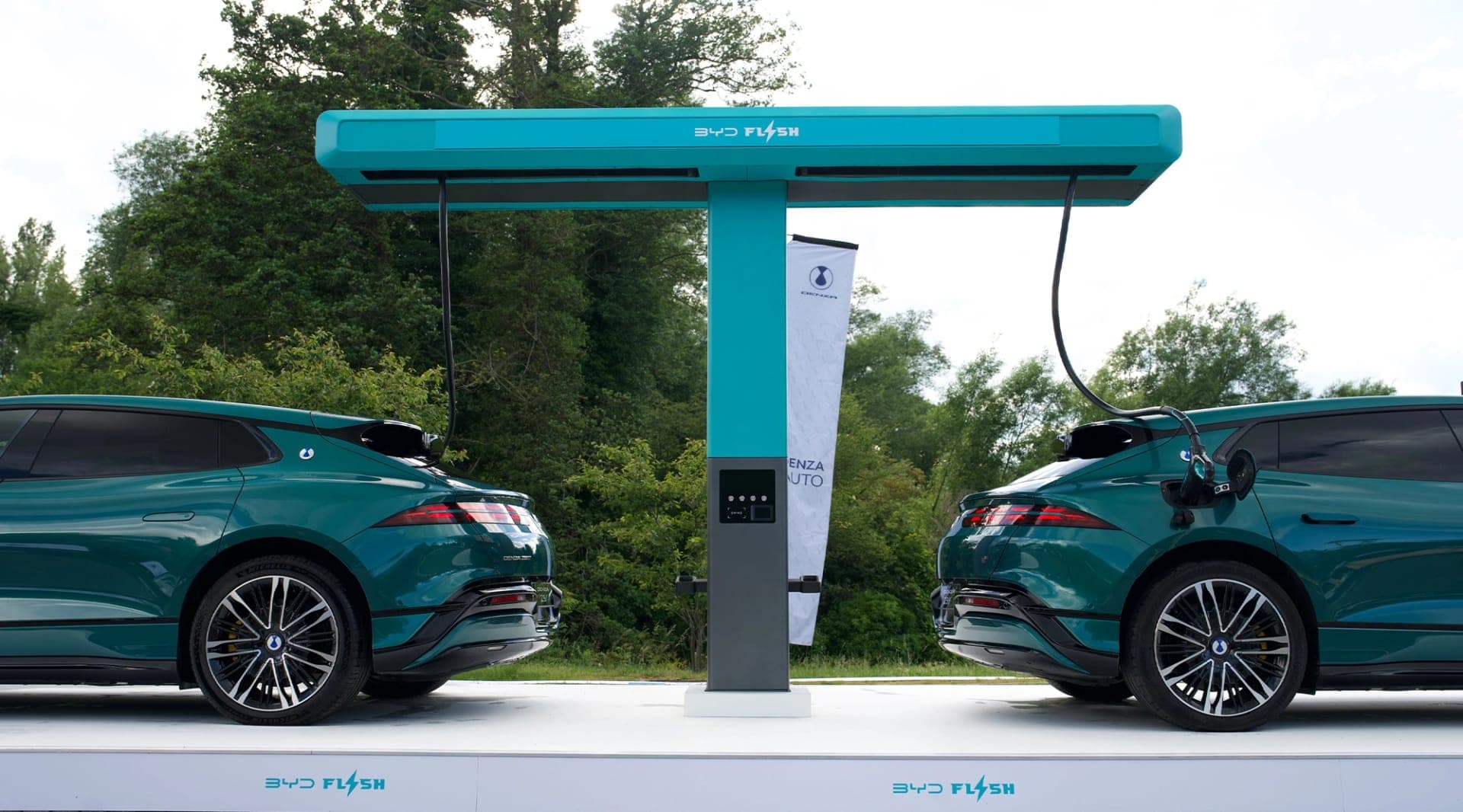
What is flash charging? The next leap in fast charging
Charging a car in the time it takes to buy a coffee
Flash charging is the next step up in fast charging: pushing an enormous amount of power into a battery in a very short burst, so an electric car gains a big chunk of range in the time it takes to visit the restroom. The headline example comes from BYD, whose system peaks at around a megawatt, roughly a thousand kilowatts, and which the company claims can add about 400 kilometres of range in five minutes. The idea started in public transport, where buses top up in seconds at their stops, and it is now arriving in passenger cars. The catch, for now, is that only a handful of cars and chargers can actually do it.
The short version
Flash charging is ultra-fast charging: up to around a megawatt, roughly three times today’s fastest public chargers.
BYD claims about 400 km of range in five minutes, but that is a 10 to 70 percent top-up, not a full charge.
It needs a compatible 800 to 1,000 volt car and a rare ultra-high-power charger, so most drivers cannot use it yet.
For daily driving you do not need it; it matters most on long trips and without home charging.
Where the idea came from: buses that sip at every stop
Flash charging did not begin with cars. It grew up in public transport, where an electric bus follows the same route all day and stops every few hundred metres. Rather than carry a giant, heavy battery, such a bus can carry a smaller one and top it up in seconds at each stop, through a contact arm or an underbody connector that drops onto a charging point while passengers get on and off. A short, very high-power jolt at every stop keeps the bus running without ever taking it out of service to charge.
The same thinking suits depots, taxi ranks and logistics fleets, anywhere a vehicle has only a brief pause but needs to keep moving. That is the world flash charging came from, and it is why the technology was built around extremely high power delivered in a very short window.
What is happening now: megawatt charging for cars
The leap that has everyone talking is bringing that power to ordinary cars. BYD has built a passenger-car system around a 1,000-volt architecture and a battery designed to swallow current fast without overheating, and it quotes a peak of around 1,000 kilowatts, a full megawatt. On its own figures a suitable model can go from roughly 10 to 70 percent in about five minutes, which works out to something near 400 kilometres of range added in the time you would spend at the counter of a service station. Its premium brand DENZA is bringing the technology to Europe, with rollouts named for France, Germany, Italy, Spain and Belgium, and BYD has talked about thousands of high-power sites and a multi-billion-euro investment to build them.
To put that in context, the fastest public chargers most European drivers meet today deliver somewhere between 150 and 350 kilowatts. Flash charging aims to roughly triple that. The manufacturers also claim their newest battery chemistry holds up better in the cold, which has always been where fast charging struggles most.
How it actually works, and why it is hard
Three things have to line up. First, the car needs a high-voltage architecture, typically 800 volts or more, so it can accept that much power without the current becoming unmanageable. Second, the battery has to be built for it, with a chemistry and cooling that can take a megawatt without cooking itself. Third, and least visible, the charging site itself needs help: pulling a megawatt from the grid for every car at once is an enormous demand, so these stations usually lean on their own on-site battery buffers to smooth the load. Miss any one of those three and flash charging simply is not possible, which is why it cannot be sprinkled onto existing chargers overnight.
The honest caveats
Flash charging is real and genuinely impressive, but it is worth keeping your feet on the ground. Only a small number of cars are built for it today, and the ultra-high-power chargers to match are still rare. Your current EV will happily plug into one of these sites, but it will only draw what it was designed for, which for most cars is far below a megawatt. Even on a car that can do it, the eye-catching figures describe the fast early part of the charge; every battery slows down as it fills, so the last stretch to 100 percent takes much longer, and the honest comparison is a 10 to 70 or 10 to 80 percent top-up, not a full charge. Cold weather, a nearly full battery and a busy site all pull the real speed below the headline. And it is worth remembering that flash charging is partly a brand name for what engineers would just call megawatt or ultra-fast charging.
What it means for you
For everyday driving, you probably do not need it. Most people who can charge at home or at work wake up to a full battery and rarely touch a public rapid charger, let alone a megawatt one. Where flash charging matters is the long motorway trip and the driver with no home charging, for whom a five-minute stop that behaves like a fuel stop genuinely changes the experience. Over the next few years, as more cars move to 800-volt and higher architectures and more high-power sites open, short charging stops will slowly become normal rather than remarkable. When you are buying an electric car, this is the practical takeaway: look at the car's real peak charging power and its voltage architecture, which tell you far more than whether a brochure uses the word flash. And remember there is more to living with an electric car than charging, like the fact that they wear their tyres a little faster. If you are shopping for one, you can browse the latest electric listings on AutoNext.
Frequently asked questions
What is flash charging in simple terms?
It is ultra-fast charging: very high power delivered in a short burst so you gain a lot of range in a few minutes. BYD's version peaks at around a megawatt, about 1,000 kilowatts, and the company claims it can add roughly 400 kilometres of range in five minutes.
How is it different from normal fast charging?
Mainly scale. The rapid chargers most European drivers use today deliver 150 to 350 kilowatts; flash charging aims for around 1,000 kilowatts, roughly three times as much. To use it, a car needs a high-voltage architecture and a battery built for that kind of current.
Can any electric car use a flash charger?
No. Only cars designed for very high power, with a high-voltage architecture and a suitable battery, can charge at the full rate. Other EVs can still plug in, but they will only draw their own, much lower maximum, so they charge no faster than usual.
Is flash charging bad for the battery?
Done properly, no. These systems pair the high power with battery chemistry and cooling designed for it, and the car manages the rate to protect the pack. Charging naturally slows as the battery fills, which is normal and is why the quoted times cover the fast early part of the charge, not the run to 100 percent.
Do I actually need it?
For daily driving, usually not, since home or workplace charging covers most people's needs. It matters most on long trips and for drivers without home charging, and it will become more useful as more compatible cars and chargers arrive across Europe.