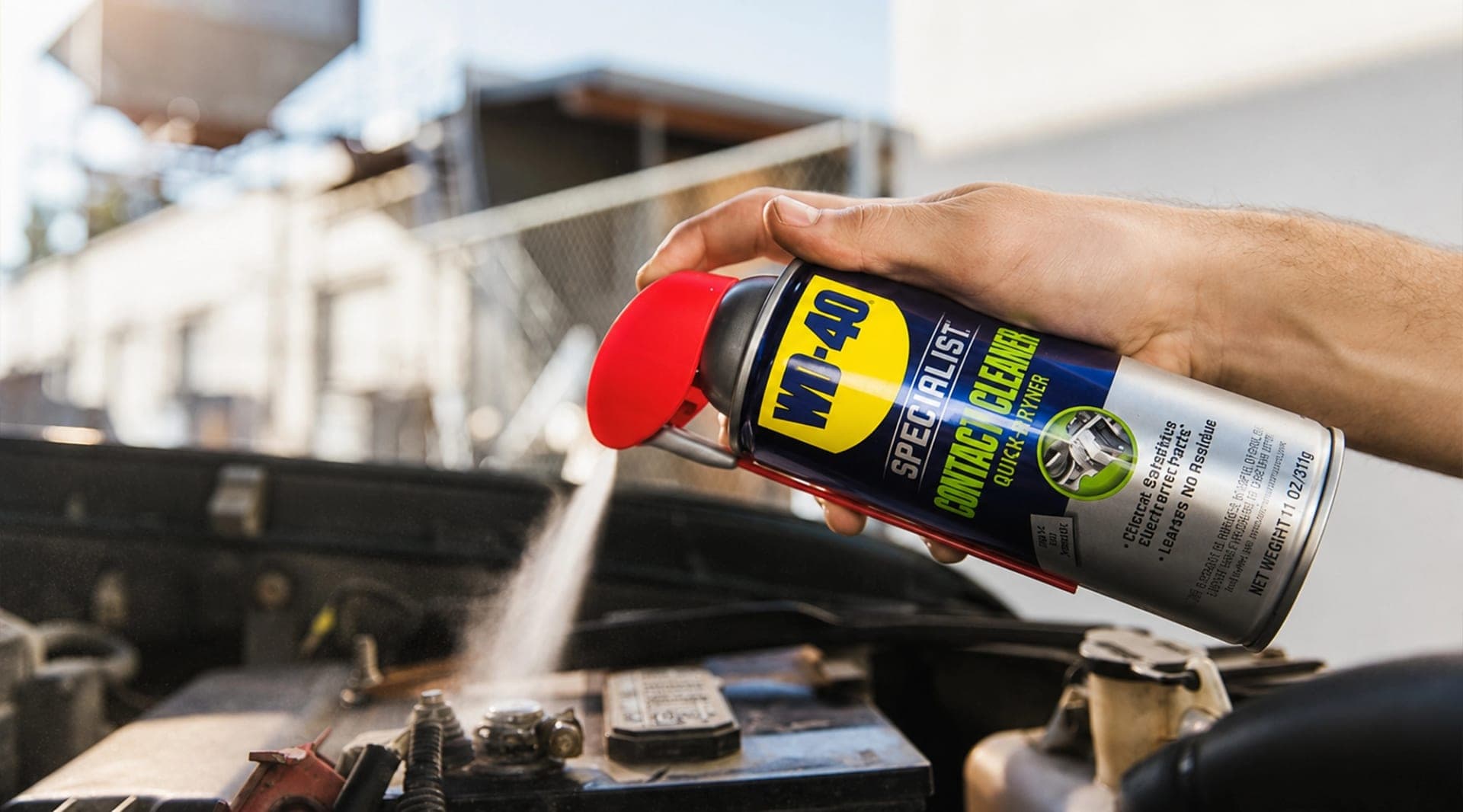
WD-40 is not a lubricant, and your car has five places that prove it
The name on the can is a set of lab notes nobody ever got round to replacing, and it is also the instruction manual.
WD stands for Water Displacement. The 40 is the fortieth attempt at getting the formula right. Put those two together and the product tells you exactly what it was designed to do, which is to push water off bare metal and creep into the gap between a corroded fastener and the thread it is stuck in. What it was never designed to do is lubricate anything that carries a load, and that single misunderstanding is responsible for a remarkable amount of avoidable damage in home garages across Europe: brake pads that had to be replaced, drive belts that failed early, door seals that went hard a season sooner than they should have, and headlight lenses that crazed. The can is genuinely brilliant at four or five specific jobs. It is the wrong tool for at least as many others, and the label has been telling us which is which since 1953.
Water Displacement, fortieth attempt
The product came out of a three-man outfit called the Rocket Chemical Company, working in San Diego in 1953 on a corrosion problem that had nothing to do with cars. Aerospace contractor Convair needed to stop the thin outer skin of the Atlas missile from rusting while it sat in storage and moved around, and what it needed was something that would displace moisture and leave a protective film behind. The team got there on the fortieth formulation, wrote the shorthand on the drum, and the shorthand stuck. Convair employees started taking cans home for jobs around the house, which is the moment the product quietly changed careers. Founder Norm Larsen put it into an aerosol can, it reached shop shelves in San Diego in 1958, and by 1969 the company had given up and renamed itself after its own product. The formula was never patented, which was deliberate: a patent would have published the recipe, so it stayed a trade secret instead, and the exact contents are still not public.
Why a water displacer is not a lubricant
Think of what is in the can as a light oil carried in a thin solvent. The solvent is what makes it creep into places nothing else reaches, dissolve grime and drive water off a surface, and then it evaporates and leaves a very thin oily film behind. That film is enough to stop flash rust on bare metal and enough to quieten a hinge for a while. It is nowhere near enough for anything that has to carry load, heat or repeated movement, because it has none of the body that grease has and it does not stay put. Worse, the same film is slightly tacky as it thins, so it collects dust, sand and brake dust and turns into a grinding paste in exactly the places you were trying to protect. The honest way to think about the can is as a cleaner and a moisture chaser that happens to lubricate a little on its way past, rather than as a lubricant that happens to clean.
The five places on a car where it does damage
First, anywhere near the brakes. A squeal from a wheel arch tempts people into a quick spray, and any of it that reaches a disc face or a pad is not cleanable: contaminated friction material has to be replaced, and until it is, the car stops worse than it did before. Second, a squealing drive belt. The spray silences it for a day or two by making the belt slip more smoothly, then attacks the rubber, and it hides the real cause, which is normally a worn tensioner, a misaligned pulley or a glazed belt that was about to be replaced anyway. Third, rubber door and window seals. The maker sells a separate silicone product for those for a reason: a solvent-carried oil is not what keeps rubber supple, and treating seals with it every autumn strips them rather than feeding them. Fourth, lock barrels. It will free a sticking lock once, and it will also wash out the grease that was in there and leave a damp film that collects dust, which is why locksmiths reach for a dry graphite or PTFE lubricant instead. Fifth, and least known, clear plastics. The manufacturer's own guidance is to keep it off polycarbonate and clear polystyrene, and your headlight lenses are polycarbonate, so it does not belong anywhere near them. Add anything that runs under real load, such as a chain, and the list is complete.
What it is genuinely excellent at
Displacing water is the job it was built for and it is still the best argument for keeping a can. A soaked connector after an enthusiastic session with a pressure washer, damp ignition leads on an older engine that will not start after a night of rain, a lawnmower or a bike that got left out: a spray drives the moisture out of the joint and leaves a film that keeps it out. Second, freeing corroded fasteners. It creeps into a seized thread, and the trick nobody uses is patience, because it needs several minutes to travel rather than a squirt and an immediate heave on the spanner. Give it time, tap the head of the bolt to send a shock through the thread, and repeat once before you reach for anything more aggressive. Third, cleaning. Tar spots, squashed insects, tree sap, adhesive residue from a badge or a dealer sticker, and old road grime all come off metal and cured paint with far less abrasion than scrubbing, provided you wash the panel properly afterwards rather than leaving an oily film to bake in the sun. Fourth, protection: a light wipe over bare metal, tools or exposed hardware keeps surface rust off things that are being stored.
The right can for each of those jobs
This is where a bit of shelf discipline pays for itself, and it is worth knowing that the brand name and the blue and yellow can are no longer the same thing, because the company sells a whole specialist range of the products listed below. Door hinges, bonnet hinges, latches and striker plates want white lithium grease, which stays where you put it and survives a winter. Rubber seals want a silicone spray or a silicone stick. Lock barrels want dry graphite or PTFE. Brake caliper slide pins and the back of the pads want the specific high-temperature grease made for them, applied by someone who knows which surfaces must stay clean. A properly seized exhaust or suspension bolt wants a dedicated penetrating fluid, which is thinner and formulated to travel rather than to protect. Chains want chain lube. None of these is expensive, all of them last for years, and between them they cover every job people currently do with one can and later regret.
The autumn mistake, and one safety note
Every year around the end of September, European drivers do the sensible thing and prepare the car for cold mornings, and a large number of them do it with the wrong can: a squirt into each lock barrel and a wipe along the door seals so the doors do not freeze shut. The intention is right and the product is wrong. Seals want silicone, which leaves a slippery, water-repellent layer that ice cannot key into, and locks want a dry lubricant that will not hold moisture in the barrel overnight. It is a good moment to look at the rubber honestly as well, because seals perish with age and exposure rather than with mileage, in the same way that the date code on your tyres matters more than the tread on a car that does not cover many kilometres. Fold this into the ten-minute check that gets a car ready for autumn and you have covered most of what actually goes wrong in the wet months. One last thing that gets forgotten because the can is so familiar: it is a flammable aerosol. Keep it away from a hot exhaust, a running engine and anything that sparks, do not spray it into an electrical box that is live, and use it with the garage door open rather than closed.
What to actually do
Keep the can, use it for the four jobs it is unbeatable at, and buy three cheap alternatives for the rest.
Use it to chase water out of soaked connectors and damp ignition parts, and to protect bare metal from surface rust in storage.
On a seized bolt, spray, wait several minutes, tap the bolt head, then try. Repeat once before reaching for heat or a dedicated penetrant.
Never spray anywhere near discs, pads or calipers, and never onto a squealing drive belt.
Keep it off headlight lenses and other clear plastics, which the manufacturer specifically warns about.
Buy white lithium grease for hinges and latches, silicone for rubber seals, and graphite or PTFE for lock barrels. Three cans, and they last for years.
After using it to clean tar or adhesive off paint, wash the panel properly rather than leaving the film to dry in the sun.
Treat it as the flammable aerosol it is: no hot exhausts, no running engines, no closed garage.
Frequently asked questions
So is WD-40 a lubricant or not?
It lubricates, but lightly and briefly, and that distinction is the whole point. It is sold as a multi-use maintenance product, and the light oil it leaves behind is enough to quieten a hinge, ease a stiff mechanism or stop a squeak for a while. What it does not do is stay in place under load, resist heat, or survive weather, because it has none of the body of a grease and its carrier evaporates. If a part carries weight, gets hot, or moves thousands of times, it needs grease and the can is a temporary measure at best. The useful rule is that it belongs to the moment you are working on something rather than to the months afterwards.
Will it free a badly seized bolt?
Often, and it works better than most people let it, because most people do not give it time. The liquid has to travel down the thread by capillary action, which takes minutes rather than seconds, so spray it, walk away, come back and tap the head of the bolt sharply with a hammer to shock the rust, then try the spanner. A second application and a second wait is worth more than extra force, which usually just rounds the head or snaps the bolt and turns a ten minute job into a drilling and re-tapping job. For genuinely welded exhaust and suspension hardware, a dedicated penetrating fluid is thinner and does the job better, and controlled heat is what professionals use when neither works. Whatever you use, keep it off the brakes.
Is it safe on paint?
On healthy, fully cured paint it is generally fine for short contact, which is why it works so well on tar spots, tree sap and sticker residue. The conditions are that it goes on cool paint out of direct sun, that it stays there for a minute rather than an afternoon, and that the panel is washed with car shampoo afterwards to take the oily film off, otherwise the next layer of dust sticks to it. Be more careful on fresh paintwork that has been resprayed within the last few weeks, on matte and satin finishes, which are ruined by anything that leaves gloss behind, and around the edges of vinyl wrap or paint protection film, where solvents creep underneath and lift the edge. And keep it off the clear plastics mentioned above.
Why not use it on door seals before winter?
Because the job you are trying to do is to leave a durable, water-repellent layer on rubber so that ice cannot bond to it, and a thin oil in a solvent is the wrong chemistry for that. It flashes off, it does not condition the rubber, and it needs redoing constantly. A silicone spray or a silicone stick is made precisely for this, costs about the same, lasts a season and does not attract grit into the seal. The same logic applies to the tailgate seal, the sunroof channel and the boot rubber, all of which are cheaper to maintain than to replace. If a seal is already hard, cracked or flattened, no product will bring it back and it is time to price a new one.
My belt squeals. Can I not just spray it?
It is the most tempting shortcut on the list and the most expensive. The noise stops for a day or two because the belt is slipping more smoothly, and the underlying fault carries on: a tensioner that has lost its spring, a pulley bearing on its way out, an alignment problem, or a belt that has glazed and hardened. Meanwhile the oil attacks the belt and can throw it off the pulleys, and on most modern engines that belt drives the alternator, the water pump and the power steering, so losing it at speed is not a minor event. Belt dressings sold for the purpose are not much better as a cure. Have the tensioner and the pulleys checked, and if the belt is glazed or cracked, replace it, which on most cars is a cheap and quick job compared with what it prevents.
