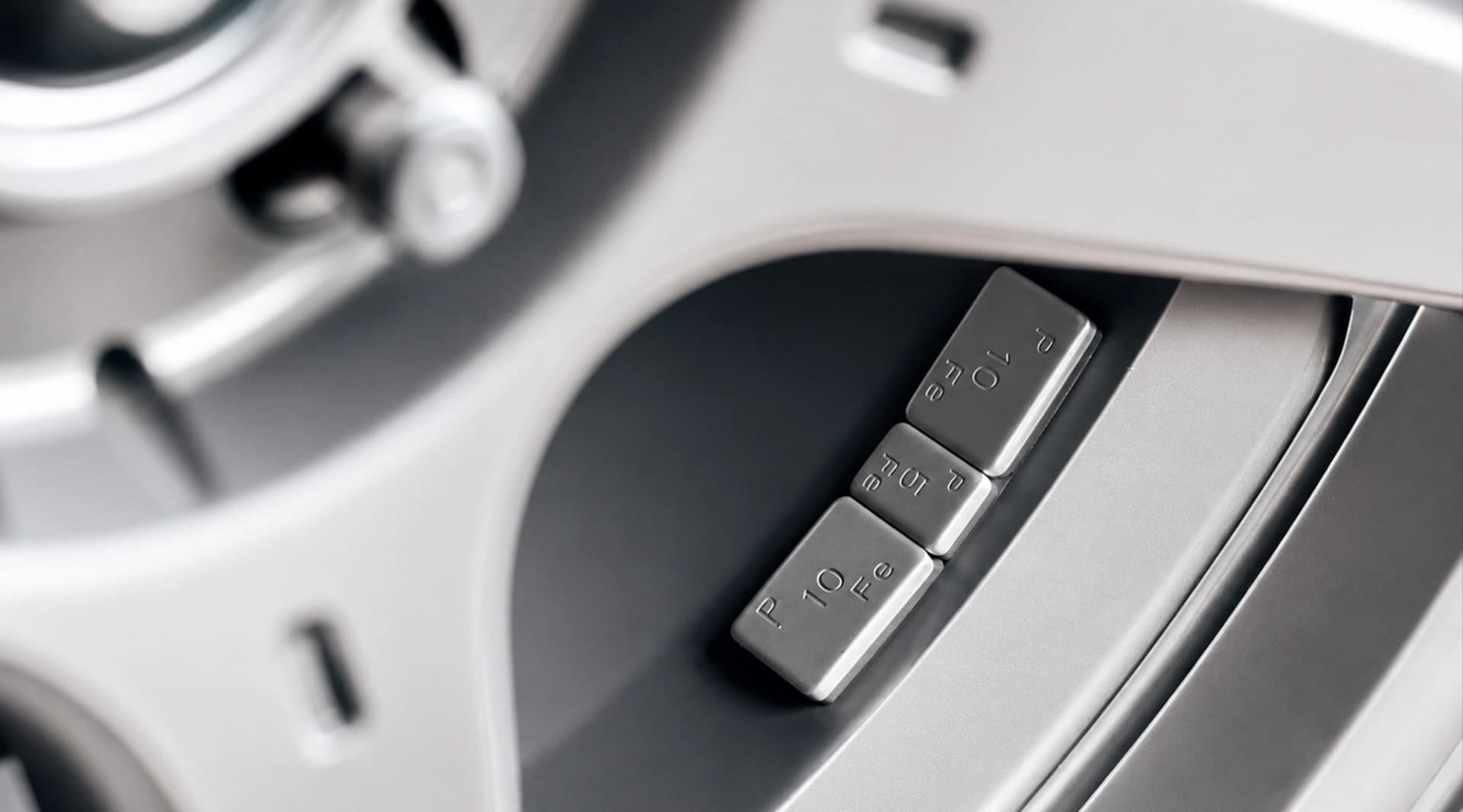
A steering wheel that shakes at 100 km/h is usually a ten-gram problem
Nothing that rolls is perfectly round, and at motorway speed the difference has to go somewhere.
A wheel and a tyre are both made to tight tolerances, and neither is exactly uniform. The rubber is a fraction denser in one place than another, the rim has a valve hole punched through one side of it, the tyre seats onto the bead with a hair more compression here than there, and the pressure sensor inside adds a few grams that sit in one spot rather than everywhere. Bolt all of that together and one part of the assembly weighs slightly more than the part opposite it. Standing still, it means nothing. Spinning at 1,000 revolutions a minute it becomes a force that grows with the square of the speed, and it has to go somewhere: into the steering column, into the seat rails, into the wheel bearing, into the tread. The small metal blocks a fitter clips or sticks onto your rim exist to cancel that difference out, they are calculated by a machine rather than judged by eye, and losing one is enough to make an otherwise healthy car feel worn out.
Ten grams, and what it turns into at 100 km/h
The reason a balance weight can be this small and still matter is that centrifugal force rises with the square of rotational speed. Take a typical family car wheel, around 32 cm from centre to tread, with a ten gram heavy spot on the rim. At 50 km/h that spot is pulling with about 600 grams of force. Double the speed to 100 km/h and it is not twice as bad, it is four times as bad: roughly 2.5 kg, yanking the wheel out of true about fourteen times every second. At 130 km/h the same ten grams is throwing more than 4 kg around. That is why a vibration so often appears at a particular speed and then fades again above it, and why nobody notices a balance problem in town. The force itself is not going to break anything quickly, but it never stops, and it is absorbed by the wheel bearing, the damper, the track rod ends and the tread, which is why a car left unbalanced for a season often comes back with scalloped, wavy wear across the tyre that no amount of later balancing will smooth out.
Static, dynamic, and why the machine uses two planes
There are two ways an assembly can be out of balance and they feel different. Static imbalance is a single heavy spot at one point around the circumference, and it makes the wheel try to hop up and down, which arrives as a vertical shake. Dynamic imbalance is heaviness distributed unevenly across the width of the wheel, inner shoulder against outer shoulder, and it makes the wheel try to steer itself from side to side, which arrives as a shimmy or a wobble through the steering. A wide rim can be perfectly balanced statically and still shake badly in the dynamic sense, which is exactly why a proper balancing machine spins the assembly and calculates a correction in two planes at once, an inner weight and an outer weight, rather than a single lump. The position around the rim is as important as the mass: the same 15 grams in the wrong place makes the vibration worse, not better.
Where you feel it tells you what it is
This is the part worth memorising, because it stops you paying for the wrong repair. A shake that comes through the steering wheel and gets going somewhere between 80 and 120 km/h is a front wheel out of balance. The same shake felt in your seat and the floor, with a steering wheel that stays calm, is a rear wheel. A vibration that appears only when you brake, and pulses through the pedal, is not balance at all, it is uneven thickness in the brake discs and no amount of weight on the rim will touch it. A vibration that is there at every speed and simply grows as you go faster points at something bent or out of round rather than merely heavy on one side, and the usual culprit in Europe is a rim that met a kerb or a pothole, which is one of the ways that parking with a wheel up on the kerb eventually presents its bill. And a vibration that arrives with a steering wheel that has gone off centre, or a car that pulls to one side, is an alignment question, not a balancing one.
Clipped on, stuck on, and why yours are not lead any more
Two types do the job. Clip-on weights hook over the lip of the rim flange, which is quick and secure and is standard on steel wheels, though on a painted or polished alloy the clip can mark the finish. Adhesive weights are strips of segmented metal on a tape backing, stuck to the flat inner barrel of the wheel where the spokes hide them, which is why on most modern alloys you cannot see any weights at all until you look behind the spokes with a torch. If you grew up looking at lead ones, they are gone: the End-of-Life Vehicles Directive removed lead balance weights from vehicles type-approved in the European Union from July 2005, and what is fitted now is zinc or steel. Zinc and steel are a little less dense than lead, so the same correction is a slightly bigger block, which is worth knowing before you decide a wheel looks over-weighted. The practical consequence of the adhesive type is that it can be removed by things you do on purpose: a pressure washer lance held close to the inner barrel, or a strong acidic wheel cleaner left to dwell, will lift the tape sooner or later. If a vibration appears the week after a thorough clean, look for a clean rectangular shadow of old adhesive on the inside of the rim, and you have found your answer without paying anyone.
When a wheel needs a lot of weight, the weight is not the problem
A few weights per wheel is normal and is evidence the job was done. As a rough guide, corrections up to about 40 grams a wheel are routine, 60 grams is worth a comment, and a rim carrying 100 grams or more is telling you something. At that point the honest answer is not another weight, it is to find out why: a rim bent slightly out of true, a tyre that is out of round or has a defect in its construction, a tyre that has not seated evenly on the bead, or simply an unlucky combination where the tyre's heavy spot and the wheel's heavy spot ended up in the same place. A good workshop will break the tyre down and rotate it on the rim to put those two spots opposite each other, which is called match mounting and often drops the required correction to almost nothing. Better equipped tyre shops go further with a road force machine, which presses a loaded roller against the tread while it spins to measure how the assembly behaves under the weight of the car rather than hanging free in the air. That is the tool that finds the tyre that is perfectly balanced and still shakes, and it is worth asking for by name if a vibration survives two ordinary balancing attempts.
Balancing is not alignment, and an electric car hides less of it
These two get confused constantly, including by people selling them. Balancing corrects weight distribution in a spinning wheel and cures vibration. Alignment sets the angles at which the wheels point and cures pulling, an off-centre steering wheel and tyres worn away on one edge. They are separate jobs on separate machines, they fix separate symptoms, and paying for alignment to cure a shake at 110 km/h is money spent on the wrong problem. Electric cars have made all of this more noticeable rather than less. There is no engine noise or combustion vibration to mask a shimmy, the cars are heavy so every imbalance is fighting more inertia, the wheels are typically large in diameter with low-profile tyres that transmit rather than absorb, and many run a layer of noise-cancelling foam bonded inside the tyre that fitters have to work around. That is on top of the fact that the extra mass is already putting more work through the tyres than a petrol equivalent would. If you drive an EV and something feels rough at speed, take it seriously early, because the tyre wear that follows an ignored imbalance is expensive on a heavy car.
What to actually do
Balancing is one of the cheapest jobs in the workshop and one of the easiest to get wrong by treating the wrong symptom.
Note where the shake is before you book anything. Steering wheel means front, seat and floor means rear, brake pedal means discs, all speeds means something bent.
If a vibration appears just after a wheel clean, shine a torch behind the spokes and look for a clean rectangle of adhesive where a weight used to be.
Check pressures cold before you blame balance. An underinflated tyre changes how everything feels at speed.
Keep the pressure washer lance and acidic wheel cleaners away from the inner barrel of the rim.
Ask for balancing whenever a tyre is fitted, repaired or refitted, and ask what correction each wheel needed. Over 60 grams deserves a conversation.
If a shake survives two balancing attempts, ask for match mounting or a road force measurement rather than paying for a third go on the same machine.
After any wheel comes off, re-check the bolt torque after 50 to 100 km. That one is safety, not comfort.
Frequently asked questions
How often do wheels need rebalancing?
There is no service interval for it, and any garage selling you one on a schedule is selling you a habit rather than a repair. Balancing belongs to events, not to dates: whenever a new tyre is fitted, after a puncture repair, after a tyre is broken off the rim for any reason, and whenever a vibration turns up that was not there before. Beyond that, a set of wheels that has been left alone stays balanced, because nothing about the assembly has changed. What does change it is losing a weight, kerbing a rim, picking up a chunk of mud or ice inside the wheel in winter, or a tyre wearing unevenly over tens of thousands of kilometres. If the car feels smooth at motorway speed, it is balanced, and no machine will improve on that.
Do I have to rebalance when I swap to winter wheels?
Not automatically. A second set that was balanced when it was built and has been sitting on a rack since spring is still balanced, because the tyre has not moved on the rim. Two things are worth doing at the swap anyway. Look at each inner barrel before the wheels go on, because a weight that fell off in the boot of your car or in the garage is easy to spot then and invisible afterwards, and re-check the bolt torque 50 to 100 km after fitting. If a wheel does shake after a changeover, the usual causes are a lost weight, a flat spot from standing on soft tyres for months that will disappear after a few kilometres, or debris packed inside the rim, and only the first of those needs a machine. Store the set at the pressures the tyre shop recommends rather than deflated, and check the age code on the rubber while the wheels are off the car and easy to read, because a second set ages by the calendar while it sits.
Can I stick a lost weight back on myself?
You can buy the strips, but you cannot know the two numbers that matter, which are how many grams and exactly where around the rim. Both come out of the machine, and guessing at either usually makes the vibration worse rather than better, because a correction in the wrong position adds a new imbalance on top of the one you were trying to cancel. There is also a second plane to think about, since the machine specifies an inner and an outer weight for the same wheel. The job takes a fitter a few minutes and generally costs well under 20 euros a wheel across Europe, often nothing at all if the tyres were bought there. The one thing worth doing yourself is the diagnosis: knowing which corner is shaking and at what speed saves the workshop time and saves you being sold a full set of four.
My car only shakes when I brake. Will balancing fix it?
No, and this is the most common wasted repair of the lot. A pulse felt through the brake pedal and a shudder that appears only under braking come from uneven thickness in the brake discs, usually because a hot disc was held against stationary pads at a set of traffic lights, or because a pad has deposited material unevenly on the face. The wheel is spinning exactly as smoothly as it did before you touched the pedal, so the balancing machine finds nothing to correct. The fix is skimming or replacing the discs and, in most cases, the pads with them. The tell is simple: if the steering shakes at a steady 110 km/h with your foot nowhere near the brake, it is balance, and if it only ever happens as you slow from motorway speed, it is not.
Are the weights bad for my alloys, and can I have them hidden?
Hidden is the normal request and any decent tyre shop will do it: ask for adhesive weights on the inner barrel rather than clip-ons on the outer flange, and they disappear behind the spokes. It is worth asking specifically on a polished, painted or refurbished rim, because a clip-on hooks over the visible edge and can chip the finish going on or coming off, and on some designs it will not sit flush at all. What you should not do is have them left off for looks. A wheel is either balanced or it is not, and taking the correction away puts the vibration straight back, along with the bearing wear and the wavy tyre wear that follow it. If you are fitting aftermarket wheels, ask whether they need any unusual amount of correction the first time they are balanced, because that is the cheapest early warning you will ever get about a rim that is not true.
