Mercedes will close two German plants if labour costs do not fall
Mercedes will keep every German plant, on a condition its workforce has refused
Michael Schiebe, the Mercedes-Benz production board member, told a works meeting in Sindelfingen on Monday that keeping all German sites remains the goal. Then he said what happens if the cost talks fail: one German assembly plant and one German powertrain plant will have to close. A company spokesperson confirmed the remarks to dpa. Outside the hall, about 20,000 employees were already on the street.
Schiebe's condition covers one assembly plant and one powertrain plant
Mercedes confirmed that its clear aim is to keep every German site, and that this requires agreement on measures acceptable to everyone to bring German costs down. If that fails, Schiebe said, the company will have to close one German assembly plant and one German powertrain plant. An assembly plant builds the finished car; a powertrain plant builds what goes into it. No decision has been taken and no site was named, which is precisely what makes every German factory a candidate. Mercedes has been pressing for lower German production costs for months, and told employees in the summer that its German plant capacity sits well above what it needs.
Sindelfingen, Rastatt and Bremen each have room for 300,000 cars
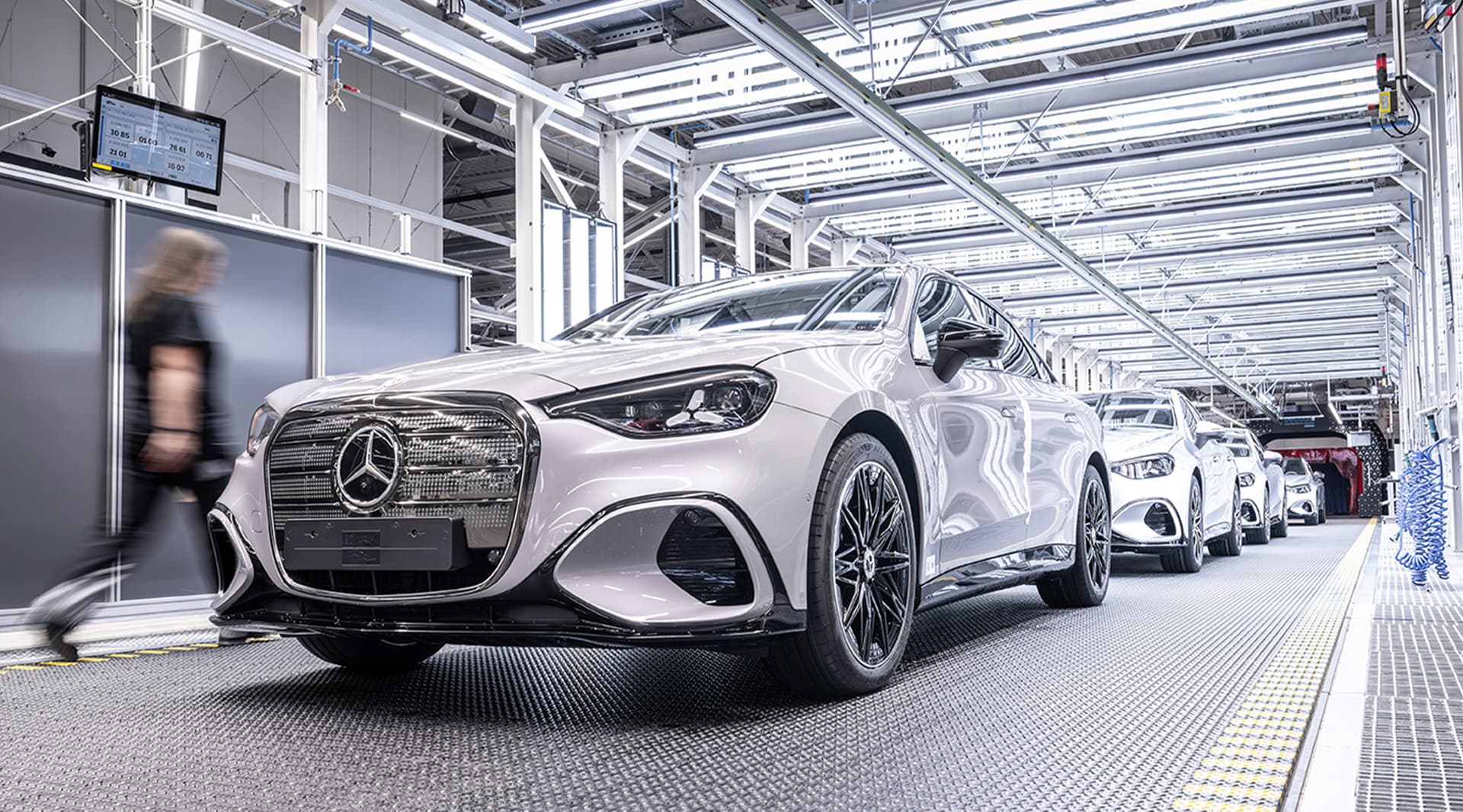
Mercedes assembles cars in Germany at Sindelfingen, Rastatt and Bremen, and each of the three has capacity for roughly 300,000 vehicles a year, about 900,000 between them. The powertrain side is wider, taking in engine, transmission and battery sites including Untertürkheim and Hamburg. Michael Häberle, deputy head of the group works council and works council chief at Untertürkheim, says management is weighing the closure of engine production at Untertürkheim, the site the company grew out of and where its headquarters still stands. For a sense of what the end of that road looks like, Audi's Brussels factory is being turned into warehouses.
The proposal is a 40-hour week paid as 35
Mercedes calls it a productivity offensive for Germany, and a board letter to employees proposed that staff work longer for the same money. In practice that means moving from the 35-hour week to 40 hours with no extra pay, which IG Metall treats as a red line rather than an opening position. Häberle, who sits at the negotiating table, called the management proposals part of a horror catalogue and said the two sides are miles apart. In 40 years at Mercedes, he said, he has never met this little willingness to compromise. The works council's counter-proposal went the other way entirely and put 30 hours on the table.
Kecskemét doubled to 400,000 cars at €15.60 an hour
Mercedes doubled capacity at Kecskemét in Hungary to 400,000 cars this year, making it the group's largest plant in Europe and bigger than any single German site. The electric C-Class moved there in 2026. Internal presentations shown at German sites put Eastern European labour costs around 75 percent below German levels, American costs almost a fifth lower, and annual working hours elsewhere more than a quarter higher. Eurostat's 2025 figures support the direction of that argument: an hour of manufacturing labour costs €49.50 in Germany, €35.00 across the European Union and €15.60 in Hungary.
German capacity is already a tenth below 2024, and 2.4 million becomes 2.2
This would not be the first cut. Mercedes has already taken about a tenth out of its German manufacturing capacity against 2024, and the group plan plots worldwide capacity down from 2.4 million vehicles to between 2 and 2.2 million by 2028 or 2029. Häberle says management has signalled further German reductions late this decade even if the works council signs the current package. The fight belongs to the whole German industry rather than to Stuttgart alone: Volkswagen's works council waved through 50,000 job cuts this month, and BMW is removing 8,000 posts. Monday's IG Metall day of action drew about 175,000 people across carmakers and suppliers, with one banner in Untertürkheim reading "40 hours for us, millions for you?"
AutoNext Take
Mercedes is not asking its German workforce to close the gap to Hungary. It is asking them to close under a fifth of it. Eurostat puts German manufacturing labour at €49.50 an hour and Hungary at €15.60, a gap of €33.90. Working 40 hours for 35 hours' pay takes the German figure to roughly €43.30, and Kecskemét still costs about a third as much. That is the honest size of the deal on the table, and it is why Häberle can call the positions miles apart without exaggerating. Five hours a week unpaid is a serious concession. It is not an answer to Hungary.
That makes the threat a statement about demand rather than about wages. Mercedes told its own staff in the summer that German capacity sits well above need, it has already removed a tenth of it since 2024, and it has built Kecskemét up to 400,000 cars. Three German assembly plants with room for 900,000 are the arithmetic problem, and no working-time deal changes that arithmetic. Mercedes publishes its 2026 annual figures in February. If German output has fallen again while Hungary fills, the works council spent this autumn negotiating over a decision the capital plan had already taken.