The same worn tyre costs you ten metres at 80 km/h and ninety-six at 120
A tyre does not grip water. It removes it, and it only ever has so long to do the job.
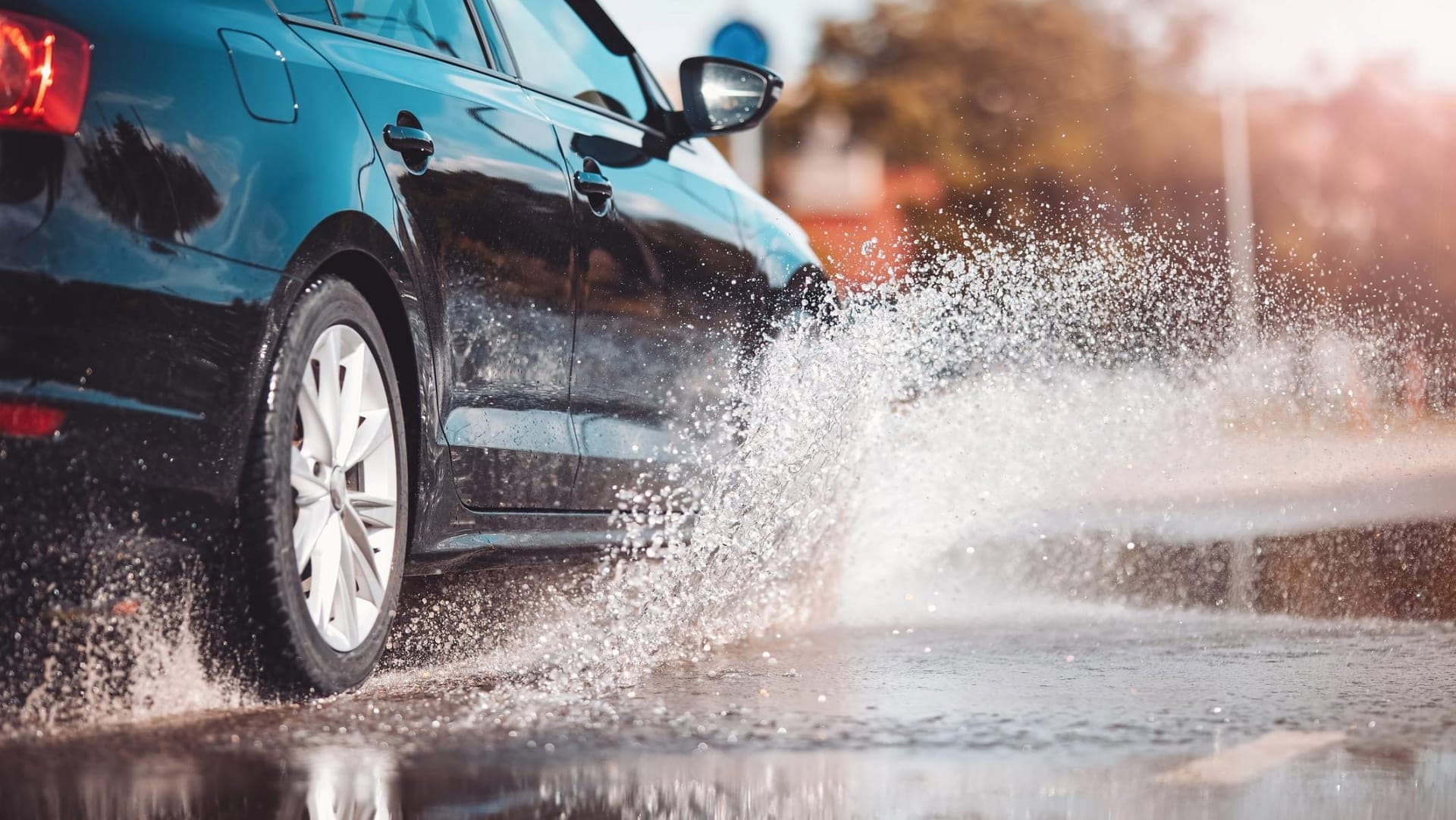
Everything your car does on a wet road depends on getting the water out of the way before the rubber arrives. The grooves in a tyre are not there for grip and they are not decoration, they are a pump: the contact patch of a new tyre can shift up to 30 litres of water a second at 80 km/h, and every litre of that has to go somewhere in the fraction of a second the tread is on the ground. The problem is that the pump is not given a fixed amount of work, it is given a fixed amount of time, and your right foot sets it. Double the speed and each square centimetre of tread has half as long to clear the same film of water. Below the threshold the tyre wins and you feel nothing at all. Above it, water builds into a wedge at the leading edge of the contact patch, lifts the tread clear of the tarmac, and the front wheels are skating: the steering goes weightless, the engine note climbs slightly as the wheels speed up against nothing, and none of the controls reach the road any more. That is why aquaplaning never announces itself as a slow, catchable slide. It is a threshold. Worn tyres do not blunt the edge of it, they move it down into speeds you use on an ordinary commute.
Ten metres at 80 km/h, ninety-six at 120
The clearest way to see a threshold is to brake across it. In a test run on Continental's proving ground for AutoBild, a VW Golf on 225/45 R17 tyres was stopped on a soaked surface from 80 km/h in 25.8 metres on new tyres, 31.0 metres on tyres worn to 3 mm, and 36.2 metres on tyres at the 1.6 mm legal minimum. That is a penalty of roughly ten metres, about two car lengths, and most drivers would shrug at it. The same three sets from 120 km/h: 59.1 metres new, 124 metres at 3 mm, 154.9 metres at the legal minimum. The penalty has gone from ten metres to ninety-six. Put an obstacle where the new tyres came to rest and the car on perfectly legal tyres reaches it essentially unbraked, still travelling at 106 km/h. Nothing about the tyres changed between the two tests. Only the speed did, and somewhere between 80 and 120 km/h the worn tread simply stopped being able to clear the water at all.
1.6 mm is a legal floor, not a safety figure
Across the EU the minimum is 1.6 mm, measured in the main grooves across the central three-quarters of the tread and around the whole circumference. The small moulded bars you can feel bridging those grooves sit at exactly that height, which means a tyre whose tread is level with its wear bars is not approaching the limit, it is at it and legally finished. Several countries have already decided the number is not enough once the weather turns: Austria treats a winter tyre below 4 mm as a summer tyre, and Slovakia and Sweden set 3 mm for the winter season. Tyre makers and the big motoring clubs recommend changing summer tyres at 3 mm and winter tyres at 4 mm, and the braking figures above justify that on their own. Depth is not the only clock running, either, because the date code on the sidewall tells you how old the rubber is, and a hardened eight-year-old tyre loses wet grip while its tread depth still measures perfectly respectably.
Your hands and feet should do almost nothing
Once the front wheels lift, the car has stopped taking instructions, and the only useful response is to give it fewer of them. Come off the throttle smoothly rather than snapping off it, hold the steering wheel exactly where it is, and leave the brake alone. On a manual, dip the clutch. What you are waiting for is contact, and it comes back within a second or two as the car slows itself. Holding the wheel still is the part that catches people out, because steering while the tyres are floating feels like it achieves nothing and in that moment it does. The wheels are now pointed somewhere the car is not going, and the instant the tread reaches tarmac the grip returns all at once and the car darts. Almost every aquaplaning crash is really that second event rather than the first. It is the exact opposite of what an emergency stop asks of you, where the right answer is to stand on the pedal as hard as you physically can, and knowing which of the two situations you are in is most of the skill.
The water is not spread evenly, and neither is the risk
Standing water collects exactly where traffic has worn the road away. The twin ruts in the nearside lane of a busy motorway fill first and drain last, the outside of a long bend catches whatever the camber sends across your path, and the strip nearest the kerb or the hard shoulder is where the surface falls away. Water that reaches across only one side of the car is the nastiest version, because the two front tyres end up with very different grip and the car pulls towards the dry one. The other thing worth switching off in heavy rain is cruise control, ordinary or adaptive. It holds a set speed by adding throttle, so if a driven wheel starts to spin up in water its instinct is to feed in more at precisely the moment you want less, and adaptive systems already have blind spots of their own. Sheeting rain on a rutted motorway is a good moment to put the speed back in your own right foot.
Pressure, and which end of the car floats first
An underinflated tyre bulges at the shoulders and lets the centre of the tread ride slightly high, and the centre is precisely the part that should be cutting into the water film, so a soft tyre aquaplanes earlier than a properly inflated one with identical tread. The dashboard is little help here, because the warning light is not a pressure gauge and on most cars it only speaks up once you are already well below where you should be. Which end floats first matters more than most people realise. The front tyres meet undisturbed water and lift first, which gives you understeer, the car running wide while the steering goes light, and that is the survivable version. If the rear axle goes first the car rotates, and an unexpected spin at motorway speed is beyond nearly everyone. That is the whole reason a new pair of tyres belongs on the rear axle, even on a front-wheel-drive car, and it is the single most commonly ignored piece of advice in the entire fitting bay.
What to actually do
The useful half of this takes five minutes on a dry afternoon. The other half is two sentences you want already in your head.
Measure your tread with a one-euro coin. The gold outer rim is exactly 3 mm wide. Push the coin into a main groove, and if any of that gold band is still visible you are under 3 mm and it is time to price a replacement.
Check in three places across the width of each tyre and at three points around it. Wear is rarely even, the legal measurement is the worst spot rather than the average, and a shoulder wearing faster than the centre is an alignment problem you are paying for twice.
Set pressures cold, at least once a month, to the figure on the sticker in the driver's door shut or behind the fuel flap. Use the fully loaded column before a holiday run rather than after it.
Replace summer tyres at 3 mm and winter tyres at 4 mm. At 80 km/h each of those two steps down cost about five metres in the test above. At 120 km/h the first cost sixty-five metres and the second another thirty-one.
When you buy two tyres rather than four, insist they go on the rear axle. Some fitters will still put them on the driven wheels unless you say otherwise.
In standing water, take 10 to 20 km/h off the limit and switch cruise control off. Speed is the only variable in this whole subject you can change while it is raining.
Keep out of the worn ruts in the nearside lane. Placing your wheels slightly wide of them puts the tread on tarmac that has not been hollowed into a channel.
If it happens: throttle off smoothly, wheel still, no brake, clutch in on a manual. Wait. Steer again only once you can feel the road through the wheel.
Afterwards, drop your speed for the next few kilometres instead of shrugging it off. The road, the water and the tyres that produced it are all still exactly as they were.
Frequently asked questions
How deep does the water have to be?
Far less than people expect. A few millimetres is enough at motorway speed, which is why aquaplaning regularly happens on roads where there is no puddle to see and no splash to hear. Heavy rain falling faster than a polished or rutted surface can drain it will do the job on its own. The thing to watch is not the depth of the water but the combination of how hard it is raining, how fast you are going and how much tread you have, and only one of those three is under your control at the time.
My tyres are rated A for wet grip on the EU label. Am I covered?
Not for this. The wet grip class on the EU tyre label is a braking test on a wet but not flooded surface, and aquaplaning resistance is not graded on the label at all. The two do not always move together, because a tread pattern optimised for short wet braking distances is not automatically the best at pumping standing water sideways. Independent tyre tests publish separate straight-line and cornering aquaplaning results, which is where to look if you drive a lot of motorway miles in the rain. And every label figure is measured on a new tyre, which is the whole point of this article.
Will ESP or traction control catch it?
No, and it is important to understand why not. Both systems work by braking an individual wheel or cutting engine torque, and both need grip to act against. A tyre riding on water has none to offer, so there is nothing for the electronics to push on. What they will do is intervene sharply at the moment grip returns, which is genuinely useful and is a reason never to switch ESP off in the wet, but it is a safety net rather than a solution. A traction control light flickering in heavy rain is worth reading as a warning that you are close to the threshold.
Do wider tyres aquaplane sooner?
All else being equal, yes: a wider contact patch has more water directly in front of it and presses down on each square centimetre a little less hard, so the wedge forms at a lower speed. All else is rarely equal, though, since modern wide tyres carry deeper and better-shaped drainage channels to compensate, and a good 245 will beat a mediocre 205. The practical version of this is narrower: if your car is offered with two wheel sizes and you cover long wet motorway distances, the smaller wheel with the taller tyre sidewall is usually the better buy, and it rides better and costs less to replace too.
The road was only damp and the car still felt vague. Was that aquaplaning?
Almost certainly not, and the difference matters because the fix is different. Aquaplaning needs standing water and speed, and it announces itself by making the steering go light. A damp road that feels greasy is usually the film of oil, rubber and diesel that builds up during a dry spell and lifts to the surface with the first light rain, which is why the first rain after a dry week is more slippery than a downpour. That one is a grip problem you can still steer and brake through, gently. Aquaplaning is not.