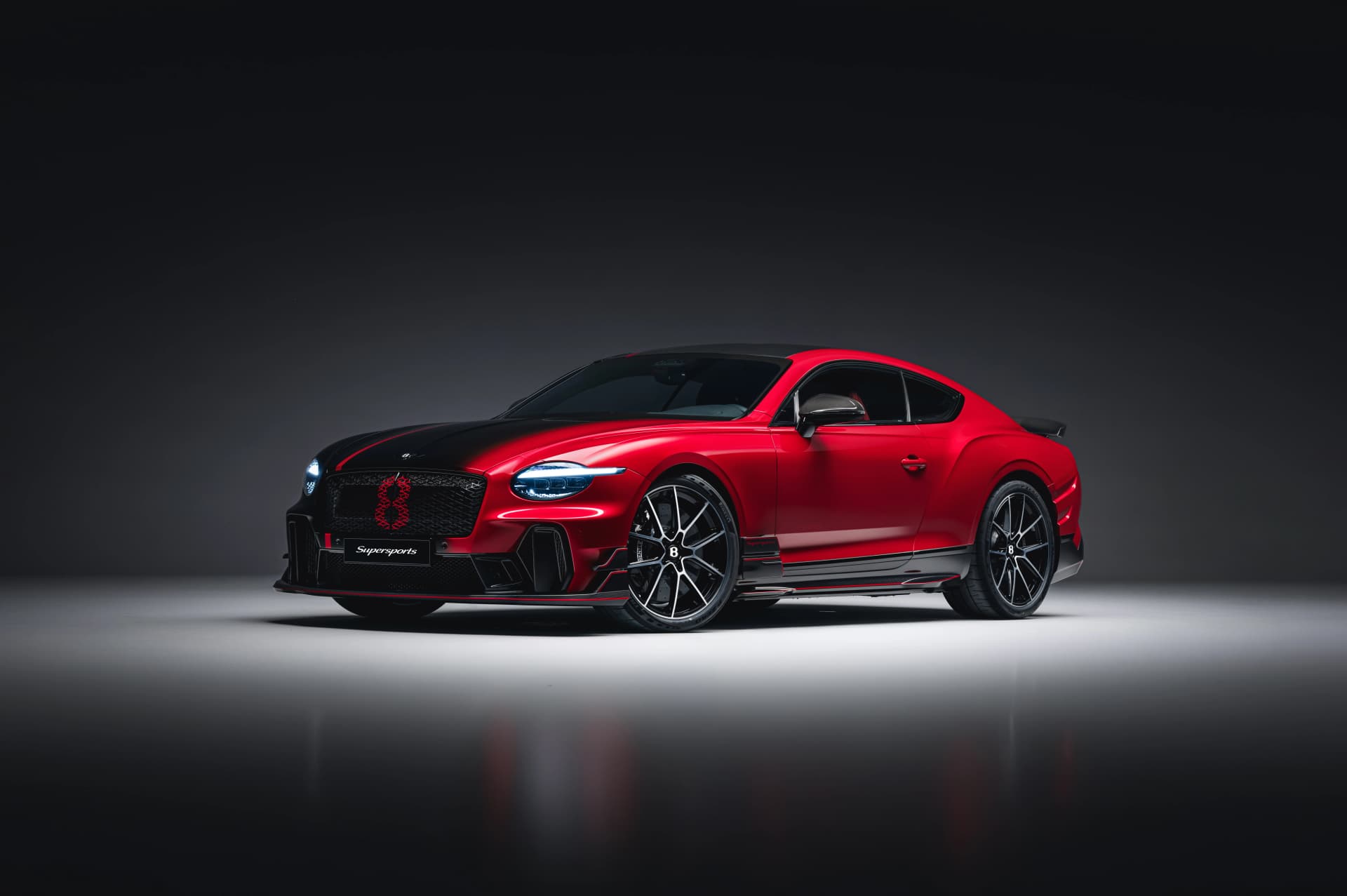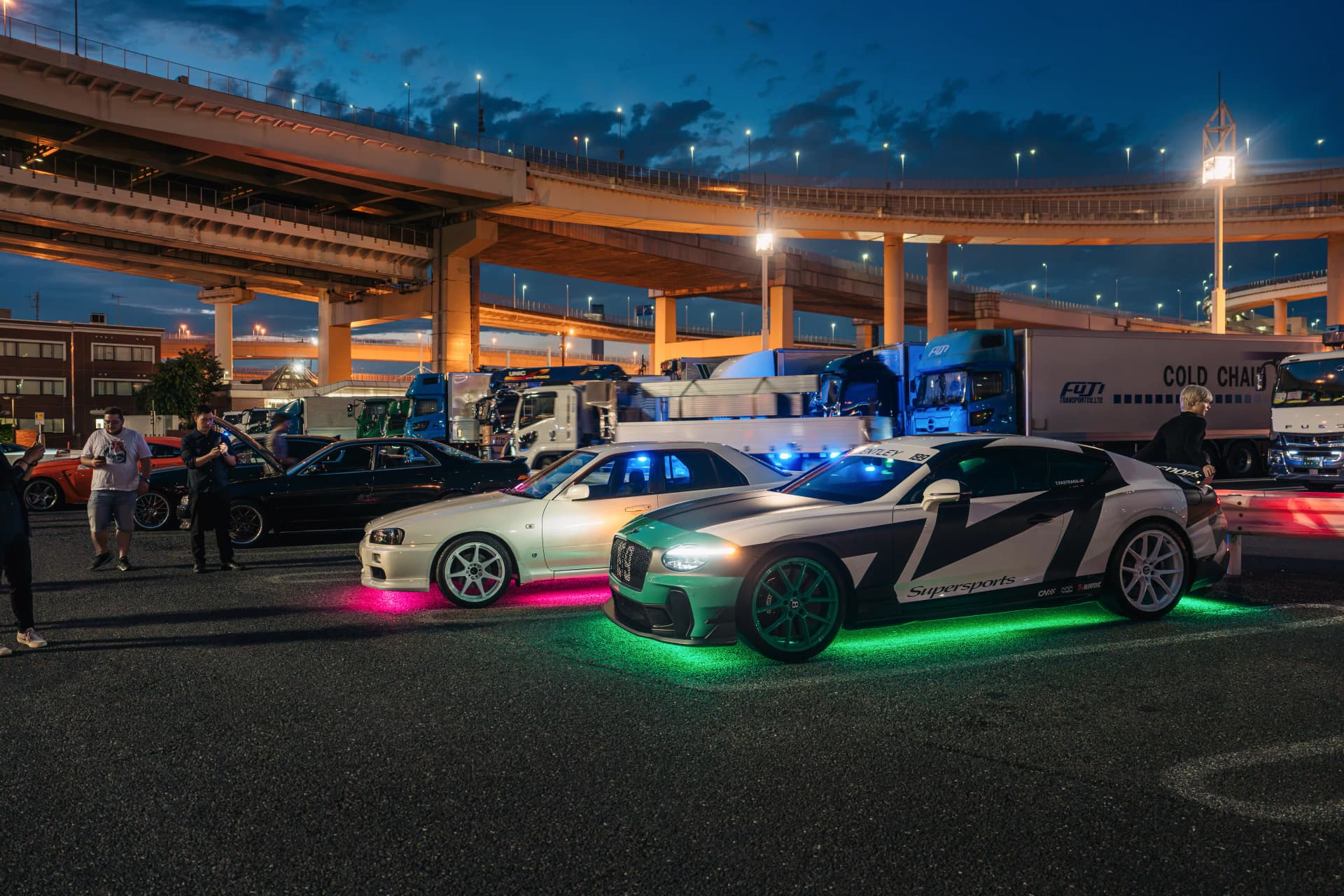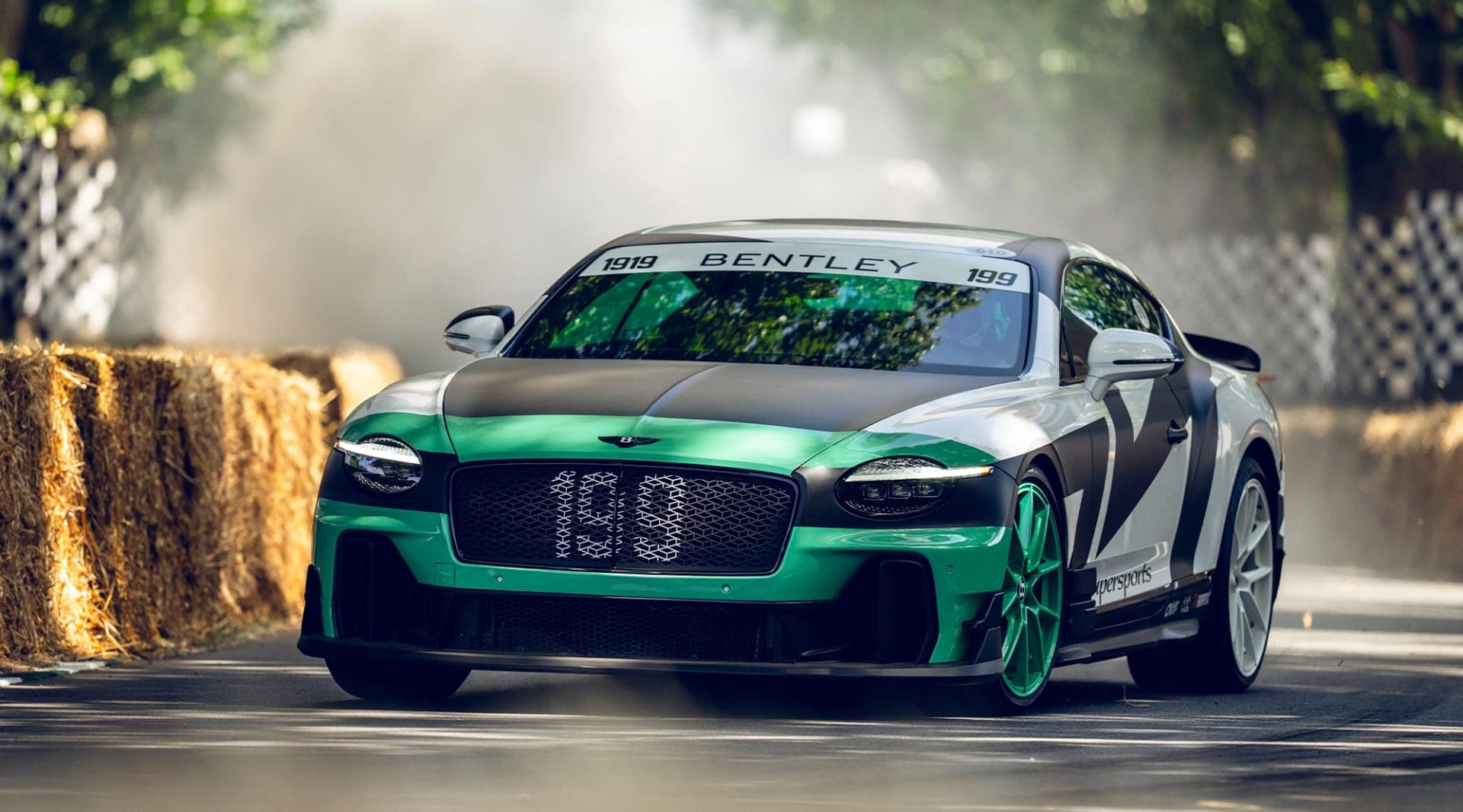
Bentley's Supersports is slower than the GT Speed, and that's the point
Bentley's lightest car since 1940 arrives with less of nearly everything
Bentley has spent a decade answering the question of speed with more: more cylinders, more boost, more electric assistance. The Supersports answers it by deleting. Out came the plug-in hybrid system, the rear seats, the front driveshafts and the four-wheel drive that has defined every Continental GT since 2003. What is left weighs 1,995 kg, makes 666 hp, and has just been let loose at Laguna Seca.
The Supersports weighs 1,995 kg, the first sub-two-tonne Bentley since 1940
At 1,995 kg the Supersports is the first road car Bentley has built under two tonnes in 85 years. The Continental GT Speed it is derived from weighs 2.45 tonnes, so more than 400 kg has gone. Almost none of it was shaved off in grams. It came out in large pieces: the hybrid battery and motor, the front differential and driveshafts, and the rear seats, replaced by a leather and carbon fibre storage hold. A carbon roof, forged wheels and a titanium Akrapovic exhaust did the rest.
666 hp goes to the rear wheels only, a Continental GT first
The 4.0-litre twin-turbo V8 stays, but with larger single-scroll turbos, a stronger crankcase, a new cylinder head and variable valve timing it makes 666 hp and 800 Nm. All of it goes rearward through an eight-speed dual-clutch gearbox and an electronically controlled limited-slip differential, which makes this the first two-wheel-drive Continental GT in 23 years of the model. Bentley kept the air springs, the rear-axle steering and the active anti-roll bars, and widened the rear track by 15 mm.
0-100 km/h takes 3.7 seconds, half a second slower than the GT Speed
This is the part Bentley does not put on a poster. The GT Speed makes 782 hp, reaches 100 km/h in 3.2 seconds and runs to 335 km/h. The Supersports needs 3.7 seconds and stops at 310 km/h. It is 116 hp down and slower everywhere a stopwatch can measure. What it gains is density: 334 hp per tonne against the GT Speed's 319, around 300 kg more downforce than a standard Continental, carbon-ceramic brakes with 440 mm front discs and ten-piston calipers, and optional Pirelli Trofeo RS tyres Bentley rates at 1.3 g.
Single vehicle approval lets Bentley leave off some mandatory driver aids
The Supersports is the only Continental GT of this generation that does not go through normal series homologation, and in Britain it reaches the road via single vehicle approval instead. Autocar's road test reports that this lets Bentley omit some of the ADAS and driver-monitoring systems fitted to everything else it sells. That is a bigger deal in Europe than it sounds. Under Regulation (EU) 2019/2144, every new vehicle registered since 7 July 2024 has to carry Intelligent Speed Assistance, drowsiness warning and emergency lane keeping, and small-series or individual approvals are among the few routes that can sidestep parts of it. It is the same regulatory clock Porsche is racing with its manual 911s.
All 500 cars are sold at £342,900, and the brakes still overheat
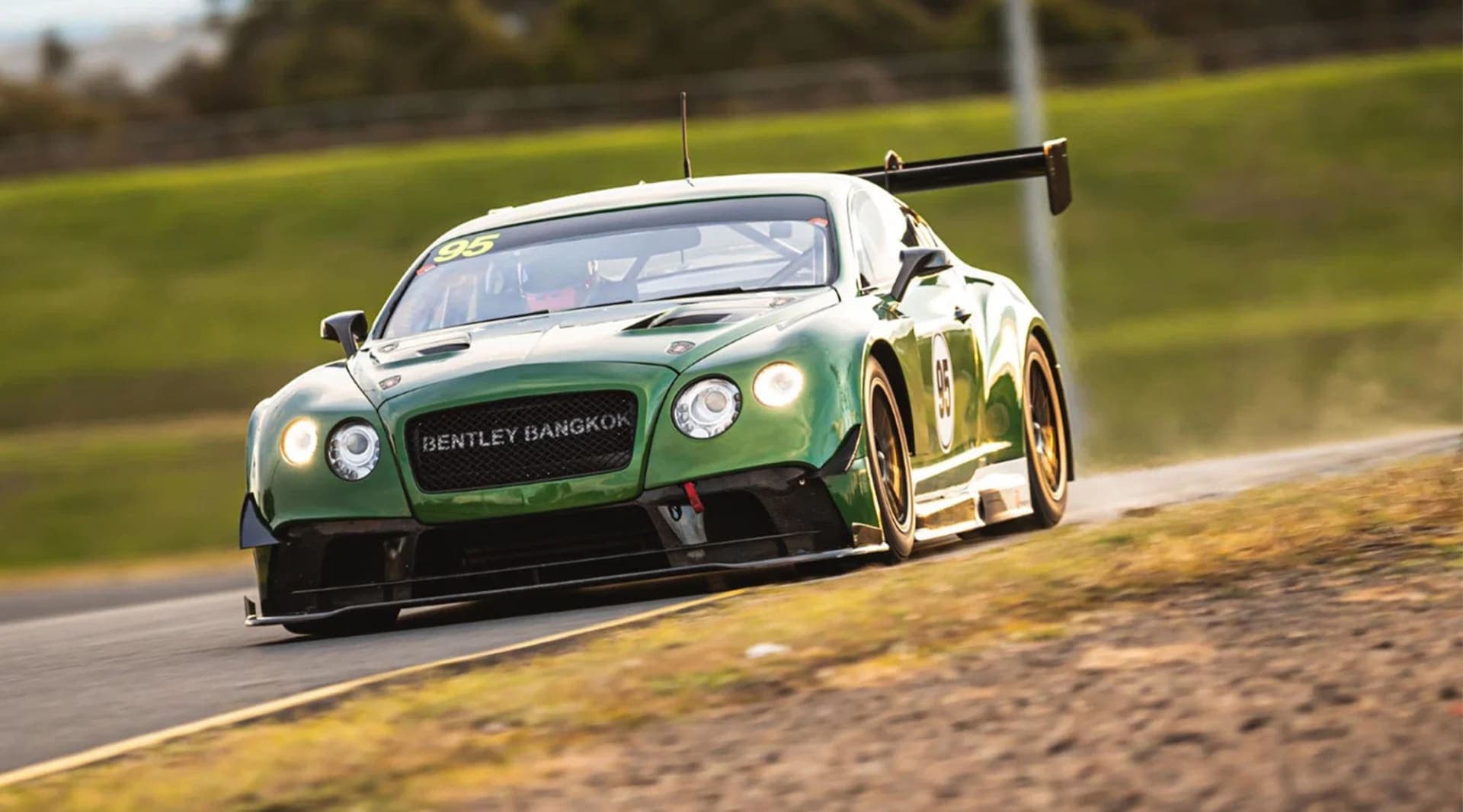
Bentley will build 500 examples, priced from £342,900, and every one is spoken for before deliveries begin at the end of 2026. Roughly a third are earmarked for the United States. Buyers are getting an honest car rather than a flawless one: in the same Laguna Seca test, Autocar found the brakes and the differential starting to overheat on longer stints, which is precisely what a track-bred car is not supposed to do. Bentley's own line on the project is that this is the car the 2015 Continental GT3-R should have been, and that one weighed close to 2,270 kg with four-wheel drive.
AutoNext Take
The number that justifies the whole project is 334 hp per tonne against the GT Speed's 319, and Bentley got there while giving away 116 hp. That is a genuine engineering result. It is also the easiest version of the problem. A 500-car run that skips series homologation can delete driver-monitoring hardware, sell without rear seats and ignore the fleet arithmetic that shapes every other car built at Crewe. Frank Walliser, the former Porsche executive who now runs Bentley, has called the Supersports a catalyst rather than a one-off, which means the car that actually matters is the next one.
So here is the test. If Bentley's second lightweight arrives with full type approval, the mandatory driver aids, back seats and a price under £250,000, and still lands under two tonnes, then the way this company builds cars has changed. If it does not, the Supersports was a superb 500-unit exemption, and the lightest Bentley since 1940 is going to hold that title for a long time.