Bugatti's Tourbillon V16 cleared 72 decibels without a single fake note
The loudest thing about the Bugatti Tourbillon is a number set in Brussels
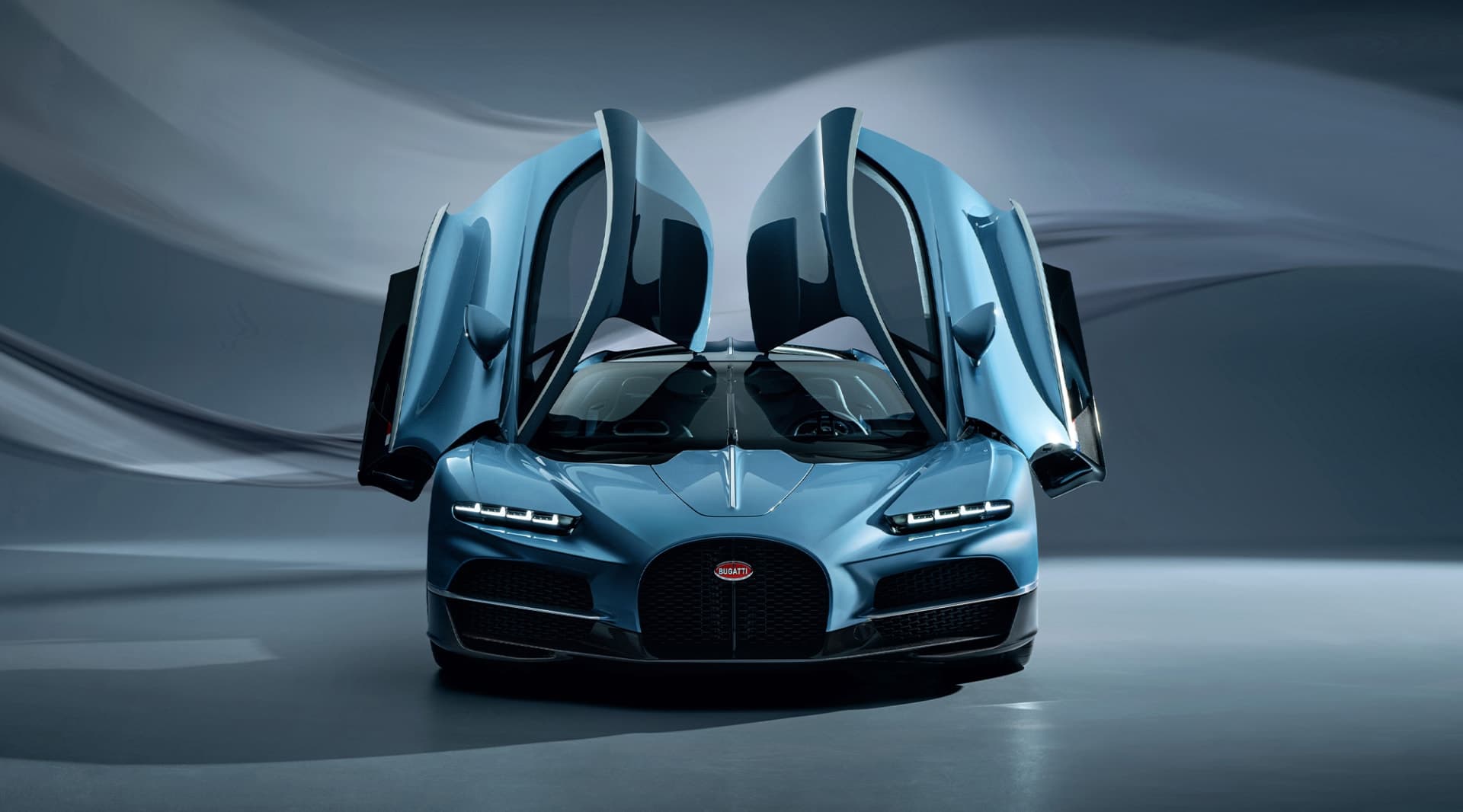
Bugatti published the newest episode of its 'A New Era' docuseries on Thursday, and it covers the one part of the Tourbillon nobody can photograph. The naturally aspirated 8.3-litre V16 that replaced the W16 screams to 9,000 rpm, and not one note of it is generated electronically. Before Molsheim could sign that off, the whole car had to survive a legal test with a ceiling of 72 decibels.
Nothing you hear in the Tourbillon comes out of a speaker
The decision that separates the Tourbillon from most of its rivals is a negative one. There is no synthesised engine note through the audio system and no piped intake noise, so everything the occupants hear is made by machinery. Bugatti tuned the acoustic package to let the powertrain through into the cabin rather than replace it, and ran thousands of simulations across the exhaust and air-intake systems to find the balance. Romain Volatier, who heads NVH and acoustics at Bugatti, says the roughness was deliberate: the marque has never had a very clean-sounding engine, and keeping it ‘a little bit dirty and raw’ became a fixed point of the brief.
The 72 decibel ceiling is the top bracket of Regulation (EU) 540/2014
That figure is not a Bugatti target, it is European law, and it is the most generous number in the table. Annex III of Regulation (EU) 540/2014 sorts passenger cars by power-to-mass ratio, and the 72 decibel line applies only to cars above 200 kW per tonne with no more than four seats and a driver's seat R point no higher than 450 mm off the ground. It is the supercar bracket, written for machines that are low, light and absurdly powerful. The Tourbillon, with 1,000 hp from the V16 alone and 1,800 hp all in, clears the power threshold several times over.
A family hatchback is capped at 68 decibels, and the gap is not small
In the same Phase 3 column, an ordinary car under 120 kW per tonne has to come in at 68 decibels. Four decibels sounds trivial, but the scale is logarithmic, so Bugatti is allowed roughly two and a half times the sound energy of a Golf. The bracket has been tightening as well. It stood at 75 decibels in Phase 1 and 74 in Phase 2, so the current limit permits half the sound energy of the original rule. Phase 3 has applied to new vehicle types since 1 July 2024 and to every first registration since 1 July 2026.
The microphones hear the tyres, the body and the active rear wing too
The test is not one reading of an exhaust pipe. It combines constant-speed and accelerated passes, and the microphones capture everything the car emits: tyre roar, airflow over the body and any aerodynamic hardware doing work. That last one matters for a Tourbillon, whose active rear wing makes real downforce and real noise while it does it. Conditions are policed as tightly as the car. Temperature and wind speed have to sit inside defined limits and a single gust can void an otherwise clean run, which is why the team rehearsed at length before the session that counted.
Bugatti's own small print says the Tourbillon is not type-approved yet
Volatier says the car passed all the homologation requirements with flying colours, and after three years the acoustic programme is closed. The paperwork behind it is not. The footnote at the bottom of Bugatti's press release states that the Tourbillon falls outside the EU consumption-labelling directive because type approval has not been granted, and noise is one approval among dozens. All 250 cars are sold at €3.8 million before options, and the new Molsheim factory built for them opened in July. That order book is the arithmetic behind Mate Rimac's argument that the top of the market stays combustion for a long time yet.
AutoNext Take
The interesting choice here is not the V16, it is the refusal to cheat. Synthesised engine sound exists because it is cheap, and because the honest alternative is expensive: insulation that has to be tuned rather than simply added, an intake path shaped for tone as well as flow, and an exhaust that must be civil in one part of the rev range and vivid in another. Bugatti has 250 buyers paying €3.8 million each, so it can afford the hard version. Almost nobody else can, which is why almost nobody else bothers.
The claim worth holding Bugatti to is that 72 decibels, not engineering, is now the binding constraint on how a hypercar sounds. Phase 3 took three decibels off a limit these cars were already being designed against, and Annex III has no Phase 4 to move on to. If the Tourbillon's successor arrives in the 2030s still naturally aspirated and still with no speaker in the loop, Molsheim will have shown the noise rules leave room for character. If it turns up turbocharged, or with a synthesiser quietly filling in the top end, the V16 was the last Bugatti built before the law decided what a Bugatti sounds like.