Camille Jenatzy broke 100 km/h in 1899, and his car was electric
Petrol needed three more years to catch a Belgian's electric torpedo from 1899
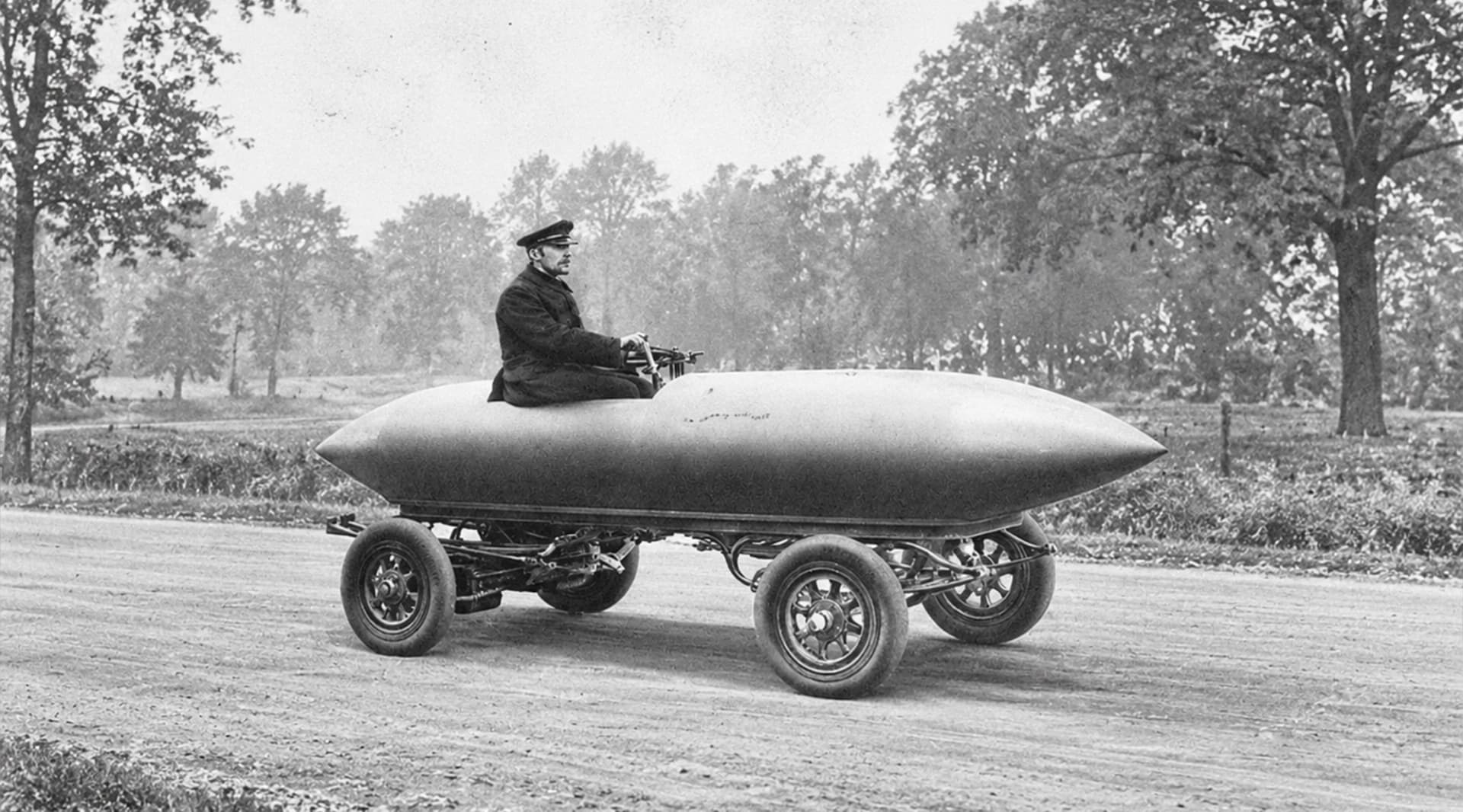
On 29 April 1899, on a straight stretch of road at Achères, north-west of Paris, Camille Jenatzy drove a flying kilometre at 105.88 km/h. The car was electric, shaped like an artillery shell and named La Jamais Contente, the never satisfied. Nobody had gone that fast on land under their own control. The first person past 100 km/h was a Belgian with a red beard, and his fuel was a battery.
Chasseloup-Laubat against Jenatzy: from 63.15 km/h to 105.88 km/h in four months
The land speed record began as a duel between two electric cars. Count Gaston de Chasseloup-Laubat set the first recognised mark on 18 December 1898, 63.15 km/h in a Jeantaud on the same Achères road. Jenatzy answered on 17 January 1899 with 66.66 km/h in a CGA dogcart; the count took it back the same afternoon at 70.31 km/h. Ten days later Jenatzy reached 80.35 km/h, and on 4 March Chasseloup-Laubat, with a crude pointed nose fitted to his Jeantaud, ran 92.78 km/h. Jenatzy had run out of ordinary cars to modify, so he built one from scratch.
La Jamais Contente: 1,450 kg, two motors and a driver sitting in the wind
La Jamais Contente was the first car designed for nothing but a speed record. Coachbuilder Rothschild shaped its 3.80 m body from partinium, a light alloy of aluminium, tungsten and magnesium, over a chassis carrying two Postel-Vinay motors at 200 volts, roughly 68 hp between them, each driving the rear axle by chain. Michelin supplied the tyres and the whole thing weighed 1,450 kg, most of it battery. Its one flaw was the man: Jenatzy sat on top of the torpedo, upright in the airflow, so much of the streamlining was undone before the car moved. It passed 100 km/h regardless.
Léon Serpollet's steam car beat the record in 1902, petrol only that August
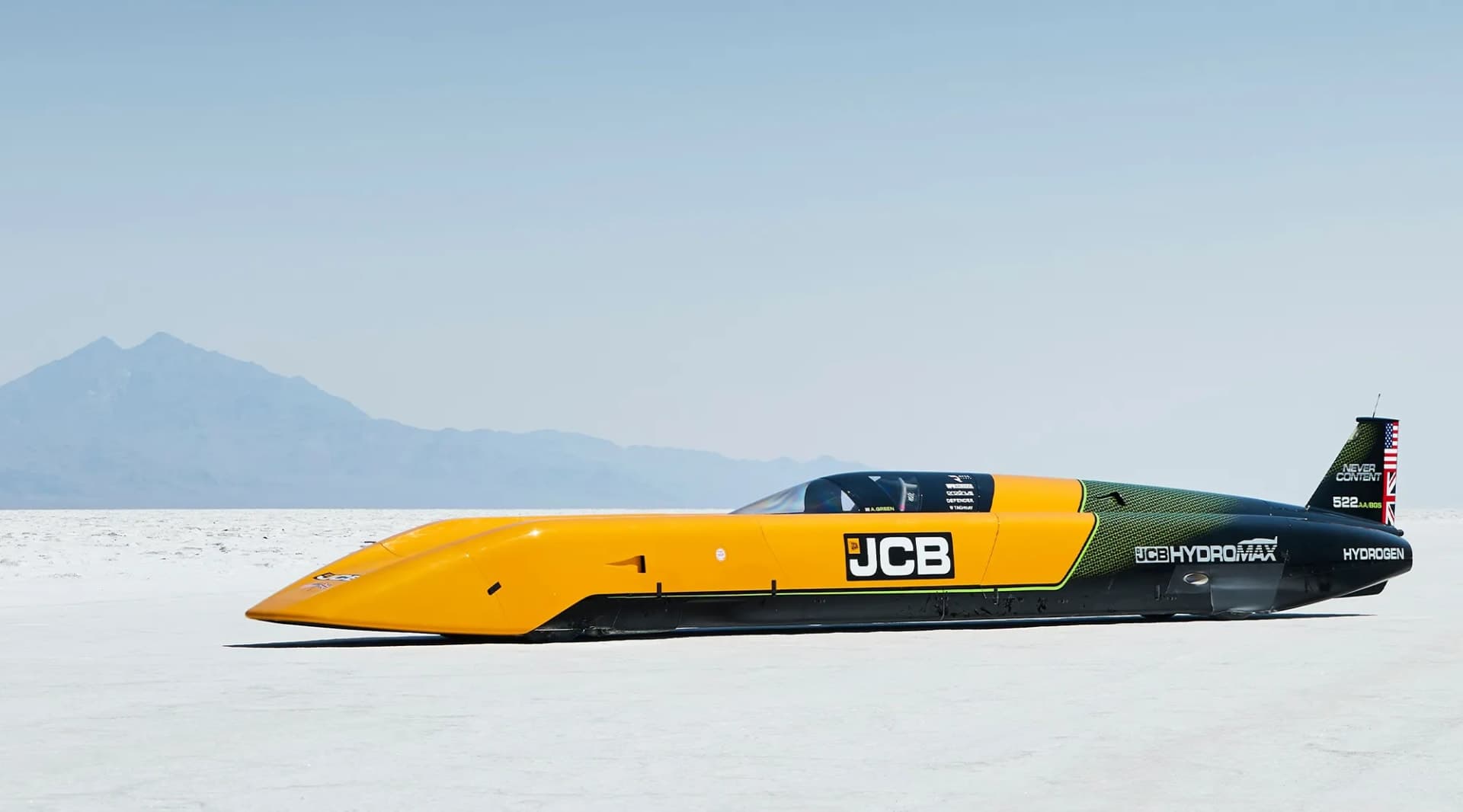
Jenatzy's 105.88 km/h stood for almost three years, longer than any mark before it. When it fell, on 13 April 1902 at Nice, the car that beat it was not petrol either: Léon Serpollet's steam-powered Gardner-Serpollet, nicknamed the Easter Egg, ran 120.80 km/h. A combustion engine did not hold the outright record until 5 August 1902, when William K. Vanderbilt drove a Mors to 122.44 km/h at Ablis. Electric and steam were quicker than petrol in a straight line for the first four years of record-keeping. The outright record has belonged to combustion ever since, with today's chasers running everything from jet engines to a hydrogen-burning JCB.
Gordon Bennett Cup 1903: Jenatzy won for Germany in a borrowed 60 hp Mercedes
Jenatzy's second great day came on 2 July 1903 at Athy in Ireland, in the Gordon Bennett Cup, the first international race held on a closed circuit. He drove for Germany, in a Mercedes, and it was not the car Daimler had built for the race. A fire at the Cannstatt factory in June 1903 destroyed the 90 hp racers, so the works borrowed 60 hp Mercedes Simplex road cars from customers, Jenatzy's from the American Clarence Gray Dinsmore. He covered the 527 km in 6 hours 39 minutes, an average of 79.2 km/h, more than ten minutes clear of René de Knyff's Panhard. Germany's first Gordon Bennett win came from a Belgian in an American's road car, and it brought the 1904 race to the Taunus, where Jenatzy finished second.
The Red Devil died in December 1913, in a Mercedes, as the legend says he predicted
The English press called him Le Diable Rouge for the beard, and the name followed him to the Vanderbilt Cup and the French Grand Prix. The son of a Brussels rubber manufacturer, he later took over the family firm and sold tyres under his own name. He died in December 1913 on a hunting party at Habay-la-Neuve in the Ardennes. The account the New York Times printed within two days is that he hid behind a bush imitating a wild animal to frighten his friends, and Alfred Madoux, director of the newspaper L'Étoile belge, shot him. He bled to death in the car rushing him to hospital, a Mercedes. The story that he had once predicted exactly that is a legend of the kind motoring collects, unprovable and repeated for a century. He is buried at Laeken in Brussels.
AutoNext Take
Electric did not lose the speed race in 1902 because it was slow. It lost because La Jamais Contente was built to be fast for one kilometre and nothing else, while Vanderbilt's Mors was a Paris-Vienna road racer that set a record on the way to somewhere. Energy in the tank beat power at the wheels, and that is the same sum every EV buyer does today when a three-second 0-100 km/h time is weighed against a 20-minute charge. Jenatzy proved the motor. The battery took another 120 years to catch up.
No electric car has held the outright land speed record since 13 April 1902, and nothing in the current programmes is aimed at the 1,228 km/h of ThrustSSC; the electric marks still being set, such as Venturi's 549 km/h in 2016, are class records. Jenatzy's honest place in the EV era is not as a prophet but as the first man to show a battery could beat everything else in a straight line, briefly. His car sits in the Château de Compiègne in France because he built it in Paris for Parisian customers. Belgium kept the man, the grave at Laeken, the nickname, and a habit of hiding its record-breakers in plain sight.