Did you know Mazda once built a “car” that fit inside a suitcase?
A car. Inside a suitcase. Or at least… that’s what they called it.
Every now and then, the automotive world reminds you that not everything has to make sense. Sometimes, it just has to exist. Because long before electric scooters flooded European cities and “last-mile mobility” became a buzzword used in every pitch deck, Mazda quietly built one of the strangest vehicles you’ve probably never heard of.
A car, a motorcycle, or something in between?
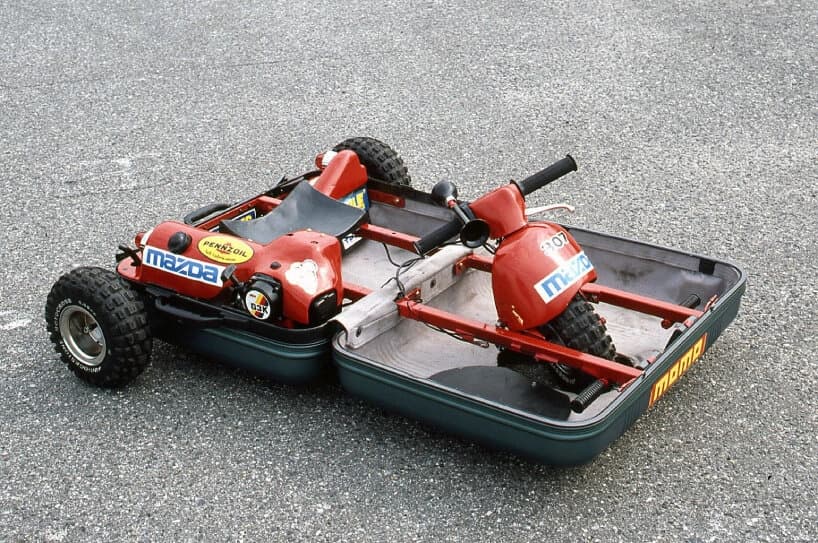
Let’s get one thing straight. Mazda named it the Suitcase Car, but technically speaking, this thing is much closer to a three-wheeled motorcycle than anything resembling a traditional car. And that’s exactly what makes it so fascinating.
Developed in the early 1990s as part of an internal innovation challenge called Fantasyard, the concept was built by a small group of engineers who were given one simple task: create something that solves a real mobility problem.
Their answer? A fully functional, foldable vehicle built inside a standard Samsonite suitcase. Yes, really.
Built for a problem we still haven’t solved
The idea behind it was surprisingly relevant, even by today’s standards. Cars get you close. But not all the way. Parking in dense cities was already becoming a problem in the early ’90s, and Mazda’s engineers were thinking ahead. What if you could park your car outside the city, open your trunk, take out your suitcase… and ride the last kilometre to your destination?
That’s where the Suitcase Car came in. Inside that hard-shell luggage sat a 34cc two-stroke engine, producing around 1.5 horsepower, enough to push the tiny machine to about 30 km/h. It weighed roughly 32 kg, and could be assembled in about a minute.
Unfold it, attach the wheels, pop up the handlebars, and you were ready to go. At least in theory.
Ingenious, absurd… and completely Mazda
Of course, it never made it to production. And if we’re being honest, it probably never stood a real chance. But that’s not the point.
Because what the Suitcase Car represents is something we don’t see enough of anymore: engineering curiosity without immediate commercial pressure. Mazda wasn’t trying to create the next big product. It was exploring an idea.
And interestingly, the concept wasn’t entirely disconnected from the brand’s DNA. The three-wheel layout echoed the early Mazda-Go from the 1930s, while the lightweight philosophy and low centre of gravity aligned perfectly with what would later define cars like the MX-5.
Two versions were eventually built (one for the US, one for Europe) with the latter even appearing at the 1991 Frankfurt Motor Show alongside the legendary 787B Le Mans winner. Today, only one is believed to still exist.
AutoNext Take
We love this. Not because it’s beautiful. Not because it’s practical. But because it represents a mindset the industry is slowly losing.
It’s weird. It’s unnecessary. It’s slightly ridiculous. And yet, it’s more memorable than most concept cars we see today. Because sometimes, innovation doesn’t come from scale or power. It comes from small, almost naive ideas like this.
And here’s the irony: The problem Mazda tried to solve over 30 years ago (that last kilometre) is still not fully solved today. Maybe they were just too early.