Loek Hartog stopped mid-race to pull Ollie Millroy from a burning Ferrari
Nobody in a fire suit reached Ollie Millroy first, a rival driver did
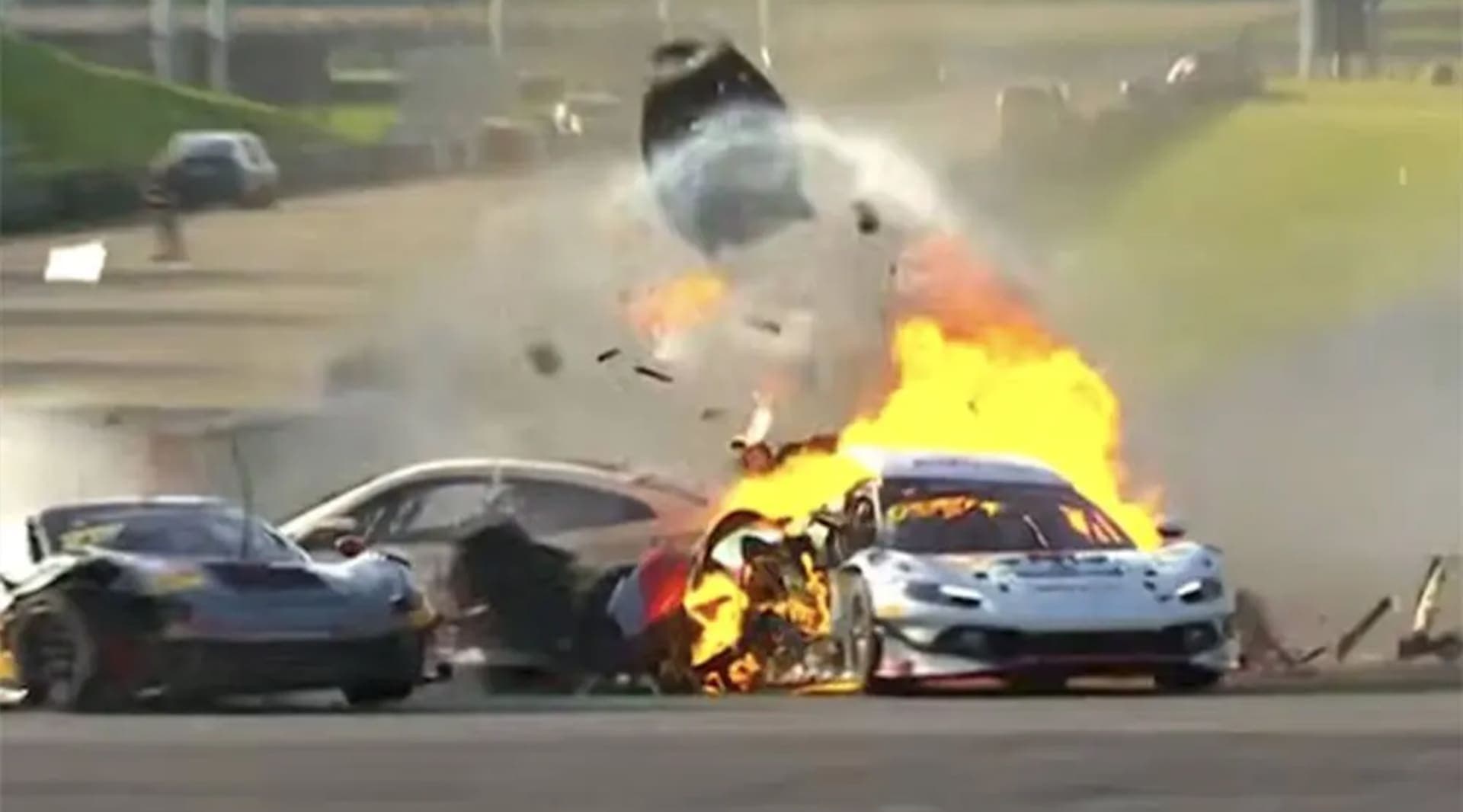
Saturday's opening China GT race at Shanghai was 20 minutes old when Ollie Millroy's Ferrari was hit from the side at the Turn 14 hairpin and caught fire. The man who got him out was not a marshal, a medic or a member of the fire crew. It was Loek Hartog, a 23-year-old Dutchman who stopped his own Porsche on the track, climbed out and went in after him.
Two cars collided at Turn 14 and hit Millroy's Ferrari side-on
Neil Verhagen's 610 Racing BMW M4 GT3 Evo and David Chen's Harmony Racing Ferrari made contact on the approach to Shanghai's Turn 14 hairpin, after Verhagen put a wheel onto damp grass trying to pass and lost the car. Both slid down towards the corner, where Millroy's FIST Team AAI Ferrari 296 GT3 Evo was struck from the side and immediately caught fire. Officials red-flagged the race and it was never restarted.
Hartog took an extinguisher from a marshal and lifted Millroy out
On-board footage from Hartog's Phantom Global Racing Porsche 911 GT3 R Evo shows him pulling up beside the burning Ferrari, getting out and running towards it. He tried the driver's side first, moved around to the opposite side, took a fire extinguisher from a marshal arriving on foot, beat the flames back and lifted Millroy from the cockpit. "When I saw a car engulfed in a huge ball of fire in front of me, there wasn't really a decision to be made," Hartog wrote afterwards. "I never had any doubts."
Millroy, 36, has five broken ribs, a broken collarbone and a bruised lung
The Briton also broke a hand and a finger, and says he remembers nothing from 30 seconds before the impact until an hour after it. He faced surgery the following day before a recovery he expects to spend several weeks in China. "I am still alive tonight, entirely thanks to one man," he wrote, describing how Hartog stopped with no flag marshals or fire crews in sight. He also thanked Ferrari for building a car that could absorb the impact at all.
FIST Team AAI has withdrawn from the rest of the 2026 China GT season
Team owner and co-driver Betty Chen said Millroy was left in the car for about a minute and a half with no immediate assistance from the fire brigade or emergency services, and called the way the incident was handled unacceptable. She confirmed the team will not enter another China GT round this year. A withdrawal is the only consequence anyone has announced so far, and it removes the victim's team from the championship rather than changing anything at the circuit.
Four drivers pulled Niki Lauda from a burning Ferrari in 1976
The precedent is exactly 50 years old. On 1 August 1976 Niki Lauda's Ferrari 312T2 speared into a bank at Bergwerk and bounced back onto the Nordschleife in flames. Guy Edwards, Brett Lunger and Harald Ertl were caught up in the crash, and Arturo Merzario stopped his Wolf after seeing the wreck. The four of them got Lauda out because the marshals could not reach him. Days earlier Lauda had tried to have the race boycotted because the organisers could not staff the 22.835 km circuit with enough doctors and fire marshals. The other drivers voted him down by a single vote.
AutoNext Take
Hartog's courage is the part everyone will replay, and it is the least useful part of the story. What should bother anyone who races is where this happened: Shanghai International Circuit is an FIA Grade 1 venue that hosts a Formula 1 round, and the cars involved came from the same customer GT3 catalogue that put 70 entries on this year's 24 Hours of Spa grid. Nothing about the equipment was improvised or underfunded. The Ferrari did its job, taking a side-on hit at a hairpin with its cell intact. What failed was the interval between the fire starting and somebody in fireproof kit reaching the cockpit, and the only person who closed that gap was a competitor in a race suit with a borrowed extinguisher.
In 1976 the answer to that same failure was structural. Niki Lauda's crash ended the Nordschleife's Formula 1 career on the spot, and Formula 1 never went back. In 2026 the answer so far is one team packing up and going home. The test is easy to apply: if China GT reaches its next round without published changes to marshal post spacing and intervention times, then the sport's takeaway from Shanghai will have been a hero, which is the takeaway that changes nothing.