Mercedes Pagoda and BMW sharknose: one Frenchman drew both
Paul Bracq learned his trade at a Paris crafts school, not a car company
Paul Bracq, born in Bordeaux on 13 December 1933, trained at the École Boulle in Paris from 1950 to 1953 and started out as assistant to the designer Philippe Charbonneaux. Within twenty years his pencil had defined the Mercedes-Benz SL of the 1960s and the BMW coupé of the 1970s. Few designers have shaped the best-loved cars of two direct rivals, and fewer did it so quietly.
Mercedes-Benz hired Paul Bracq at Sindelfingen in March 1957
Mercedes-Benz took Paul Bracq on in March 1957 as the first designer in its main body development department at Sindelfingen, according to the company's own heritage archive. He stayed ten years. In that decade he worked on the coupé and cabriolet versions of the Fintail saloons, the 600 limousine (W100), the W108 and W109 S-Class and the W114 and W115 'Stroke Eight'. That covers most of the shapes that defined Mercedes in the 1960s, from the state car to the taxi rank.
The 230 SL Pagoda roof began as Béla Barényi's engineering idea
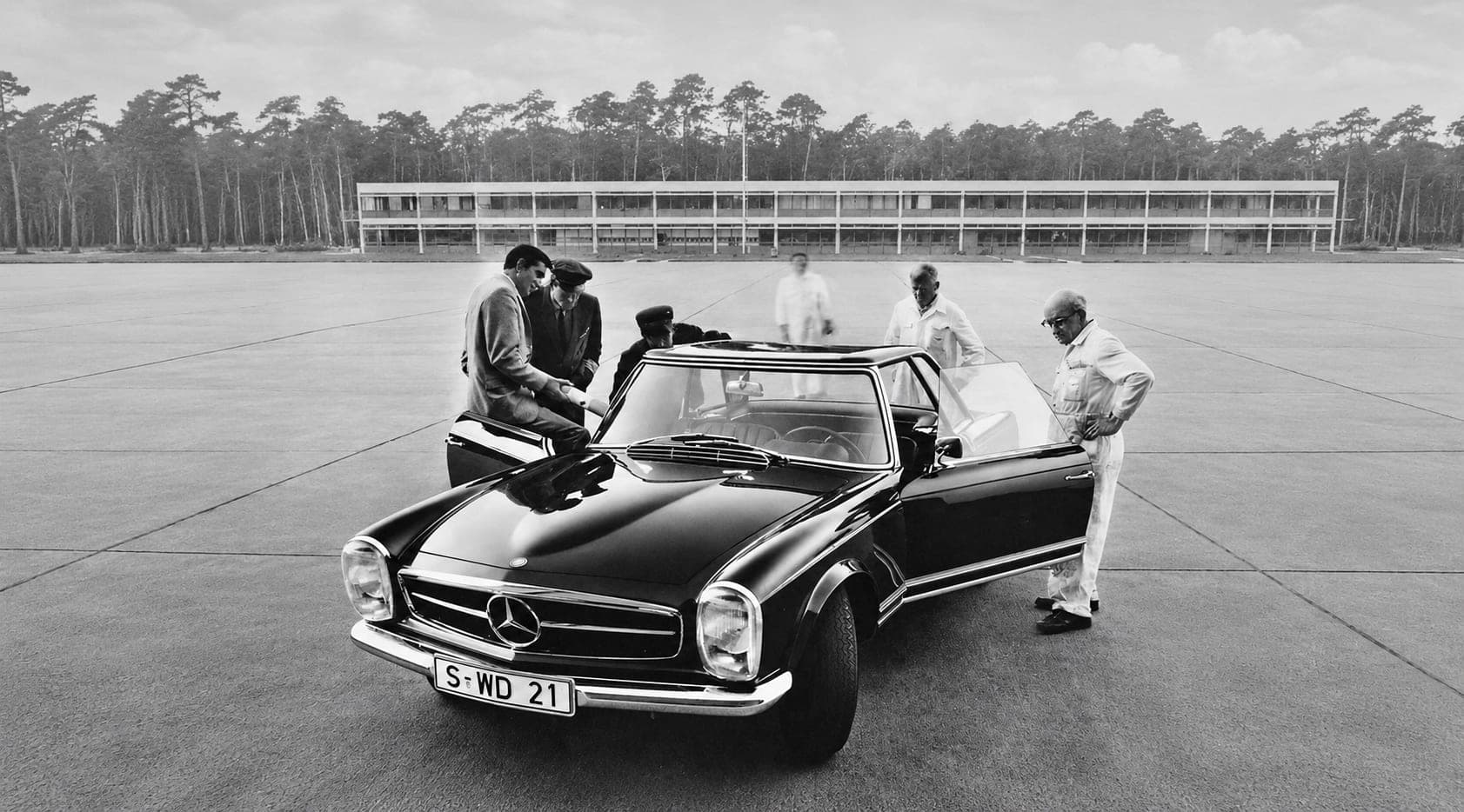
The concave hardtop that gave the 230 SL its Pagoda nickname started with Béla Barényi, the Mercedes engineer best known for the crumple zone, who argued that a roof curving downwards is stiffer than one bulging upwards. Bracq turned that argument into a shape, under design chief Friedrich Geiger, and the car opened at the Geneva Motor Show in March 1963. Mercedes built 48,912 W113 roadsters, as 230, 250 and 280 SL, until 1971. Decades later Bracq still called the design 'perfect', and few cars carry an engineer's idea so lightly.
Between Mercedes and BMW, Bracq helped style the TGV 001 train
Back in France in 1967, Bracq joined the rail equipment maker Brissonneau et Lotz and worked alongside designer Jacques Cooper, who led the styling of the TGV 001, the gas-turbine prototype that opened France's high-speed rail story. In the same period Bracq drew two car prototypes: a sports car based on the BMW 1600 ti and a coupé based on the Simca 1100. In 1970 BMW made him its head of design, succeeding Wilhelm Hofmeister, and the young studio in Munich finally had a Frenchman with a German decade behind him.
The 1972 BMW Turbo put gullwing doors on a 200 hp mid-engined study
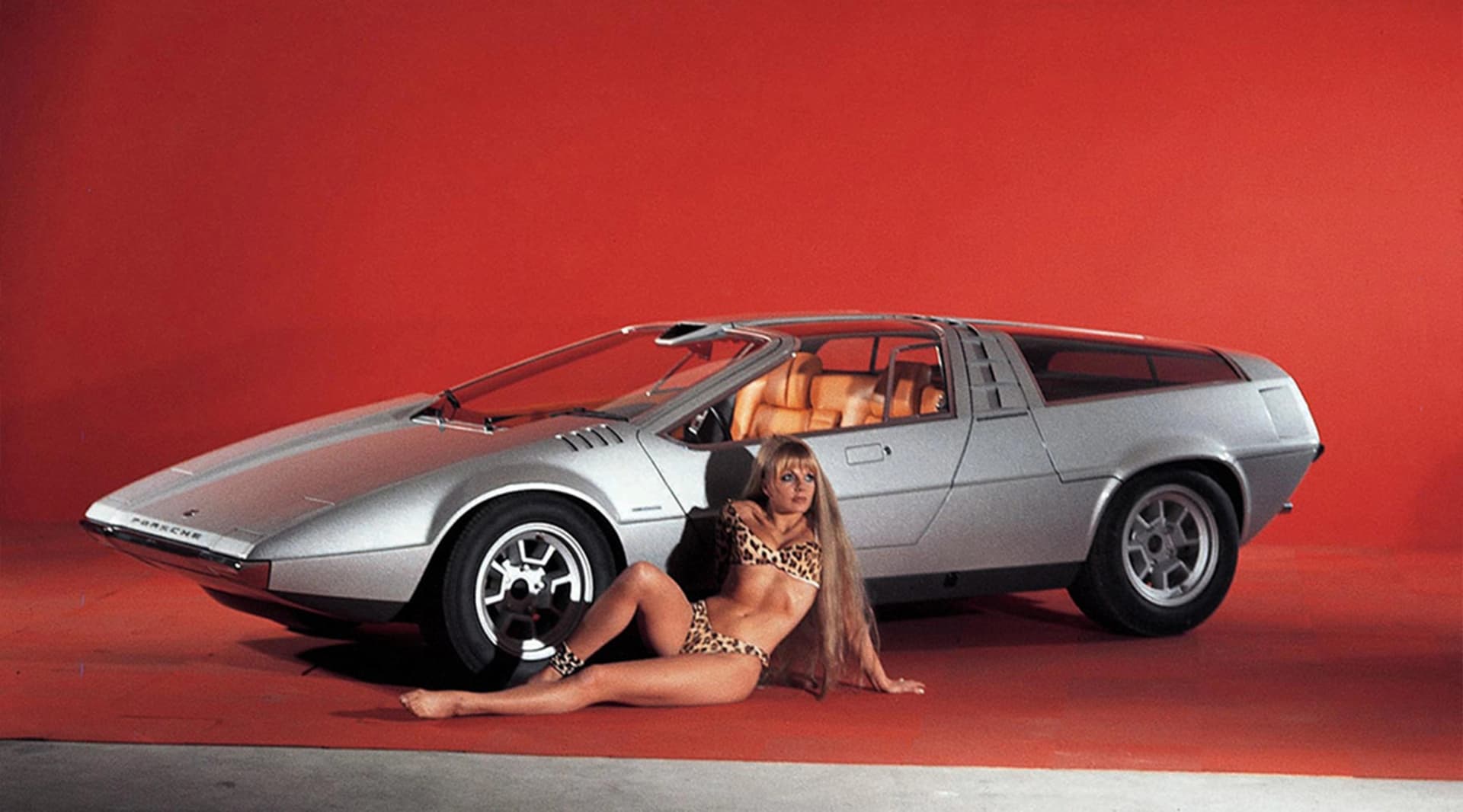
BMW handed Bracq the brief for the Turbo in 1971 and showed it in 1972, the year Munich hosted the Olympic Games across the road from BMW's new headquarters. The company had long sent its styling outside, to Bertone for the 3200 CS, Michelotti for the 700 and Albrecht von Goertz for the 507; the Turbo showed what its own studio could do. It was a mid-engined two-seater with gullwing doors, foam-filled bumpers and a turbocharged 2.0-litre four making 200 hp, with up to 280 hp available by raising the boost. At 980 kg it ran 0 to 100 km/h in 6.6 seconds and reached 250 km/h. Its twin roundels on the tail reached production six years later, on the 1978 BMW M1.
The E24 6 Series sharknose ran for 13 years, a BMW record
Bracq's best-known BMW is the E24 6 Series of 1976, whose forward-leaning 'sharknose' front BMW itself credits to him. He also drew the first designs for the E12 5 Series, the E21 3 Series and the E23 7 Series, then left for Peugeot in 1974, before most of them reached showrooms. The E24 stayed in production for 13 years, the longest run of any BMW model series, and the BMW Museum in Munich is marking its 50th anniversary with an exhibition until the end of January 2027. At Peugeot, Bracq led interior design on cars such as the 205 and 405 until he retired in 1996.
AutoNext Take
Bracq is the strongest case that a great car designer does not need a signature flourish. The Pagoda, the 1960s S-Class saloons and the sharknose share no trademark line; they share restraint, generous glass and proportions that let engineering ideas, Barényi's roof or the Turbo's foam bumpers, sit in plain view. That is why both his German icons still look modern on a museum floor, and why his name has stayed smaller than his work.
Any list of the best-looking German cars of the 1960s and 1970s that leaves out the 230 SL or the 635 CSi is wrong, and both came from the same hand. Anyone in Munich before the end of January 2027 can check that claim at the BMW Museum, then drive two hours west to Stuttgart, where the Mercedes-Benz Museum keeps a 230 SL in its own collection.