It's here! Tesla Full Self-Driving finally approved in Europe
Why the Netherlands could be the beginning of a much bigger shift.
On April 10, 2026, Tesla confirmed that Full Self-Driving (Supervised) has received official regulatory approval in the Netherlands, making it the first European country where customers can activate the system on public roads. For Tesla, the moment represents far more than a software launch. It marks the first real entry of advanced AI-driven driving technology into the European regulatory landscape, a continent traditionally known for cautious legislation when it comes to automation.
A system designed to reduce the stress of everyday driving
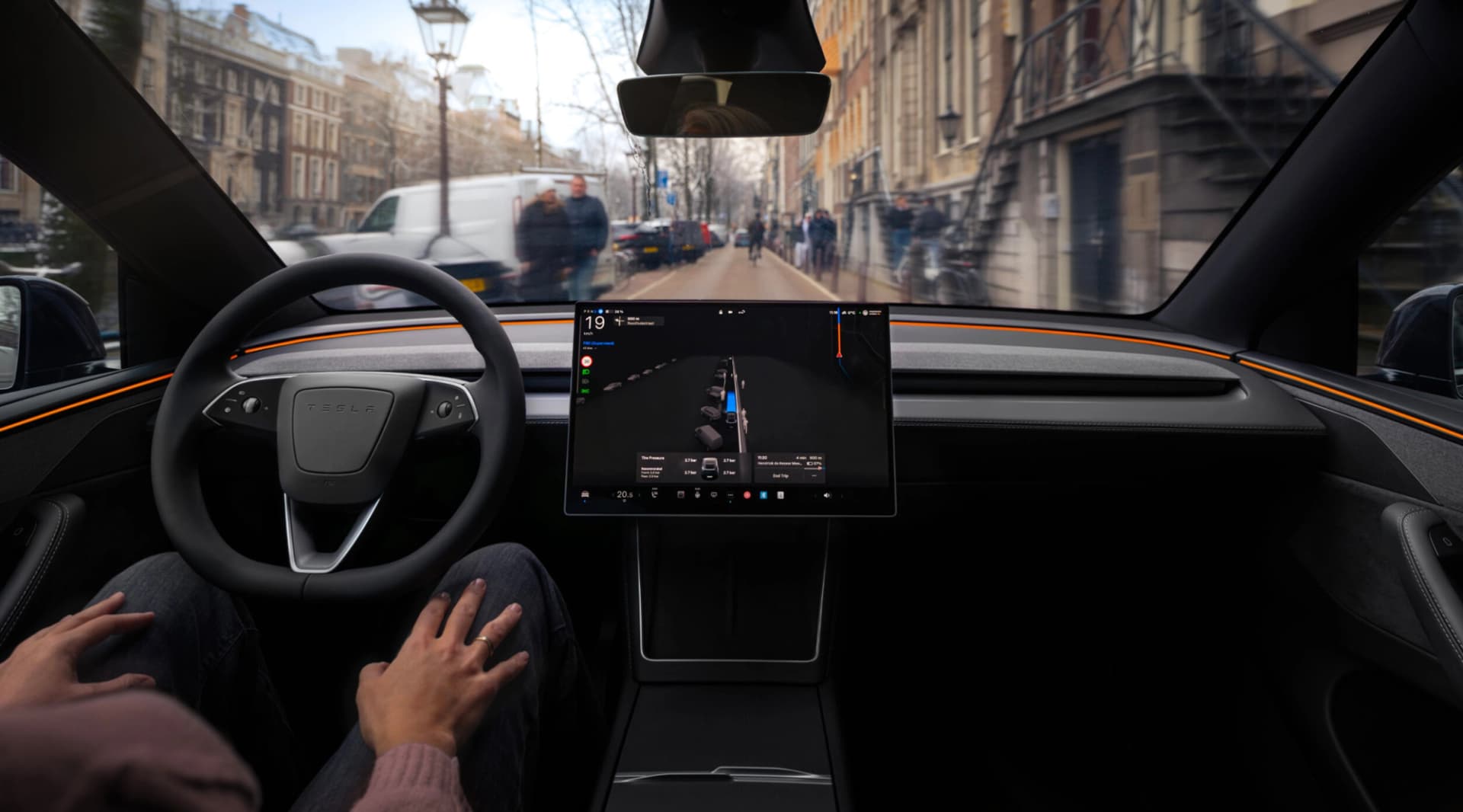
When activated, the system can manage many aspects of driving including navigating through city traffic, handling intersections, changing lanes and adjusting to real-time road conditions. However, Tesla emphasises an important distinction: the system still requires active driver supervision.
The technology relies primarily on Tesla’s camera-based vision system, supported by artificial intelligence capable of interpreting the surrounding environment in real time. Unlike some competing approaches, Tesla does not depend on lidar sensors, instead relying on a neural-network architecture trained using vast amounts of real-world driving data.
Across Tesla’s global fleet, vehicles collectively generate more than 500 years of driving experience every single day, feeding anonymised information into Tesla’s learning systems. In total, the company reports that over 14 billion kilometres have already been driven with Full Self-Driving (Supervised) enabled worldwide.
According to Tesla’s internal data, the system can reduce the likelihood of a collision by up to seven times per kilometre driven compared with driving without such assistance.
Learning to drive like humans do
Instead of relying on rigid, manually coded rules for every possible traffic situation, Full Self-Driving operates through an end-to-end neural network trained using real-world driving scenarios. That means the system learns in a way somewhat similar to humans: through observation and repetition.
The neural network interprets elements such as lane markings, traffic lights, pedestrians, cyclists and other vehicles, and then directly sends steering, braking and acceleration commands to the car.
Because the software improves as more data becomes available, Tesla can continuously refine the system via wireless software updates, allowing vehicles to become more capable over time.
Why Europe took longer and why this approval matters
Over the past 18 months, Tesla worked closely with European regulators to secure approval for the system. The process included:
Extensive circuit testing
Thousands of safety-scenario evaluations
Detailed documentation for regulators across the EU
Demonstrations to authorities in multiple European countries
Before today’s launch, Tesla also organised FSD demonstration drives across Europe, allowing more than 13,000 participants in countries including Germany, France, Spain, Denmark, Italy and the Netherlands to experience the technology firsthand. In addition, Tesla conducted over 1.6 million kilometres of internal testing on European roads with the system enabled.

The Netherlands as Europe’s testing ground
The Netherlands has often played a pioneering role in mobility innovation. From early electric-vehicle adoption to progressive infrastructure policies, the country has repeatedly acted as a gateway market for emerging automotive technologies.
Granting approval for Full Self-Driving therefore sends a signal far beyond Dutch borders. If the system performs safely in real-world conditions, other European regulators could follow: potentially unlocking access to the technology across major automotive markets such as Germany, France and Scandinavia.
For Tesla, this is a crucial step toward building a broader European presence for autonomous driving technology. And for the wider automotive industry, it may accelerate the race toward AI-assisted mobility.
A new pricing model: autonomy as a subscription
Alongside the rollout, Tesla is also introducing a new subscription model for Full Self-Driving in the Netherlands. Instead of paying a large one-time fee, customers will be able to activate the system for €99 per month.
For a limited time, Tesla will continue to offer both the traditional purchase option and the subscription model. After several weeks, however, the subscription is expected to become the primary way to access the feature.
This shift reflects a broader transformation happening across the automotive industry. Increasingly, vehicles are becoming software-defined products, where new features (from driver assistance to performance upgrades) can be activated through digital services.
AutoNext Take
Autonomous driving has always been one of the most fascinating (and controversial) frontiers in the automotive world. If we’re completely honest, we would love to try it ourselves before fully trusting it.
Because driving remains an emotional experience. Many enthusiasts still enjoy the sense of control that comes with steering, braking and feeling the road beneath the wheels.
The approval in the Netherlands might therefore not just be a local milestone but the first real step toward autonomous mobility becoming part of everyday life across Europe. Whether drivers will embrace that future with excitement or cautious curiosity… is something we are about to find out.