VW's Mission Efficiency beats the Mercedes EQXX using ID. Polo parts
A 135 hp Polo motor just used less energy than Mercedes' 1,200 km hero car
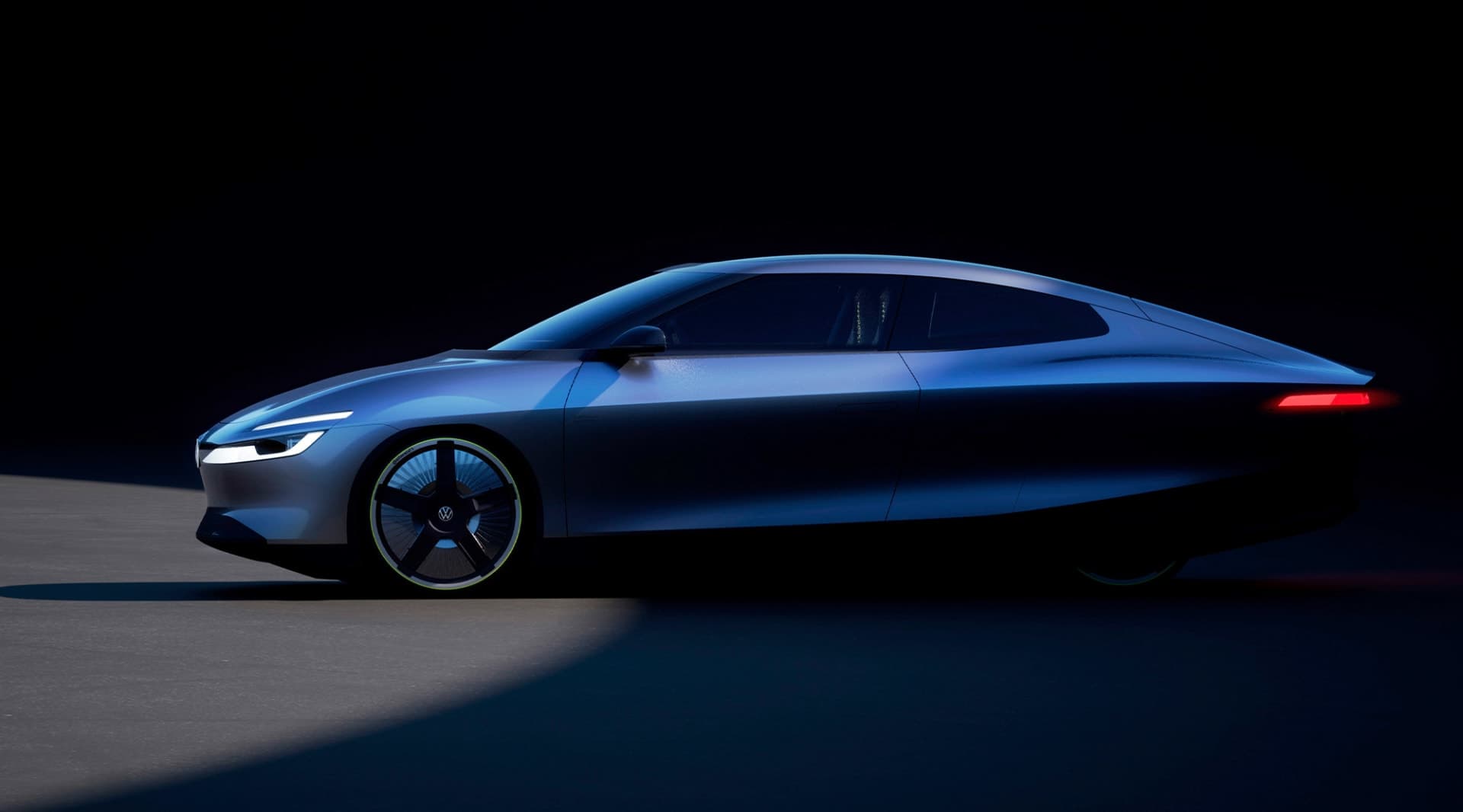
Volkswagen's Mission Efficiency covered 1,278.36 km from Wolfsburg to Vienna at 6.89 kWh per 100 km, excluding charging losses. The Mercedes Vision EQXX, the previous benchmark, needed 8.3 kWh over its 1,202 km run to Silverstone in 2022. Volkswagen got there with the ID. Polo's 135 hp motor, a supermini's battery and a body that cuts through the air harder than any road-legal car before it.
Three records: Cd 0.158, 6.48 kWh/100 km at 68 km/h, and 6.89 kWh/100 km on the road
The drag coefficient of 0.158, on a frontal area of 2.08 m², is the lowest certified for a road-approved car, under the XL1's 0.189 and the EQXX's 0.17. The second record came at Ehra-Lessien: 6.48 kWh/100 km at a constant 68 km/h, no gradients, air conditioning off. The third is the road run: 1,278.36 km via Poznań and Olomouc at an average of 67.72 km/h and a peak of 138 km/h, 7.51 kWh/100 km at the plug and 6.89 kWh in the battery. The 54.9 kWh pack was charged once, and the car reached Vienna with 164 km left. Volkswagen calls that a class record for a near-production electric car, and defines the class itself.
The drivetrain is the ID. Polo's: 135 hp APP290 motor, 54.9 kWh, 105 kW charging
Under the composite panels sits the MEB+ front-wheel-drive hardware Volkswagen shares between the ID. Polo, which already carries a ten-month order queue, and the ID. Cross. The motor is the 99 kW APP290, a 75 kg unit rated at 135 hp and 264 Nm. The battery is the ID. Polo's 52 kWh NMC cell-to-pack unit with 2.9 kWh of buffer unlocked by software, giving 54.9 kWh net, and charging stays at 11 kW AC and 105 kW DC. Above 80 km/h Volkswagen says the car uses more than 30 percent less energy than a standard ID. Polo, and at 140 km/h about what the Polo needs at 100. The Polo's 52 kWh pack is rated at up to 454 km WLTP; this body gets about 650 km from 2.9 kWh more.
4,775 mm long, 1,392 mm tall, and a rear axle 170 mm narrower than the Polo's
The body is 4,775 mm long and only 1,392 mm tall on a 2,700 mm wheelbase, and the rear axle is 170 mm narrower than the ID. Polo's so the tail can taper into a boat shape. The underbody is almost fully closed, the rear wheels are enclosed, and three active flaps in the nose open only when the battery or cabin needs air. Patented deflectors inside every rim keep air out of the wheel. The tyres are a Continental concept based on the EcoContact 7, 155 mm wide with a rolling resistance of 4.9 kg per tonne, about 25 percent under the EU's A-label threshold. The structure behind the A-pillar is aluminium, with doors, bonnet, tailgate and wings in carbon-aramid composite. Volkswagen kept glass mirrors because the wind tunnel showed cameras would gain little and cost more, and fitted an electromechanical rear brake, a first for the brand.
A 2+2 with a 481-litre boot, a 370 W solar roof and no touchscreen
This is not an XL1-style two-seat pod. The Mission Efficiency is a 2+2 with rear seats for passengers up to about 1.60 m, a 481-litre boot that becomes a 1.80 m load floor with the backrest down, and lockers behind the rear wheel covers for the charging cable. A 370 W photovoltaic layer in the glass roof and tailgate feeds the 12 V system, worth up to 30 km a day in good conditions. There is no built-in infotainment: a phone or tablet clips onto a rail, a portable Bluetooth speaker replaces the stereo, and a small e-paper display shows the climate settings. Top speed is 160 km/h and 0 to 100 km/h takes 9.0 seconds, ID. Polo territory too.
The XL1 cost €111,000 in 2013; Volkswagen is now talking about €50,000
The XL1 this car openly quotes was a 795 kg, two-cylinder diesel plug-in hybrid that returned 0.9 litres per 100 km, seated two, and cost €111,000 for one of 250 examples. Volkswagen's press material calls the Mission Efficiency a concept that is not for sale. Its head of product communications, Stefan Voswinkel, told Auto Express something looser: the company is still looking at a production car, at around €50,000. That is double the ID. Polo's €24,995 entry price and well above the €38,200 Audi wants for the A2 e-tron, which it calls its most efficient car ever at 12.8 kWh/100 km WLTP. The Mission Efficiency's WLTP figure is 8.4 kWh/100 km.
AutoNext Take
Mercedes needed a bespoke body and a battery nearly twice the size to get the EQXX to 8.3 kWh per 100 km. Volkswagen has gone 17 percent lower with the motor and battery from a €24,995 supermini, and that is the only part of Monday's announcement that matters to a buyer. The 0.158 drag figure will never reach a showroom. The rim deflectors, the sealed nose, the narrow tyres and the 30 percent saving above 80 km/h all can, on cars Martorell is already building.
The Vienna run averaged 67.72 km/h and Volkswagen's own 30 percent comparison only begins above 80 km/h, so 6.89 kWh is not a motorway number and should not be quoted as one. The honest measure of this project is whether the ID. Polo's WLTP rating improves when the 2027 model year is homologated next summer. If the deflectors and the closed nose are worth 30 percent on this body, they are worth a few percent on that one, and a few percent is 20 km of range on a car with a ten-month queue.
Follow us on Google News.
Set AutoNext as your preferred source on Google Discover.