Your rear fog light is compulsory in Belgium and fineable in the Netherlands
Europe agreed on how bright the lamp is allowed to be, and then let every country write its own rule for the switch.
The rear fog lamp is the only light on your car that was designed to be unpleasant. Under UN Regulation 38, the type approval every rear fog lamp sold in Europe has to meet, the lamp must put out at least 150 candela and is capped at 300 for a steady light, while the rule covering ordinary rear position lamps allows them a maximum of 17. That is a red light roughly twenty times stronger than the one glowing next to it, pointed straight at the eyes of whoever is behind you, and the installation rules take the consequences seriously enough to demand at least 100 millimetres between the lit area of a rear fog lamp and the lit area of the brake light beside it, because a fog lamp sitting too close to a stop lamp simply swallows it. All of that is harmonised across the continent. What is not harmonised is the only question a driver ever actually asks, which is when the switch is allowed to be down. There the rules stop dead at national borders, and the distance between two neighbouring countries can be the difference between a legal obligation and a fine for the identical piece of hardware in the identical weather.
Fifty metres in one country, a hundred in the next, and rain changes the answer again
Germany puts the threshold in paragraph 17 of the StVO: the rear fog lamp may be used only when fog cuts visibility to less than 50 metres, and fog is the only weather that counts. The Netherlands draws the same 50 metre line, adds snowfall to it, and rules rain out entirely, which is why switching it on in a downpour is a fineable offence there in the order of 190 euros. Cross into Belgium and the rule inverts twice over, because the threshold is 100 metres rather than 50, heavy rain does count, and below that point the lamp is not merely permitted but required. France allows it in fog or snowfall, forbids it in rain, and attaches a fourth-class fixed penalty of 135 euros to getting that wrong. The United Kingdom names no number in law at all and leaves the Highway Code to define seriously reduced visibility as generally less than 100 metres. Drive from Antwerp to Breda in heavy rain and you are obliged to have the lamp on for the first half of the trip and liable to a fine for the second.
The posts along the road are a ruler, and on a motorway they stand 50 metres apart
Nobody can judge 50 metres through a windscreen, which is why German driving instruction hangs the entire rule on the delineator posts, the reflective white markers spaced at a standard 50 metres along motorways and main roads. If you can see two of them ahead of you, visibility is more than 50 metres and the rear fog lamp is not legal in Germany or the Netherlands. If the next post only emerges from the grey as you draw level with the one before it, you are inside the threshold and the lamp belongs on. Those same posts carry a second rule with them, because German law also caps you at 50 km/h whenever fog reduces visibility below 50 metres, on the Autobahn as much as anywhere else, so the moment your rear fog lamp becomes legal is the moment a derestricted motorway becomes a 50 zone. It is a speed limit that no sign announces and no gantry enforces, which makes it one your car will not help you with either, unlike the speed assistance that now beeps at you for the posted ones.
The lamp does its real damage by hiding the light next to it
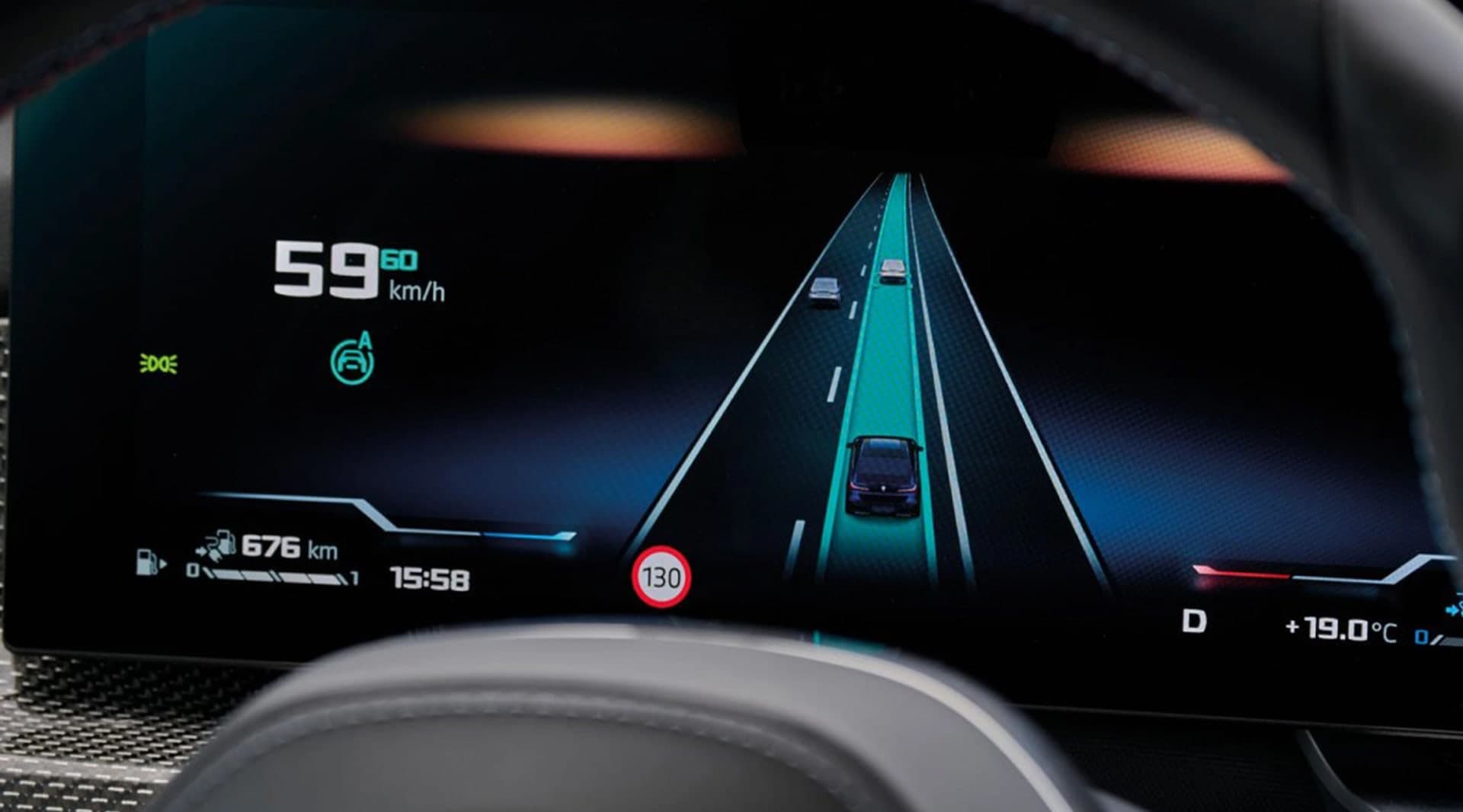
The reason misuse is treated as an offence rather than a discourtesy is that a rear fog lamp does not simply annoy the driver behind, it deletes information they need. In spray at night, a bright red light that never changes reads as a brake light that never releases, and after a few kilometres of staring at it a following driver stops reading your actual brake lights at all. That is the failure mode the 100 millimetre separation rule was written against, and it is the reason the lamp is fitted with a mandatory tell-tale in a colour of its own. Learn the two symbols, because they are not interchangeable: the rear fog telltale is amber and shows straight horizontal lines cutting through a vertical wavy line, while the front fog symbol is green and its lines slope downwards. Amber is the one that gets you fined. If your car has only one rear fog lamp, and a great many do, European installation rules place it on the centre line or on the side away from oncoming traffic, which in right hand traffic means the driver's side, so a single lamp glowing low on the left is the design rather than a blown bulb on the right. All of this matters most in the conditions where grip is already worse than it looks, which is why the first rain after a dry spell and a dazzled driver behind you are a bad combination.
Fog lifts in a few hundred metres, and the switch stays down for forty kilometres
Autumn is the season this lamp gets left on, and the mechanism is always the same. Radiation fog settles in river valleys and low fields before dawn and thins out within a few hundred metres of climbing out of one, so the driver who quite correctly switched on at the bottom of the hill carries the lamp for the rest of the commute because nothing in the car objects. Your headlights will switch themselves on and off all day without being asked and will never once touch the rear fog lamp, for the simple reason that no sensor on the car can measure visibility. Front fog lamps are a different instrument governed by a looser rule, since they light the verge and the road edge underneath the fog rather than announcing you to the traffic behind, and most countries also allow them in heavy rain, with the Dutch rule of thumb putting the practical justification at around 200 metres of visibility. On plenty of recent cars they no longer exist at all, replaced by a cornering function inside the main headlight. Autumn is also the season when the shape at the edge of the fog is an animal rather than a car, and a lamp aimed backwards does nothing whatever about that.
What to actually do
None of this costs anything and none of it needs a garage. It needs one habit, which is treating the rear fog lamp as something you switch off deliberately rather than something that goes off by itself.
Treat it as a fog light, not a bad weather light. Fog and snow count almost everywhere in Europe, rain counts only in some countries.
Use the delineator posts as your ruler. On motorways and main roads they stand 50 metres apart, so two posts in view means visibility is over 50 metres.
In Germany and the Netherlands, two visible posts means the lamp stays off. Below that, it goes on, and in Germany your speed limit becomes 50 km/h at the same moment.
Belgium works the other way round. Below 100 metres, heavy rain included, the rear fog lamp is compulsory rather than optional.
France and the Netherlands both forbid it in rain. On a journey that crosses borders, the switch is part of the crossing.
Learn the two tell-tales. Amber with straight lines is the rear lamp and the one that gets fined, green with sloping lines is the front pair.
Switch it off the moment the fog thins rather than at the next junction. Nothing in the car will do it for you, because nothing in the car can see.
If a driver behind you flashes their lights in fog, check the amber symbol before you assume they mean your headlights.
Check the lamp actually works before the season starts. On many cars it is a single bulb, and it is an item the roadworthiness test looks at.
Frequently asked questions
How do I tell whether I have the front or the rear fog lights on?
By colour before shape. The rear fog tell-tale is amber and the front one is green, and that difference is deliberate because only one of the two is capable of dazzling anybody. Both symbols show a vertical wavy line, standing for fog, with light beams crossing it, and the beams are the giveaway: horizontal and straight for the rear lamp, sloping downwards for the front pair. On many cars they sit on the same rotating collar of the light switch, one click apart, which is precisely how drivers end up with the rear lamp lit while believing they turned on the fronts.
Can I use the rear fog lamp in heavy rain?
It depends entirely on which country you are in, which is the single most useful thing to know about this lamp. Belgium requires it in heavy rain once visibility drops below 100 metres. The Netherlands and France both forbid it in rain outright, restricting it to fog and snowfall. Germany goes further still and restricts it to fog alone. The safe default for a driver crossing borders is to reserve the lamp for genuine fog and falling snow, and to accept that in Belgium you owe it to the traffic behind you in a real downpour as well.
Is using it compulsory or just permitted?
Both, depending on where you are, and this is where most confusion starts. Fitting the lamp is compulsory across Europe, so every car on the road has one. Using it is compulsory in Belgium below the 100 metre threshold, while in Germany, the Netherlands and France the rules are written the other way around, as permissions that expire the moment visibility improves. In practice the distinction matters less than it sounds, because in real fog thick enough to meet any of these thresholds you want the lamp on regardless of whether a rulebook is insisting.
The car behind keeps flashing me. What are they telling me?
In bad weather, nine times out of ten it is your rear fog lamp, and the reason it feels so aggressive from their seat is that the lamp is doing to them exactly what a full beam headlight would. Glance at the dashboard for the amber symbol rather than at your headlight stalk. The second most common answer, in a queue at night, is that the whole back of your car is bright red because you are riding the brake pedal, which produces a similar effect for a similar reason.
My car has no front fog lights at all. Is that a problem?
No. Front fog lamps have always been optional equipment in Europe, and a growing number of new cars leave them off entirely, either because the main headlight now spreads its beam sideways when you need it to or because the bumper simply had no space left. What is not optional is the rear lamp, which every car must carry. If you drive a car without front fogs, the substitute in fog is not more light but less speed and more distance, since dipped beam bouncing back off water droplets is the reason main beam makes fog worse rather than better.