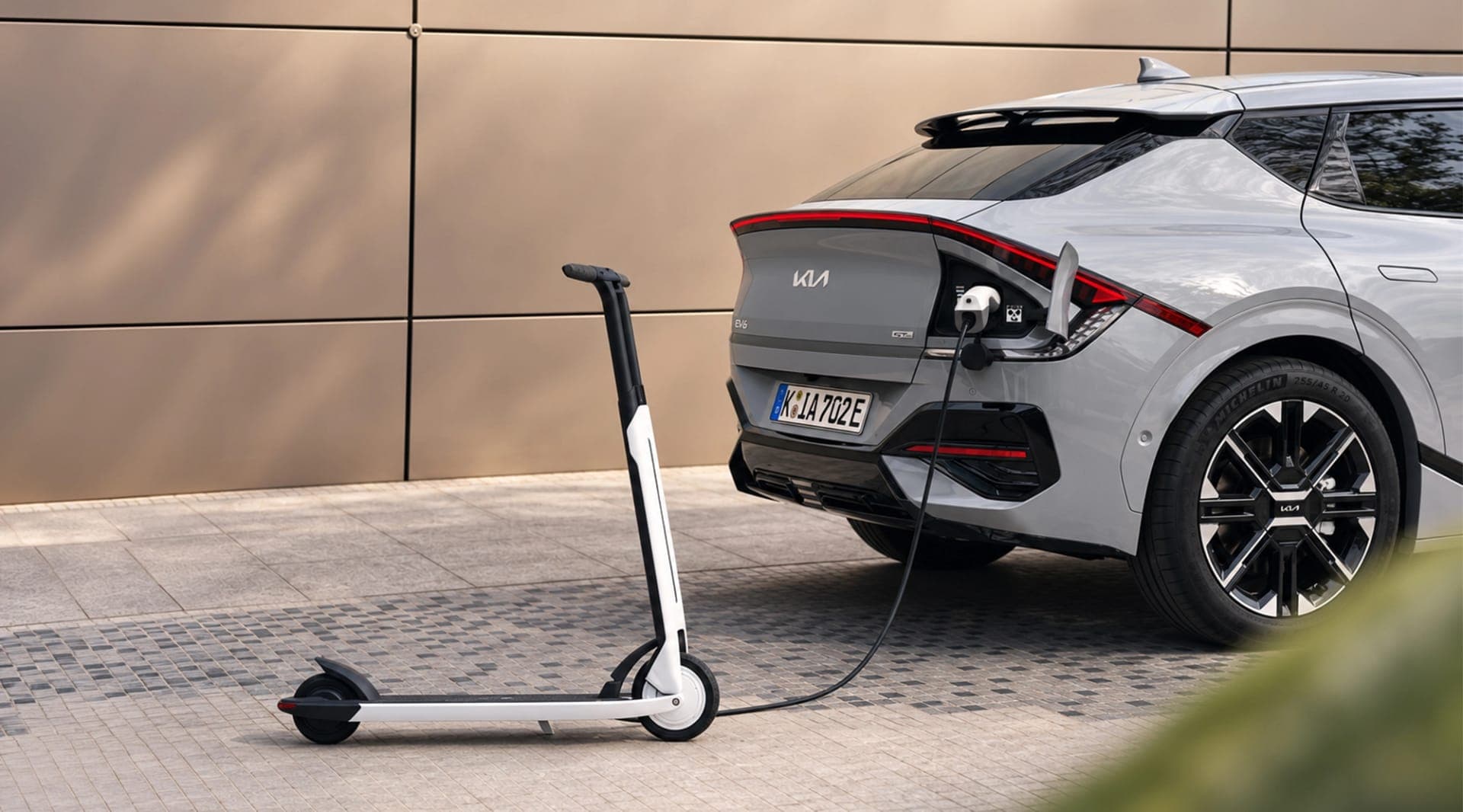
What can you run from your electric car's V2L socket?
Your charging port works in both directions
A growing number of electric cars sold in Europe since 2021 can run a coffee machine, a cool box or an e-bike charger straight from the drive battery. The feature is called vehicle-to-load, V2L for short, and all it needs is an adapter that plugs into the Type 2 charging socket and ends in a normal Schuko household socket. Output is about 3.6 kW on most cars, the same as one wall socket at home. The number that decides whether it is worth using is a smaller one: the 390 to 500 watts the car burns just to keep the socket alive.
The short version
Most cars deliver 2.2 to 3.7 kW, enough for a coffee machine or power tools.
The car uses 390 to 500 watts on top, whatever you plug in, so short, heavy jobs make the most sense.
Set a battery floor so you can still drive home, and never use it in the rain.
V2L is not for powering a caravan or a house. That needs vehicle-to-home and an electrician.
How V2L works
V2L reuses the onboard charger that normally turns mains alternating current into direct current for the battery, and runs it the other way. Hyundai and Kia rate the output at 3.6 kW, or 16 amps at 230 volts, Renault quotes 3.7 kW for the 5 E-Tech, BYD 3.3 kW for the Dolphin and MG 2.2 kW for the MG4. Some cars, such as the Ioniq 5 and EV6, add a second socket under the rear seat that shares the same power.
The adapters are not standardised. Some end in a multi-socket block, Kia's has a rain hood, and you switch V2L on with a button on the adapter on BYD, Kia and Renault or on the touchscreen on MG, while BMW and XPeng do it automatically. The Ioniq 5 locks the adapter in place so nobody can walk off with it, but the ADAC found that on some cars it can be pulled out while live.
What the ADAC test found
The ADAC put six cars through short-circuit and overload tests in the lab: a BMW iX3, a BYD Seal, a Kia EV5, an MG4, a Renault 5 and an XPeng G9. All six cut the power safely, none damaged its high-voltage system, and all drove away afterwards. Continuous output ranged from 2.2 kW on the MG4 to 3.7 kW on the BMW. Only the BMW briefly allowed more, 4 to 5 kW for about ten minutes and a peak of 7.2 kW, so it coped best with the start-up surge of a hedge trimmer or circular saw.
The complaints were about ease of use rather than safety. Error messages ranged from Kia's clear 'consumption too high' to BYD asking you to call customer service after a simple overload, and the Renault 5 only worked again after the car had gone to sleep with the key out of range for several minutes. And every one of the six carmakers forbids using V2L in the rain.
The hidden cost: up to 500 watts on standby
Keeping the socket live costs power whatever you plug in: 390 watts on the Kia EV5, 400 on the MG4 and XPeng G9, 440 on the BYD Seal and 500 on the Renault 5. That pays for the control units and charger electronics that have to stay awake. The ADAC's sums: a 60 kWh battery drawing 450 watts is empty in five and a half days with nothing plugged in.
At a typical 18 kWh per 100 km, every hour the socket is on costs about 2.5 km of range before the appliance draws anything. A cool box running for a 48-hour weekend therefore takes around 24 kWh, roughly 130 km, of which the box itself used less than 3 kWh. Ten minutes of a 2,000 watt coffee machine, by contrast, costs 0.4 kWh including standby, about 2 km. V2L is for big loads over short periods, not small loads for days.
Settings and safety rules to know
Every V2L car lets you set a battery level at which the socket switches off, and on Hyundai and Kia it can only be set below the current charge. Choose it with the drive home in mind. Because the socket cuts out regardless of what is plugged in, Hyundai bans medical equipment or anything that must never lose power. Its manual also rules out kettles, toasters and irons on the interior socket, allows at most two fully unrolled extension leads, and warns that the cooling fan can start on its own.
V2L is not a way to power a caravan or a house. The car's socket is a separate, isolated circuit, and connecting it to a building's wiring is a job for an electrician, not an extension lead. Powering a home properly is called vehicle-to-home, and it needs a bidirectional wallbox such as Renault's Mobilize Powerbox for the 5.
What the adapter costs
Check before you buy, because the adapter is often extra. In the ADAC sample, prices ran from 120 euros for XPeng to 392 euros for Kia. Renault charges 200 euros, BMW 199 euros on top of a 740 euro option that bundles V2L with the 22 kW charger, and BYD includes everything.
How to get the most out of V2L
Check the spec sheet: V2L is standard on BYD, MG and the Renault 5, depends on trim at Kia and is an option at BMW.
Find out how to switch it on, on the adapter, the screen or automatically, before you need it.
Set the discharge floor to the charge you need to get home, plus a margin.
Add up your appliances and stay under about 3.5 kW. Two 2,000 watt devices at once trip every car except, briefly, the BMW.
Use it for short, heavy jobs. For a 50 watt cool box over a weekend, a 500 Wh power bank is the cheaper option in range.
Never in the rain or a thunderstorm, never with wet hands, and at most two fully unrolled extension leads with an earthed plug.
Never plug the car into a caravan's mains inlet or a house socket. That is vehicle-to-home, and it needs an electrician.
Frequently asked questions
Does V2L damage the battery?
No more than driving does. Discharging at 3.6 kW is a fraction of what the motor pulls, and the car manages temperature and current the same way. What matters is the floor: leaving the pack at 5 percent for days is what to avoid, and the usual charging rules for LFP and NMC batteries still apply.
Will V2L drain the 12-volt battery?
No. The charger and its control units only wake with the car, and on Hyundai and Kia the interior socket needs the car switched on or in Utility Mode, which powers the electronics from the drive battery instead of the 12-volt battery. With the exterior adapter this happens automatically.
Can I charge another electric car from mine?
On Hyundai and Kia, yes, with the V2L adapter and the car's own portable charging cable, at up to 3.6 kW, and the donor car stops at 20 percent. It is an emergency measure to reach the next charger, not a way to fill a battery: 10 kWh takes three hours.
Can I heat a tent overnight with V2L?
Technically yes, sensibly no. A 1,500 watt fan heater for eight hours plus standby takes about 16 kWh, roughly 90 km of range, and a heater running unattended in a tent is a fire risk the manuals rule out anyway. A camping heater of a few hundred watts is the better tool.