How often should you replace your wiper blades?
Your wipers failed in June, not in September
A wiper blade is a strip of rubber whose working edge is finer than a pencil line, and it does not wear out by wiping. It wears out standing still on hot glass through July and August, where sun, ozone and heat harden that edge until it skips instead of sliding. That is why wipers seem to fail overnight in the first rain after a dry summer: they failed months ago, and nobody used them. ADAC advises new blades once a year, yet in an ADAC survey of 1,037 German car owners more than a third waited two years or longer.
The short version
Replace the blades once a year, at the end of summer, whether they look worn or not.
A missing or obviously defective blade is a major fault at the roadworthiness test.
Fill the washer bottle with screenwash all year, never with plain tap water.
Never switch on wipers that are frozen to the glass.
Sun and heat age the rubber, not wiping
Ultraviolet light and ozone attack wiper rubber from the day it is made, so a car that lives outside wears out its blades faster than one kept in a garage. Heat finishes the job: a dark windscreen in summer sun gets far hotter than the air around it. When ADAC tested eight blades, all eight did well at room temperature, but at minus 10 degrees only one still wiped well. It was the 27-euro Bosch, ten euros cheaper than the blade in third place. Price bought nothing; age is what counts.
A worn blade or a dirty windscreen?
A thin line left on every pass means a nick in the rubber or a grain of grit. Wipe the edge with a damp cloth, and if the line stays, the blade is finished. A haze or smear can be a hardened blade or a film on the glass, so wash the windscreen with glass cleaner and try again. Judder usually comes from wax or a rain-repellent coating, or from an arm that has twisted. The simplest test is a bottle of water on a dry day: a good blade clears the glass in one pass.
What the roadworthiness test checks
Inspectors look at the wipers and switch them on. Under the EU roadworthiness rules, a blade that is missing or obviously defective is a major fault, and so are wipers or washers that do not work. The rear wiper is not tested at all, which is why it is often the most neglected blade on the car. A worn blade also drags grit across the glass and scratches it, and on a car with a camera behind the mirror a new windscreen is no longer a cheap repair. New blades are the cheapest item on the checklist before your test.
Why tap water does not belong in the washer
In 2010 health officials in England and Wales noticed that professional drivers turned up among sporadic cases of Legionnaires' disease five times more often than expected. Their study found one exposure that stood out: riding in a car whose washer bottle held plain water without screenwash. The researchers estimated that around 20 percent of sporadic community cases could be linked to it, and a follow-up study found live Legionella bacteria in bottles filled without screenwash.
The reason is simple. A black plastic tank under the bonnet sits between 20 and 45 degrees, the range in which the bacteria grow. The water stands still for weeks, and the jets then turn it into a fine mist at head height. Screenwash concentrate is the whole fix.
Frozen wipers can burn out the motor
Switching on wipers that are frozen to the glass can blow a fuse, burn out the motor or bend the linkage, a repair of several hundred euros. Rain-sensing wipers make it worse, because they can start the moment you switch the ignition on. On a frosty night, set the stalk to off before you park and free the blades by hand in the morning. Cars that park their wipers under the bonnet edge have a service position that stops them halfway up the glass. On Volkswagen Group cars, switch the ignition on and off and push the stalk down within about ten seconds.
How to look after your wipers
Fit new blades every twelve months, before the autumn rain, and replace the rear blade at the same time.
Wash the windscreen with glass cleaner before you blame the blades.
Clean the rubber with a damp cloth only. ADAC warns that alcohol-based cleaners make it porous.
Fill the bottle with screenwash all year, and switch to a winter grade rated to minus 20 from October.
Set the wiper stalk to off before you park on a frosty night.
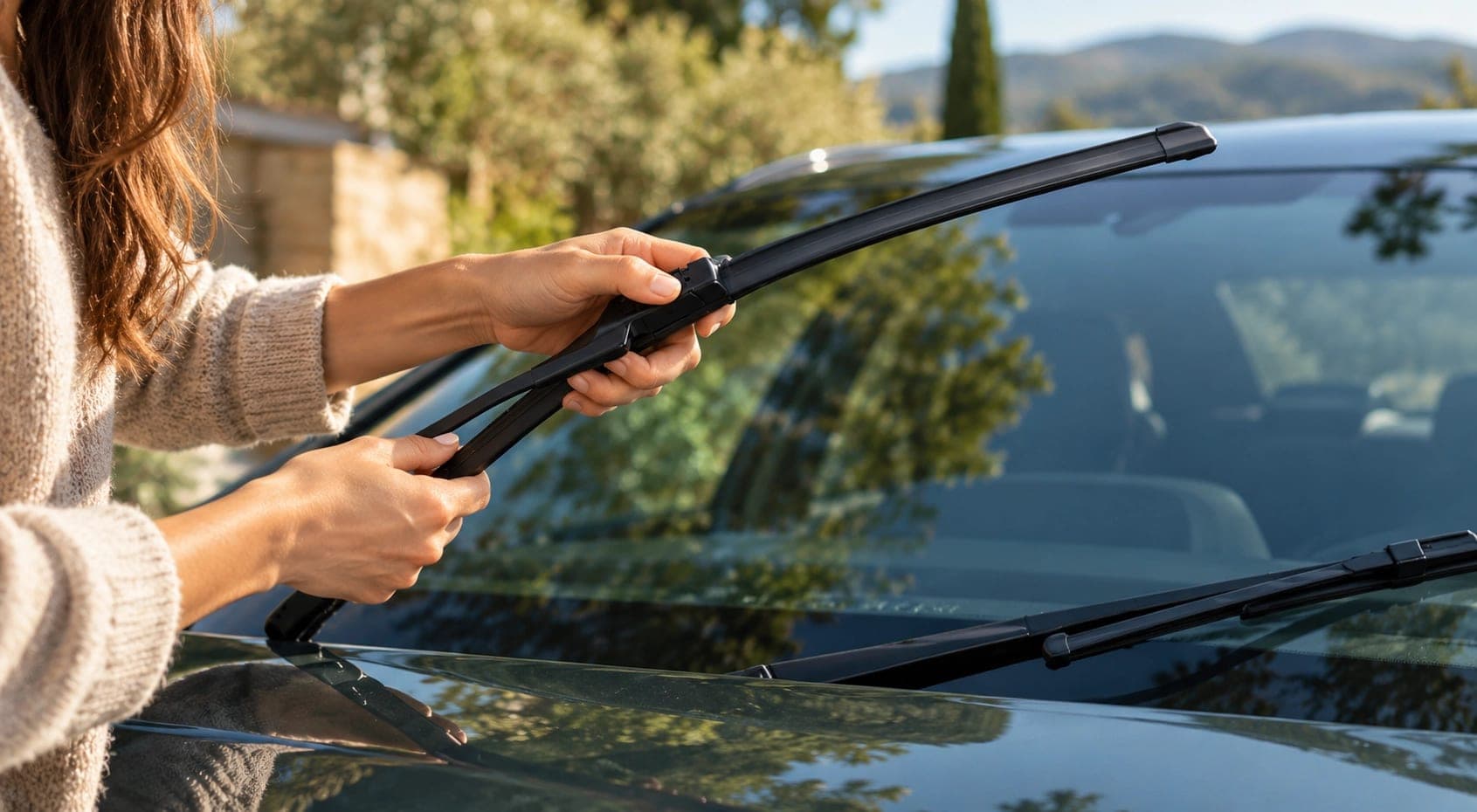
Lay a folded towel on the glass while you swap blades: an arm that snaps back can crack the windscreen.
Buy by registration number or measure both blades, as the two sides usually differ in length.
Frequently asked questions
How often should I replace my wiper blades?
Once a year, as ADAC recommends. Sun, ozone and heat harden the rubber whether you drive or not, so the end of summer is the best moment to swap them.
Can worn wiper blades fail the roadworthiness test?
Yes. A missing or obviously defective blade is a major fault, and so are wipers or washers that do not work. A less serious blade defect counts as a minor fault, and the rear wiper is not inspected at all.
Is it safe to use tap water in the washer bottle?
No. A UK study linked washer bottles filled with plain water to around 20 percent of sporadic Legionnaires' cases. Plain water also freezes in the pipes and jets at the first frost. Use screenwash in every season.
Why do my new wiper blades still judder?
Almost always because of the glass. Wax from a car wash or a rain-repellent coating gives the rubber nothing to slide on, so clean the windscreen with glass cleaner and a drop of washing-up liquid first. If it still chatters, the wiper arm may be twisted.