Bolt wants 25,000 Lucid robotaxis. Lucid built 18,378 cars last year
Bolt's 25,000-car Lucid deal is Europe's largest robotaxi commitment, and it is a memorandum
Bolt and Lucid announced a partnership on Thursday to develop and run autonomous taxis across Europe, with Bolt aiming to deploy at least 25,000 driverless Lucids in multiple cities and countries. The number is more than twelve times the largest existing European commitment, Uber and Pony.ai's 2,000 cars, and it rests on a memorandum of understanding with no financial terms, no order date and no stake changing hands.
Bolt aims for Level 4 Lucids on the Midsize platform, with a first batch in 2028
The cars will be Level 4 versions of Lucid's upcoming Midsize platform, the one under the delayed sub-$50,000 Cosmos, fitted with NVIDIA's Hyperion reference architecture and its standard sensor set. Bolt's dedicated unit, Bolt Autonomous Driving Solutions, will co-design the vehicle from the product stage, set the software, safety and rider parameters, and own and operate the cars itself. Lucid's side is a new division called Lucid Technologies, which gathers its AI, driver-assistance and autonomy work. Chief executive Silvio Napoli told the Financial Times the first batch could arrive as early as 2028, that capital will be deployed in stages, and that financially the deal is 'a very important step for us'. Unlike Uber, Bolt takes no equity in Lucid.
Lucid built 18,378 cars in 2025 and now has 60,000 robotaxis promised
Lucid produced 18,378 cars in 2025 and delivered 15,841, its best year yet, and it has now signed away more than three years of that output to ride-hailing platforms: Uber has committed to at least 35,000 Lucids for its Nuro-equipped robotaxi network, backed by a $500 million investment, and Bolt adds at least 25,000 on top. Second-quarter deliveries were 3,953 on revenue of $405 million against an adjusted EBITDA loss of $901 million, which works out at roughly $228,000 lost per car delivered. The Cosmos that underpins the robotaxi slipped to the second half of 2027 in August's operational reset, and Napoli says the Bolt volume will help fill the new AM2 plant in Saudi Arabia, whose supply chain is the reason the Cosmos slipped.
Stellantis was promised a major role in Bolt's 100,000, and now shares it with Lucid
Bolt's target of 100,000 autonomous vehicles on its platform by 2035 is not new, and neither is the promise of who would build them. When Bolt signed with Stellantis in December 2025, the plan was Stellantis' AV-ready eK0 van and STLA Small platform, test cars in 2026, larger pilots after that and industrial scale from 2029, with Stellantis 'expected to play a major role' in the 100,000. A three-way pilot with Pony.ai was announced for Luxembourg in June. Nine months later a quarter of that target is allocated to an American carmaker instead, and Bolt, which runs in 50 countries and more than 850 cities, still has no autonomous vehicle carrying a passenger anywhere.
BCG expects 120,000 robotaxis in Europe by 2035, and Bolt wants 100,000 of them
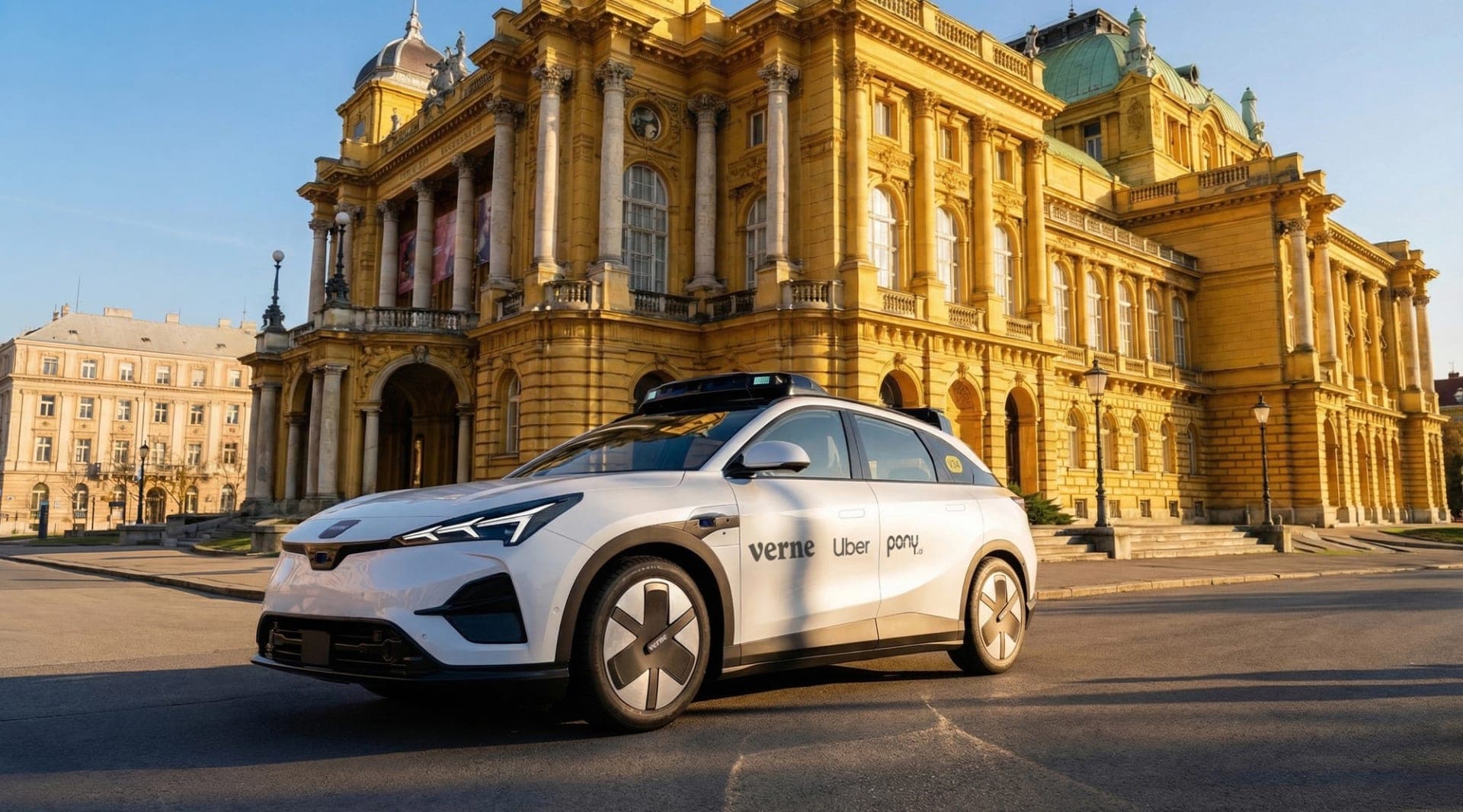
Boston Consulting Group estimates roughly 120,000 robotaxis on European roads by 2035, so Bolt's ambition alone would be five sixths of the entire continent's fleet. The current reality is smaller: Verne went driverless in Zagreb this month as Europe's first fully autonomous public service, Waymo has picked Munich for a 2027 launch, and most other programmes still run with a safety driver. Regulation is the other clock: the EU has no common framework for Level 4 taxis at scale, and both companies say they will work with regulators on the way, the phrase firms use when the rule they need does not yet exist.
Volkswagen's MOIA lost its last two investors on the same day
Volkswagen's robotaxi unit MOIA has failed to find an outside investor, Manager Magazin reported on Thursday, after Uber and Lyft both pulled out of joint-venture talks. The magazine puts Volkswagen's spending on MOIA at about €2 billion so far, with at least another billion needed before the division turns commercially positive in the 2030s, and says a sale to Uber is the last-resort option. Volkswagen said in February it wanted to be Europe's robotaxi champion. On the day that ambition ran out of investors, Europe's own ride-hailing platform chose a Californian carmaker majority-owned by Saudi Arabia's Public Investment Fund to build its fleet.
AutoNext Take
Europe's ride-hailing champion has just told Europe's carmakers what it thinks of their robotaxi platforms, and it did so with a signature rather than a speech. Stellantis had the first call on Bolt's 100,000 and now shares the order book with a company that built 18,378 cars last year and loses six figures on each one. The pull for Bolt is a software-defined car designed around a Level 4 sensor set from the first sketch, at a maker desperate enough for volume to co-design it. The pull for Lucid is a customer who wants the cars without wanting the shares.
Napoli says 2028, and the car this rides on will not reach paying customers before the second half of 2027, so the first driverless Lucid on a European street with no safety driver is a 2029 event at the earliest. The definitive agreement, when it replaces the memorandum, is the number to hold both sides to: Uber's deal grew from 20,000 to 35,000 because Uber put $500 million in, and Bolt is putting in nothing. If the signed figure is still 25,000 by the time Lucid reports its 2027 full-year results in February 2028, Bolt will have done something no European operator has managed, which is to commit to a fleet before anyone has proved the car.