Renault's electric 8 Gordini has 270 hp and will never be sold
Renault's rear-engined icon returns as a carbon two-seater, unveiled today ahead of Paris
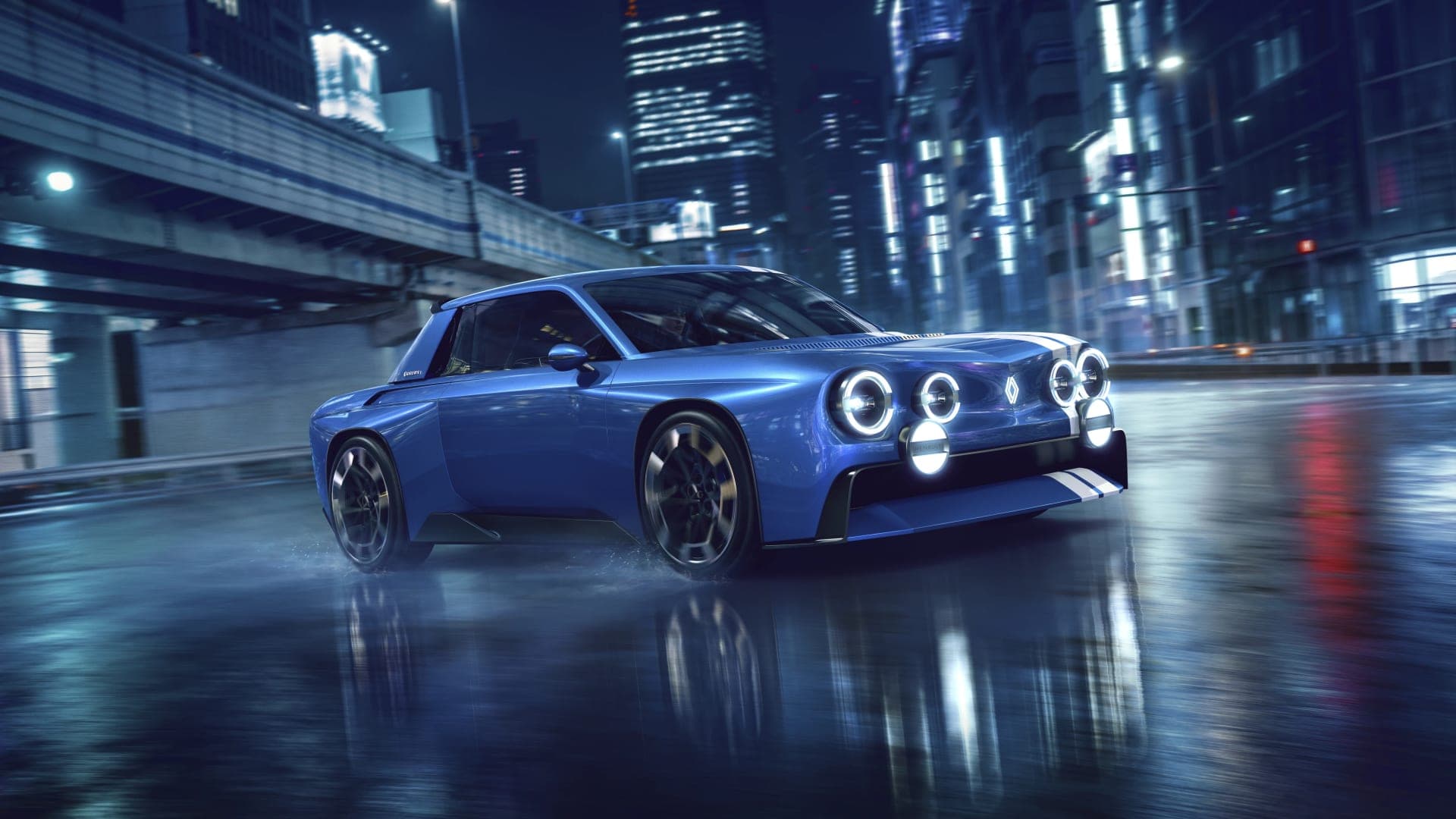
Renault pulled the covers off the 8 Gordini Concept today, a two-seat electric coupé with 270 hp and rear-wheel drive, and it goes on the brand's stand at the Paris Motor Show from 12 to 18 October. The original was a four-door saloon with its engine behind the rear axle and a pair of white stripes down the bonnet. This one keeps the layout, the colour and the stripes, and throws away almost everything else.
The 8 Gordini Concept is 4.12 m long with 270 hp and rear-wheel drive
Renault gives the concept 4.12 metres of length, 1.88 metres of width and 1.27 metres of height, on 19-inch front wheels and 20-inch rears. The body is carbon, the nose has no grille and no shut line, so the whole front lifts off in one piece the way a racing car's does, and six round headlights sit recessed in the bodywork. There is no battery capacity, no kerb weight and no performance figure anywhere in the material.
Renault confirms the 8 Gordini Concept will not be sold
Asked directly whether the car will reach customers, Renault answers no. It is a single example and a pure design exercise, the fourth in a run of heritage one-offs that includes the R17 restomod with Ora Ïto and the Renault 5 Diamant. The cars are never the product. The names are: Renault has already put the Renault 5 and the Renault 4 back on European price lists on the strength of exactly this kind of affection.
The original 8 Gordini had 95 hp and was built at Flins
The 8 Gordini arrived in 1964 with 95 hp from a tuned four-cylinder mounted behind the rear axle, which made it quick, tail-happy and famously difficult. It taught a generation of French drivers how to catch a slide, Jean Ragnotti among them, and Renault is right that it delivered cheap performance a decade before the Golf GTI made the idea famous. The Renault 8 was assembled at Flins, which is where the Renault Collections museum is now being built, so the concept is going to end up parked on the site that made the car it copies.
An internal contest produced 300 sketches and two scale models
The design is entirely in-house, unlike the R17. Renault ran a competition among its own designers, collected more than 300 sketches, took the two strongest to 2:5 scale mock-ups and then merged them. The Bleu de France of the original is rebuilt in three layers so the historic shade catches along the edges, and the twin white stripes are no longer stickers: the windscreen vent and the rear light graphics line up on them, and they run across the dashboard inside.
The Renault 5 Turbo 3E already does this for real, with 540 hp
Renault does not need a concept to prove it can build a rear-driven electric performance car, because it is building one. The Renault 5 Turbo 3E puts its motors in the rear wheels, makes 540 hp, and is limited to 1,980 cars from 2027, a number chosen for the year the original 5 Turbo landed. That is twice the power of the car Renault unveiled today, on sale, with a deposit list. The concept borrows the 3E's stripped-back design language and half its output.
AutoNext Take
Nobody in Europe is mining their own back catalogue as carefully as Renault is. The 5, the 4 and the Twingo came back as cars people actually buy, and the one-offs beside them are made with real craft: 300 sketches, two scale models, a blue mixed in three layers so the 1964 shade shows at the edges. The 8 Gordini Concept is a lovely thing and Renault is honest about what it is. The detail worth keeping is where it goes afterwards, because the museum at Flins is standing on the ground that built the Renault 8.
Which leaves one gap in the plan. Renault has brought Alpine back as a badge you can buy and given it a 540 hp flagship, and it still has nothing to put on the warm cars underneath. Gordini is that badge, and it has spent forty years in a collection rather than a brochure. A concept in Paris on 12 October is an audition. Watch whether the name turns up next to a price before the Flins museum opens in around fifteen months, because that would make this the most useful sketch Renault's designers have drawn all year.