Ceer's 1,100 hp Exobot is Saudi Arabia's first car, two years late
Saudi Arabia's first car arrives with a Croatian motor and a McLaren pen
Ceer has revealed the Exobot sedan and SUV, launched by Crown Prince Mohammed bin Salman as the first cars from the brand the Public Investment Fund founded with Foxconn in November 2022. Ceer says both were designed and engineered in Saudi Arabia. The supplier list reads differently: a Rimac rear drive, Hyundai Transys front motors, a Foxconn platform, a BMW technology licence and a design chief hired away from McLaren.
The Exobot sedan and SUV claim more than 1,100 hp and 0-100 km/h in 2.1 seconds
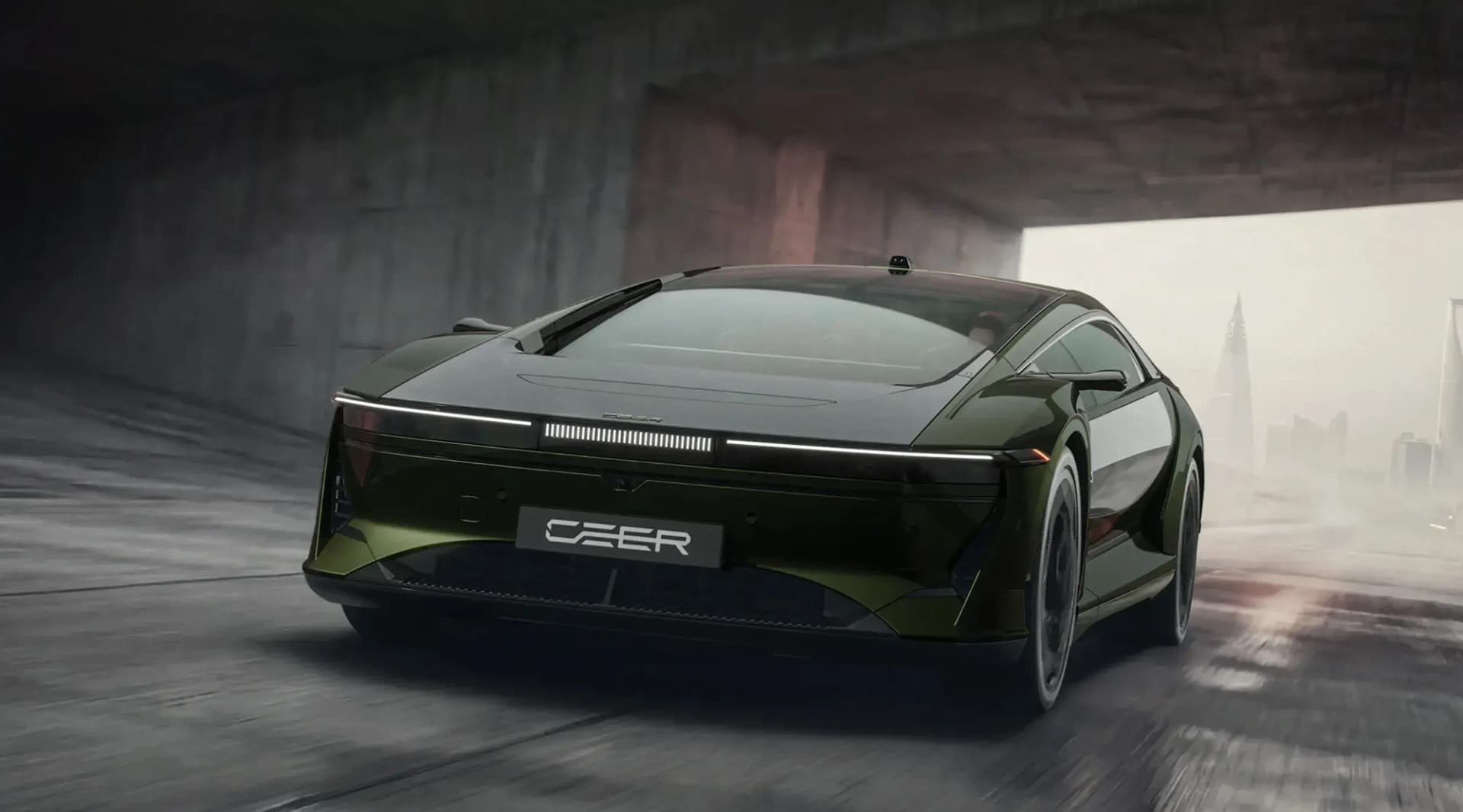
Ceer published no specifications at the reveal, so the figures come from its chief executive. James DeLuca says top versions of both Exobots will offer more than 1,100 hp, reach 100 km/h in 2.1 seconds and carry launch control and a drift mode. Both are E-segment flagships with no B-pillar and gullwing doors so large that DeLuca calls each one "more like a whole body side", although they open within the footprint of a normal door. The glass roof is claimed as the largest fitted to any current car, the windscreen carries a silver coating to reflect heat, steer-by-wire replaces a mechanical column and surface exciters replace loudspeakers. The light bars hold 32 elements, a reference to 1932, the year Saudi Arabia was unified. Range, battery size and price were not given.
Rimac, Hyundai Transys, Foxconn and BMW sit inside what Ceer calls Saudi engineering
The platform and electrical architecture come from Foxconn, the iPhone assembler that also builds the EV Mitsubishi sells as a rebadge. Rimac Technology supplies the rear electric drive system under a contract signed at its Croatian headquarters on 17 October 2024, its first in the Gulf, and Hyundai Transys supplies the front motors. BMW licensed component technology to Ceer at the brand's founding, and DeLuca says the company will draw on "their 100-and-some years of experience" in engineering and manufacturing. The design is by Rob Melville, who spent 13 years at McLaren and signed off the 720S, Senna and Artura before leaving to become Ceer's chief design officer. DeLuca himself spent most of a 47-year career at General Motors and ran VinFast before Ceer. Even the factory is German: Dürr supplies the paint shop, Schuler the press line at up to 64 parts a minute, and Siemens the automation.
Ceer promised cars in 2025 and now starts production in January 2027
When the Crown Prince launched Ceer on 3 November 2022, the announcement said its vehicles would be available in 2025. Series production at King Abdullah Economic City is now scheduled for January 2027 and the first customer deliveries for March, after the company said in January this year that the plant would start in the fourth quarter of 2026. DeLuca says prototype testing is largely complete, the cars are in final product validation, and nothing launches "until the product is absolutely ready". The two Exobots are homologated for the Gulf only. Five more models follow: a D-segment saloon, SUV and coupé-SUV in 2027 and compact cars in 2028, all engineered so they could be homologated for global markets, although Ceer's business plan runs to 2040 on Saudi Arabia and its neighbours alone.
Saudi Arabia bought about 800,000 cars last year, and roughly 3% were electric
The Exobots are flagships for a market that barely buys EVs. Saudi Arabia registered just over 800,000 cars in 2025 and around 3 percent of them were electric, so the pair exist to make the technology visible rather than to fill the plant. DeLuca says the platform accepts plug-in hybrid and range-extender powertrains with minimal design changes, which is the realistic reading of a seven-model plan in the Gulf. The industrial targets are larger than the cars: 2,300 staff today, 46 percent of them Saudi, 45 percent local content by 2034, and a projected $8 billion contribution to GDP with 30,000 direct and indirect jobs by the same year. Supplier contracts worth SAR 5.5 billion were signed in February 2025 and another SAR 3.7 billion in February 2026.
PIF has scaled back Neom and LIV Golf, and Lucid shares the same Red Sea cluster
Ceer's money comes from the same sovereign fund that has scaled back the Neom megacity and pulled its funding from LIV Golf, so DeLuca's insistence that the business plan is "fully funded" through 2040 answers a question already being asked. The nearest precedent sits in the same industrial cluster. Lucid, majority-owned by PIF, opened its King Abdullah Economic City plant in September 2023 with a Saudi government order for up to 100,000 cars over ten years and a planned capacity of 155,000 a year. Lucid built 18,378 cars in total in 2025, and the full Saudi plant is still being commissioned. Ceer will open what it calls the largest car factory in the Middle East next to a neighbour that shows how slowly an EV plant fills in the Gulf.
AutoNext Take
Saudi Arabia's first car is the most European car in the Gulf. The motor is Croatian, the platform Taiwanese, the designer British, the licence Bavarian and the paint shop from Bietigheim-Bissingen. That is not a criticism: every new carmaker of the past decade started this way, Lucid and Xpeng included, and Ceer has been more open about it than most. What is Saudi is the money and the deadline, and both have moved. 2025 became 2027, and the fund behind the brand has spent two years trimming its Vision 2030 commitments.
Ceer has already replaced 2025 with March 2027, and DeLuca has tied his own "absolutely ready" line to that month. The first Exobot handed to a customer in King Abdullah Economic City by the end of March 2027 turns the delay into a footnote. A second slip turns the seven-model plan into another Vision 2030 project the fund describes rather than delivers, and a 3 percent EV market will not be the excuse.