A Chinese SUV looped a tunnel at 130 km/h. Proving it happened was the hard part
A Chinese electric SUV just drove a full loop around the inside of a tunnel at 130 km/h. The hard part was proving it.
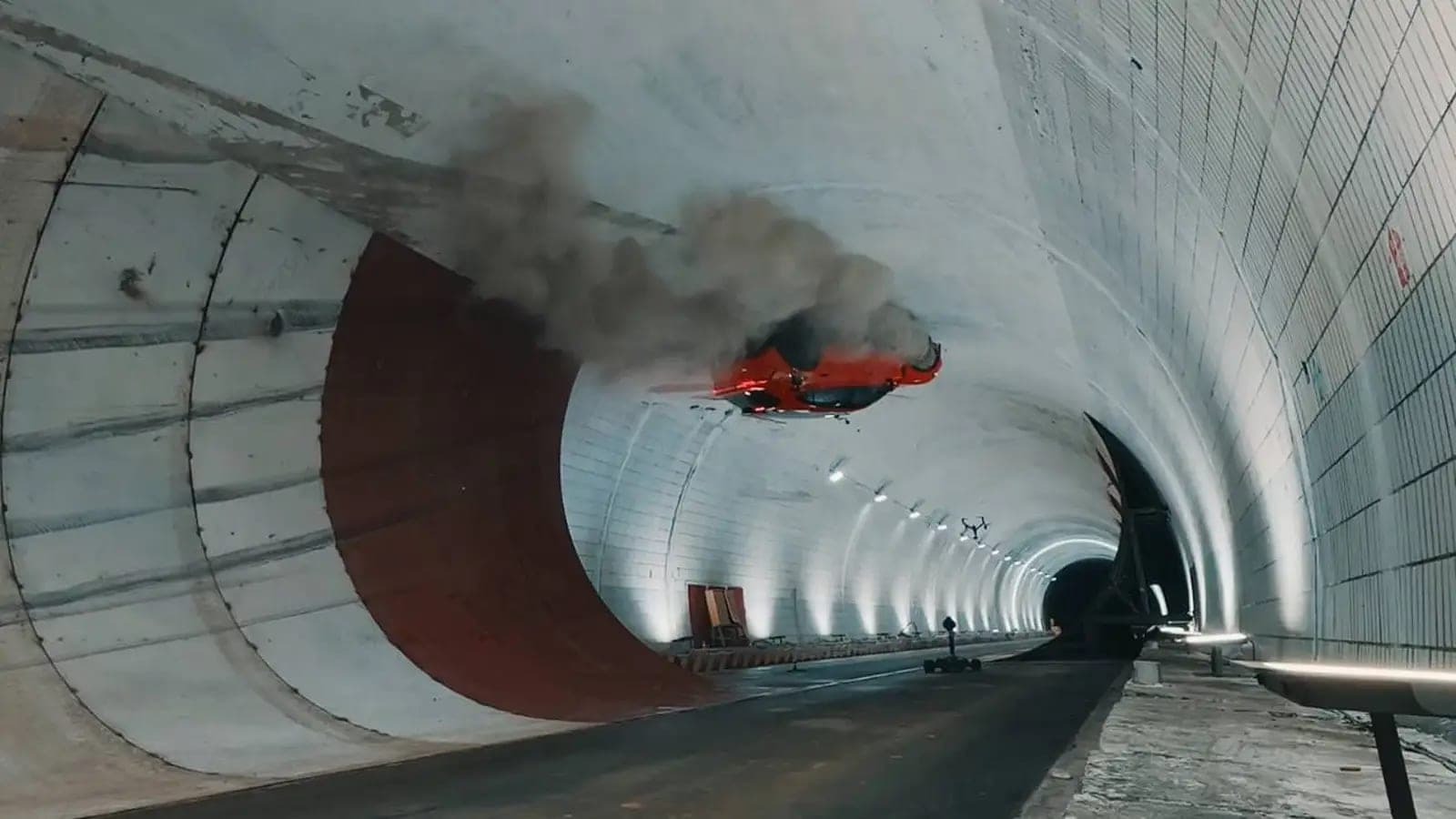
Voyah, the premium electric brand owned by China's Dongfeng, has recreated one of the most famous car stunts ever filmed: a full 360-degree loop around the curved wall of a tunnel, the trick made legendary by a 2010 Mercedes SLS AMG advert starring Michael Schumacher. Voyah's version, performed with its new Passion S, is genuinely audacious. But the truly modern part of the story is not the loop itself. It is what Voyah had to do the moment the footage went online: prove, with uncut video, that any of it actually happened. In 2026, pulling off the stunt turns out to be the easy bit.
The stunt, and the car
The physics are unforgiving. The car accelerates to roughly 130 km/h, turns into the curved tunnel wall at a precise 16-degree steering angle, and lets centrifugal force hold it against the surface as it runs up and over the ceiling and back down. Drop just 3 to 5 km/h below the threshold and it falls. Voyah claims the Passion S is the first unmodified production car to manage it, keeping its full battery and hardware with no weight reduction and no visual effects, a bolder feat than the original because it was done in a heavy production SUV rather than a lightweight supercar. The car doing it is no toy: a dual-motor version with 637 hp and 765 Nm, 0 to 100 km/h in 4.5 seconds, a 98 kWh battery good for up to 740 km on China's CLTC cycle, and 800V charging that adds around 474 km in ten minutes. It launched on 15 August, priced in China from about 30,000 euros, rising to roughly 42,000 euros for the top trim.
A stunt famous for being doubted, doubted all over again
Here is the delicious irony. The 2010 Schumacher advert Voyah copied was itself never fully believed; for years people insisted it was computer-generated, or performed by a professional stunt driver rather than Schumacher. Voyah recreated a stunt whose entire reputation rests on people suspecting it was faked, and then, predictably, got accused of faking it too. So the company did the only thing that carries weight now: at the Passion S launch it released a one-take, uncut video of the loop, supported by a leaked earlier clip of a camouflaged prototype tumbling from the tunnel ceiling, honest proof that the attempts, and the failures, were real. Even so, the world-first claim has not been independently verified, and Voyah knows perfectly well that the doubt is now part of the show.
In the deepfake era, the proof is the product
This is what makes an old advertising trick suddenly interesting again. In 2010 a stunt could trade on ambiguity: audiences half-believed, felt the thrill, and moved on. In 2026, when anyone can generate a flawless fake tunnel loop on a laptop in an afternoon, seeing is no longer believing, and the marketing challenge has quietly flipped. The difficult, valuable thing is no longer performing the spectacle but authenticating it. Voyah is effectively selling credibility in a market flooded with slick advertising, and the actual pitch is not the loop but the four words attached to it: unmodified, one take, no effects. The uncut video is the product now.
Why a cheap SUV doing this should worry the West
Strip away the theatre and the message is pointed. An unmodified, two-tonne-plus family electric SUV, on sale from around 30,000 euros, just did something once reserved for a stripped-out German supercar. Where established brands spend decades and fortunes earning performance credibility on racetracks, Chinese makers are manufacturing it overnight through viral spectacle, and the confidence on display is the real headline. It is exactly the swagger that has Western executives sounding the alarm about Chinese competition. The loop is a magic trick; the ability to build the car that performs it, and sell it for the price of a mid-range hatchback, is not.
AutoNext Take
The loop is a magic trick, and like every magic trick the wonder now lives entirely in whether you believe it. Voyah's cleverest move was not driving the tunnel; it was filming it uncut, because in 2026 the scarce commodity is not horsepower or nerve, it is credibility. Whether or not you buy the world-first claim, the lesson outlasts the SUV: the next great car stunts will be judged less on what they do than on whether we still trust our own eyes.