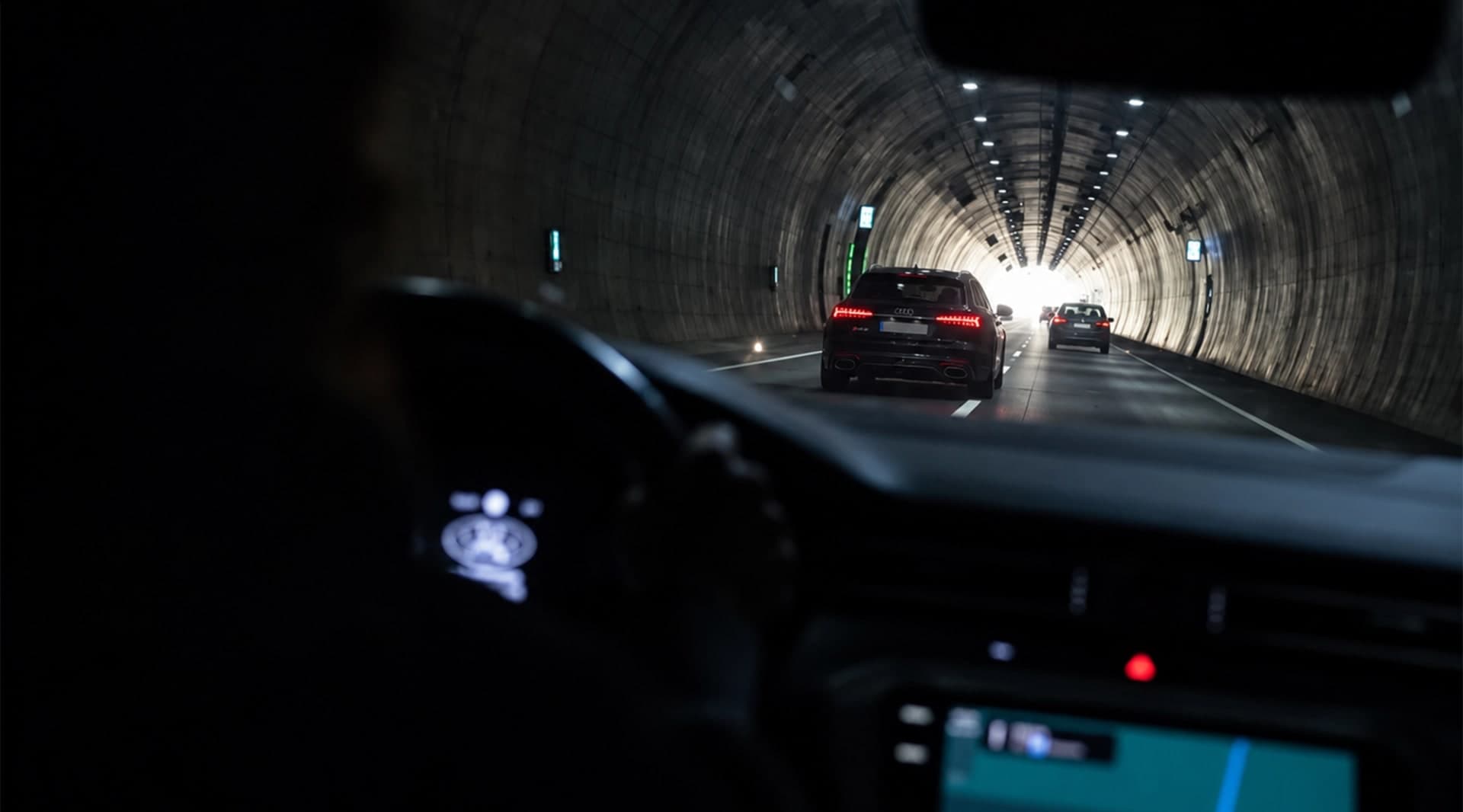
Tunnel driving rules and what to do in a breakdown or fire
The same mistake costs more inside a mountain
On the open road, a shunt at 80 km/h is an insurance claim. Inside a tube with one lane each way, the same shunt can block the only way out, and if a fuel tank ruptures, the smoke has nowhere to go but along the ceiling towards the cars queuing behind. That is why tunnels have their own rules. Austria's motorway operator ASFINAG says crashes are far rarer in its tunnels than on the open road, yet it still counted more than 600 in its 166 tunnels in 2019, mostly down to inattention, too little distance or too much speed.
The short version
Switch on dipped headlights and take your sunglasses off before the entrance.
Keep the posted gap, or at least two seconds, and never overtake in a two-way tunnel.
Never stop, turn around or reverse, not even in a jam.
Breakdown or fire: hazard lights, engine off, key left in, and the emergency telephone rather than your mobile.
What the EU put in every long tunnel
On 24 March 1999 a lorry caught fire in the Mont Blanc tunnel between France and Italy. The fire burned for 53 hours and killed 39 people. The Tauern tunnel in Austria burned two months later, and in 2001 a collision in the Gotthard killed eleven. Europe answered in 2004 with a tunnel safety directive that covers every tunnel longer than 500 metres on the trans-European road network.
That is why long tunnels now look alike wherever you drive: an emergency station with a telephone and two extinguishers no more than 150 metres apart in new tunnels and 250 metres in older ones, emergency exits no more than 500 metres apart in busy tunnels, and evacuation lights fitted no higher than 1.5 metres, because that is the layer of air that stays breathable when smoke builds up under the roof. The nearest telephone is never far away.
How much distance to keep
Most tunnels ask for the usual two-second gap, but some Alpine tunnels post their own figures. In the 11.6 km Mont Blanc, every vehicle keeps 150 metres to the one in front while moving and 100 metres when stopped, drives between 50 and 70 km/h and never overtakes. Blue lights on the wall every 150 metres make it easy: keep two of them between you and the vehicle ahead. The toll barriers even release one vehicle every 8 seconds to create the gap, and in France a short following distance costs 135 euros and three points.
In the 16.9 km Gotthard the limit is 80 km/h, nobody may overtake, and cars and motorcycles keep 50 metres, lorries and buses 150. If the traffic stops, the ADAC and ANWB advise five metres to the car in front, hazard lights on, the engine off if the wait is long, and a rescue lane formed before anyone asks for it.
Lights on, and never turn around
Switch on dipped headlights before the entrance. Germany fines you from 10 euros if you forget, Belgium requires them whenever you cannot see clearly for about 200 metres, which is the case in every tunnel, and France puts up a sign that makes them compulsory. Daytime running lights are not enough, because they usually leave the rear of the car dark. Take your sunglasses off too, since your eyes need a few seconds to adjust, and switch off the rear fog light and main beam, which dazzle the driver behind you in a tube.
Inside, the rules are short: never overtake in a two-way tunnel, never turn around, never reverse and never stop outside an emergency. Germany charges 60 euros and a point for turning, and Belgium bans stopping and parking in tunnels. Tune your radio to the frequency on the entrance sign and end any hands-free call: the Gotthard's operator warns that police messages broadcast in the tunnel never reach you while you are on the phone.
If your car breaks down
Check your fuel or charge before a long tunnel, because running dry inside one closes the tube. If the car fails anyway: hazard lights on straight away, coast into the next lay-by or as far right as you can, engine off, and leave the key in the ignition so the tunnel crew or fire brigade can move the car without you. Put your vest on before you open the door.
Then call from the emergency telephone rather than your mobile. In Austria's ASFINAG tunnels there is one every 125 metres, and opening the niche door tells the control centre exactly where you are and puts your section's cameras on their screens. In the Gotthard, simply lifting an extinguisher from its bracket raises the alarm. Then walk along the wall to at least 50 metres from the car and wait, just as you would after a breakdown on the motorway.
If there is a fire
If your own car starts to smoke and still drives, drive it out of the tunnel. If it does not, stop as far right as you can, switch off, leave the key in, leave the luggage and walk to the nearest green-and-white exit sign. Only fight the fire while it is small enough for the extinguisher from the niche. The shelters are close: every 300 metres in the Mont Blanc and every 250 metres in the Gotthard, each with its own ventilation.
If another vehicle is burning, stop well back and leave the lane free for the fire brigade. Close the windows, set the ventilation to recirculation and leave on foot as soon as you are told to, with the key left in the car. Whatever happens, never reverse out: it blocks the only road the rescue services have.
How to drive through a tunnel safely
Check your fuel or charge before any tunnel longer than a few kilometres.
Before the entrance: sunglasses off, dipped headlights on, rear fog light and main beam off.
Tune to the radio frequency on the entrance sign and end any hands-free call.
Keep the posted gap, or at least two seconds. In a jam, leave five metres, switch on the hazard lights and form a rescue lane.
Never overtake in a two-way tunnel, never turn around, never reverse, never stop outside an emergency.
Breakdown: hazard lights, far right or into the lay-by, engine off, key in, vest on, emergency telephone, then wait 50 metres away.
Fire: drive out if you can. If not, stop, leave the key in and walk to the nearest green exit sign.
Frequently asked questions
Do I need dipped headlights in a tunnel if my car has daytime running lights?
Yes. Daytime running lights usually leave the rear of the car unlit, and countries such as Germany and Belgium require dipped headlights in tunnels. Switch them on by hand before the entrance unless you are sure the automatic setting does it for you.
Why should I leave the key in the car?
So the tunnel crew and the fire brigade can move it. A locked car whose key is in someone's pocket 400 metres away in a shelter blocks the only road they have. From the ASFINAG to the ADAC, operators and motoring clubs all put this on their list.
Why use the emergency telephone rather than my mobile?
Because it tells the control centre your exact position the moment you open the niche, and switches the cameras in your section onto their screens. A mobile call only gives them a description of a wall. In new tunnels covered by the EU rules, they are no more than 150 metres apart.
Do the same rules apply in short tunnels?
The driving rules do. The EU safety equipment is only required in tunnels over 500 metres, so a short underpass may have no telephones or exits. But dipped headlights, no stopping, no turning and no reversing apply in every tunnel and underpass.
