Jaguar XK120 proved its name on a motorway near Bruges in 1949
Britain's fastest postwar cars all had to cross to Flanders to prove it
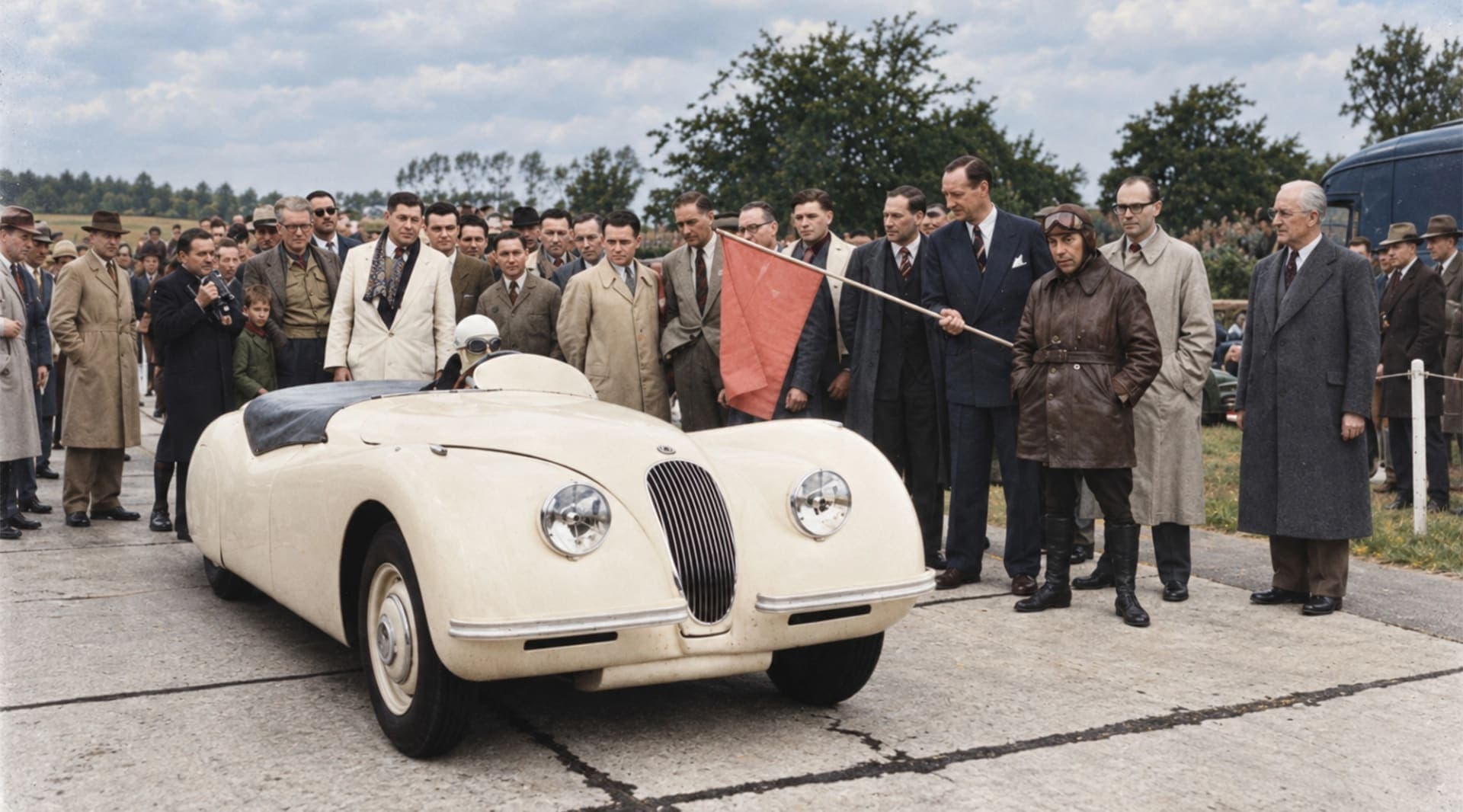
On 30 May 1949 Jaguar test driver Ron 'Soapy' Sutton took an XK120 down a closed stretch of the Ostend to Brussels motorway at Jabbeke, near Bruges. The Royal Automobile Club of Belgium timed it at 213.4 km/h over the flying mile. The name promised 120 mph, or 193 km/h. The Belgian stopwatches showed 132.6 mph, with British journalists flown in to watch.
Jaguar XK120 beat its 120 mph name by 12.6 mph at Jabbeke
The XK120 averaged 132.596 mph (213.4 km/h) over runs in both directions, with its windscreen swapped for a small aero screen and a tonneau over the passenger seat, and 126.448 mph with the hood up. Engineer Walter Hassan was meant to drive but fell ill, so Sutton stepped in. The car was chassis 670002, only the second XK120 built, and it ran on ordinary Belgian pump petrol. British buyers could not do the same: they were still limited to 70-octane Pool petrol, and Jaguar gave UK cars a low-compression 7:1 engine to cope.
Britain opened its first motorway in 1958, nine years after the XK120 run
The Preston Bypass, Britain's first motorway, opened on 5 December 1958. Until then a British maker that wanted an officially timed top speed on a public road had to cross the Channel. The Ostend to Brussels highway was flat, straight and a short drive from the ferry ports, and the Royal Automobile Club of Belgium was willing to close one carriageway and supply the timekeepers. In 1949 Jaguar flew its press party from Heathrow to Ostend in a Sabena Dakota, while Belgian officials patrolled the course in an Alfa Romeo.
Goldie Gardner's MG EX135 ran Jaguar's new engine at Jabbeke in 1948
Jabbeke's first regular was Lieutenant Colonel Goldie Gardner, who brought his streamlined MG EX135 in 1946, just as the road was finished. In September 1948 he came back with Jaguar's support, and engineers Walter Hassan and Lofty England fitted an experimental four-cylinder version of the new twin-cam engine. The MG passed 170 mph (274 km/h). Eight months later the six-cylinder XK engine returned to the same concrete under the bonnet of the XK120, so the road had timed Jaguar's engine before it ever timed Jaguar's car.
Rover JET1 and Triumph TR2 set records at Jabbeke in 1952 and 1953
Rover brought the gas turbine JET1 in June 1952, and Spen King, the engineer who later led the Range Rover project, drove it to 152 mph (244 km/h), a world record for a turbine car. In May 1953 Triumph's competition chief Ken Richardson took a TR2 with an undertray, rear spats and a metal cockpit cover to 124.889 mph (201 km/h), a record for a two-litre production sports car. His first run managed only 104.86 mph, until the team found a loose spark plug lead had left the engine running on three cylinders.
Pegaso Z-102 took the record in September 1953, and Jaguar answered at 172 mph
On 25 September 1953 Celso Fernández drove a supercharged Pegaso Z-102 to four Royal Automobile Club of Belgium records at Jabbeke, including the fastest production car title the XK120 had held since 1949. Jaguar came back in October with test driver Norman Dewis and a heavily modified XK120: a full undershield, slick tyres and an airtight bubble canopy taken from a glider. Dewis sat on a thin pad of foam instead of a seat so he would fit beneath it. He averaged 172.412 mph (277.5 km/h) over the flying mile, and Jaguar then returned the car to road trim and sold it.
AutoNext Take
Jabbeke is remembered as a publicity stunt, and it was one, but an unusually honest kind. Every figure was taken by the Royal Automobile Club of Belgium, averaged over runs in both directions and watched by the press from the verge, which is more independent scrutiny than a maker-timed Nürburgring lap gets today. It also paid: more than 12,000 XK120s were built by 1954, and over eight in ten were left-hand drive, made for the export markets those Belgian headlines were staged for.
The road itself survives as a stranded strip of original concrete beside the E40 near the Jabbeke service area, and its best record cars have outlived it: the JET1 sits in London's Science Museum and Dewis's bubble-top XK120 has been restored to its 1953 shape. Jaguar's 1,030 hp Type 01 reaches customers in the second half of 2027, and the first figure someone outside Jaguar measures on one will be quoted long after the brochure numbers, exactly as 132.6 mph was in 1949.