Europe just had a record month for EV sales and the market is starting to move fast
Europe’s EV market just delivered one of its strongest signals yet.
In March, more than 500,000 plug-in vehicles were registered across Europe, including around 349,000 fully electric cars. Battery-electric vehicles reached a record 22% market share, while plug-in hybrids added another 10%. Add conventional hybrids to the picture, and around 70% of all new cars registered in Europe had some form of electrification.
BEVs are no longer waiting for the future
Plug-in vehicle registrations grew by 39% year-on-year, while BEVs performed even better with a 42% increase. The overall car market also grew, up 11% year-on-year to around one million units, but the real growth engine was clearly electrification.
At the same time, traditional combustion powertrains continue to lose ground. Petrol registrations dropped by 10% year-on-year, while diesel fell by 14%, leaving diesel with just 6% market share.
That is perhaps the most symbolic figure in the whole story. Diesel once defined the European car market. Now, in a record EV month, it is becoming a small minority.
Tesla is back on top, but the story is bigger than Tesla
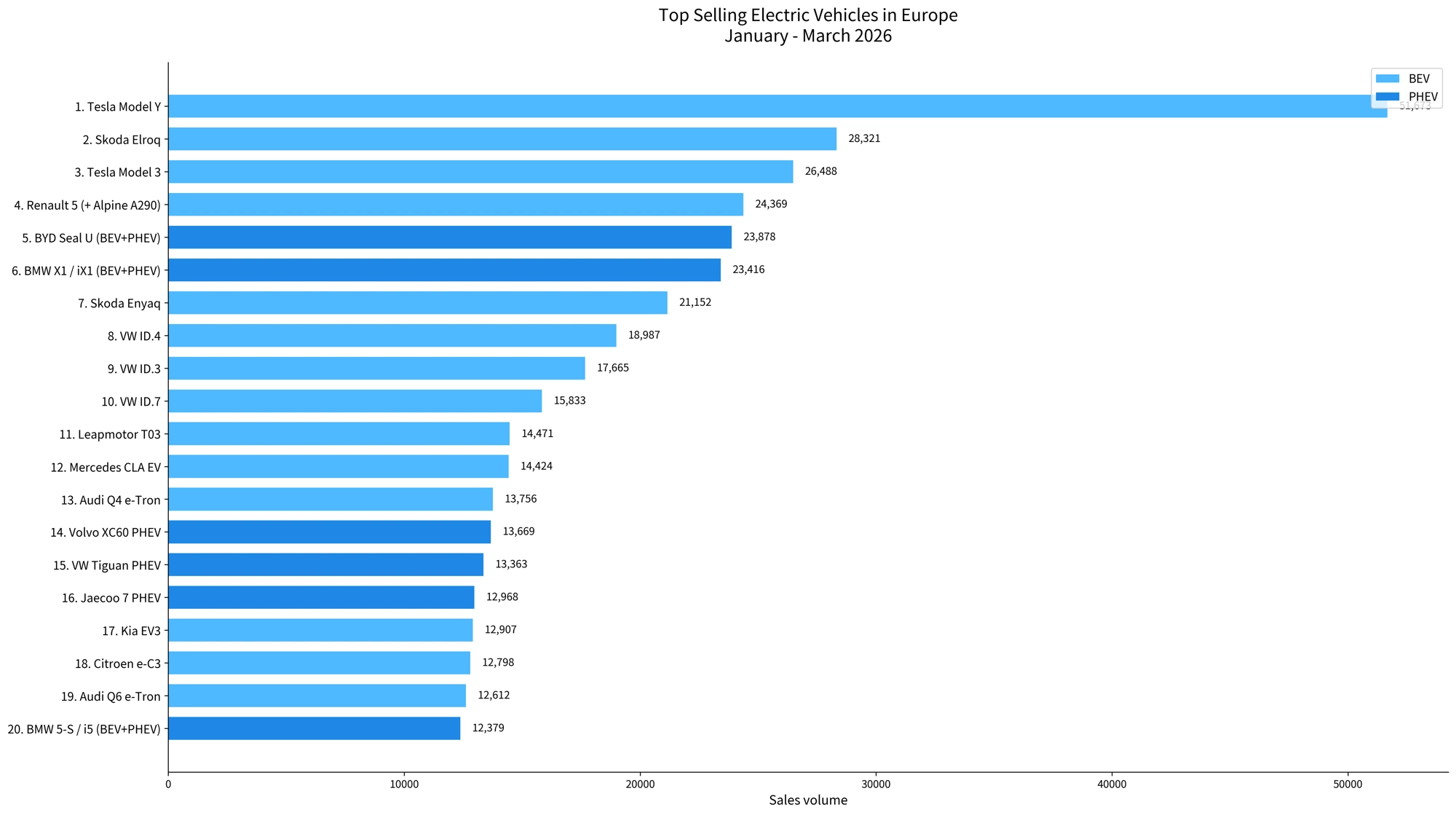
The Tesla Model Y returned to the top of the European EV ranking with 33,857 registrations in March, its best result in three years. The Model 3 followed in second place with 18,832 registrations, giving Tesla a powerful one-two finish.
It shows that price, availability and efficiency still win. The Model Y remains difficult to beat because it offers strong range, fast charging, generous interior space and a relatively competitive starting price. For many buyers who are switching from combustion cars to EVs to reduce running costs, the Tesla argument remains very rational.
Europe’s own EVs are also getting stronger
The third-place finish of the Skoda Elroq, with 11,672 registrations, is just as important as Tesla’s dominance. It shows that Volkswagen Group is finally finding stronger rhythm in the mainstream EV space.
The BMW iX1/X1 PHEV continued to perform strongly with 10,134 registrations, while the Renault 5, including the Alpine A290, reached 9,888 registrations. That gives Europe a more diverse EV top five, mixing Tesla efficiency with Skoda practicality, BMW premium appeal and Renault’s retro-modern city car strategy.
This is exactly what the European EV market needed: not one winner, but more credible options across different segments.
Chinese brands are no longer outsiders
The biggest pressure, however, is coming from China. BYD, Jaecoo, Leapmotor and other Chinese brands are no longer entering Europe as curiosities. They are taking real volume in real segments. The Jaecoo 7 PHEV recorded 7,102 registrations, helped strongly by demand in the UK. The Leapmotor T03 delivered another major surprise with 6,680 registrations, heavily driven by Italy, where it became one of the country’s strongest-selling cars overall.
Italy is a market where small cars matter deeply, and if Chinese EVs can win there, the threat is no longer theoretical. It is already happening in one of Europe’s most traditional automotive cultures.
BYD is also building momentum. The brand climbed to 7.3% plug-in brand share in Europe, putting it just behind Volkswagen and close to Tesla and BMW. That is a huge statement for a brand that, not long ago, many European buyers barely knew.
Stellantis should be worried
Europe is clearly buying electric cars. Smaller electric cars are clearly gaining traction. The demand exists. But Stellantis had no model in the top 20, even while models like the Leapmotor T03 and Renault 5 made strong progress.
For a group with Fiat, Peugeot, Citroën, Opel and Jeep under one roof, this should be a natural battlefield. City cars, compact hatchbacks and affordable crossovers are supposed to be Stellantis territory. If that ground is being taken by Chinese brands and more focused European rivals, the alarm bells should be loud.
Premium EV battle is about to explode
Another major signal is the arrival of the new BMW iX3. With almost 5,000 registrations in its first month, the Neue Klasse-based iX3 appears to have landed strongly. Its promise of high efficiency, long WLTP range, fast charging and a new design direction makes it one of the most important European premium EV launches of the year.
The Mercedes GLC EV, GLB EV, future C-Class Electric, and upcoming Volvo EX60 are all part of a new generation of European premium EVs. This is the market where Europe still has the best chance to fight back properly: design, quality, range, charging speed, software and brand trust all matter at once.
The next 12 months could decide which legacy premium brands remain truly competitive in the EV era.
Volkswagen Group still leads, but pressure is building
Volkswagen remains the leading plug-in brand in Europe with 9.2% share, while Volkswagen Group as a whole holds a dominant 24.8% share among automotive groups.
If Volkswagen wants to remain relevant in a fully electrified global car market, it needs to win at home. For now, it still does. But BYD is rising quickly, Tesla has recovered strongly, BMW has the iX3 entering the market, and Mercedes has several new EVs launching in the same year.
AutoNext Take
For years, the discussion was full of hesitation: charging anxiety, pricing concerns, infrastructure questions, political uncertainty and doubts about whether buyers were truly ready. Those questions still matter, but March shows something very clearly. The market is moving anyway.
A 22% BEV share and 70% electrified share means Europe is no longer debating whether electrification will happen. It is debating who will win, who will lose, and how fast the shift will go.
Europe does not need more excuses. It needs affordable EVs, efficient EVs, desirable EVs and electric cars that people can actually buy now.